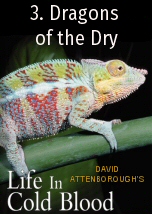
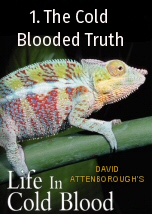
About 340 million years ago a brand new family of animals was evolving in the primeval swamps. They were to go one step further than the amphibians who had emerged onto dry and before them. For they would eventually completely cut their ties with water. They were the ancestors of todays lizards. They evolved scaly impermeable skins and moved up into the forests. They diversified into a multitude of different shapes and sizes. They developed signalling systems to communicate with one another. And they squabbled as animals do. For food they hunted insects that were already well established on the land in great numbers. And here without returning to water they produced their families. They powered their bodies not only with food but with the heat that they drew directly from the sun.
As they diversified so they spread into the harshest of the lands habitats. The baking waterless deserts which eventually they would come to dominate. Discover jacky lizards that wave, wrestling beaded lizards and the the world's smallest chameleon, which is no bigger than his thumbnail, and the biggest lizard in Australia.
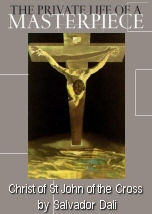
Salvador Dali's strange crucifixion is often called the greatest religious painting of the 20th century. Yet its artist was a notorious blasphemer some of whose work had outraged the Catholic Church. The Christ of St John of the Cross by Salvador Dali is the first of two extraordinary crucifixions painted by Dali in the early 1950s. The painting is based on a 'cosmic dream' Dali is said to have had, in which the nucleus of the atom was a figure of Christ himself. The painting offers a surrealist view of the crucifixion of Christ, and is based on a drawing by the 16th century Spanish friar Saint John of the Cross. But Dali's vision was somewhat unique, using an unusual artistic perspective in which Christ is seen from above. His Christ of St. John of The Cross was inspired by a weird mix of Spanish mysticism and nuclear physics, with his Christ being modelled by a Hollywood stuntman. It's also a masterpiece of painting technique.
David Attenborough reveals the surprising truth about the cold-blooded lives of reptiles and amphibians. These animals are as dramatic in combat, as colourful in their communication and as tender in their parental care as any other animals. Join giant courting crocodiles, jousting tortoises and bright red sumo-wrestling frogs in their sophisticated, solar-powered lives.
For a predominately visual medium like cinema, its musical component plays a vital role as well, especially its score. In that essential musical accompaniment, the soul of the film is expressed whether it be sweepingly majestic fanfares or delicate lyrical pieces. This documentary explores the artistic role of this special musical discipline that completes the cinematic artistic creation process and the artists who have devoted their careers to this contribution. We explore the form's history and examine the masters who defined it with their own distinctive artistic vision. In doing so, the various components of this delicate creative process are revealed as they create a musical compositional work that has inspired a popular appreciation of music in all its forms, which gave some old musical ways their own new lease on life.
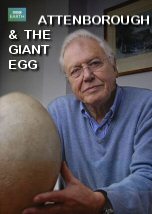
David Attenborough returns to the island of Madagascar on a very personal quest. In 1960, he visited the island to film one of his first ever wildlife series - Zoo Quest. Whilst he was there, he acquired a giant egg belonging to an extinct bird known as the 'elephant bird' - the largest bird that ever lived. It has been one of his most treasured possessions ever since. Fifty years older, he now returns to the island to find out more about this amazing creature and to see how the island has changed. Could the elephant bird's fate provide lessons that may help protect Madagascar's remaining wildlife? Using Zoo Quest archive and specially shot location footage, this film follows David as he revisits scenes from his youth and meets people at the front line of wildlife protection. On his return, scientists at Oxford University are able to reveal for the first time how old David's egg actually is, and what that might tell us about the legendary elephant bird.
The turbulent life of soul and blues singer, the late Joe Cocker. A former gas fitter from Sheffield, catapulted to world stardom in 1969 at Woodstock with his legendary performance of the Beatles song, 'A Little Help from My Friends'. But in the early 1970s, Joe Cocker's inner demons nearly killed him. Overcoming his struggles with alcohol and drugs, he rebuilt his reputation as 'one of the great primal rock and roll vocalists of all time' (Billy Joel).






As they diversified so they spread into the harshest of the lands habitats. The baking waterless deserts which eventually they would come to dominate. Discover jacky lizards that wave, wrestling beaded lizards and the the world's smallest chameleon, which is no bigger than his thumbnail, and the biggest lizard in Australia.