


Last Watched

"Cosmos"  Sort by

Cosmic Holes

   2007    Science
Today, we know black holes exist, and now scientists are trying to confirm that other holes lurk in hyperspace. Our infinite cosmos could contain a variety of "holes" such as black, white, "mini" and wormholes. White holes are the reverse of black holes; instead of matter being sucked into it, matter is ejected out. Wormholes are gateways in the fabric of space and time. They are included in Einstein's field equations as possibilities for their existence. Neither white holes nor wormholes have ever been found. Learn about new discoveries including, colliding binary black holes, intermediate black holes and manufacturing mini black holes.
Series: The Universe
How the Universe Built Your Car

   2015    Science
See as never before in this series the inner workings of our world, and explore black holes, supernovae, neutron stars, dark energy, and all the titanic forces that make us. A users guide to the cosmos from the big bang to galaxies, stars, planets and moons. Where did it all come from and how does it all fit together. A primer for anyone who has ever looked up at the night sky and wondered". Beneath the hood of your car lies the history of the Universe. The iron in your chassis, the gold in your stereo and the copper in your electronics all owe their existence to violent cosmic events that took place billions of years ago.
Series: How the Universe Works Season 4

Unafraid of the Dark

   2014    Science
Tyson describes the discovery of cosmic rays by Victor Hess through high-altitude balloon trips. Swiss Astronomer Fritz Zwicky, in studying supernovae, postulated that these cosmic rays originated from these events instead of electromagnetic radiation. Also tells how Vera Rubin observed that the rotation of stars at the edges of observable galaxies did not follow expected rotational behavior leading to consider the existence of dark matter. This further led to the discovery of dark energy to account for the increasing rate of expansion of the universe. Tyson then describes the interstellar travel of the two Voyager probes. Tyson tells the Carl Sagan's role in the Voyager program, including creating the Voyager Golden Record to encapsulate humanity and Earth's position in the universe. Tyson concludes the series by emphasizing Sagan's message on the human condition in the vastness of the cosmos, and to encourage viewers to continue to explore and discover what else the universe has to offer.
Series: Cosmos: A Spacetime Odyssey

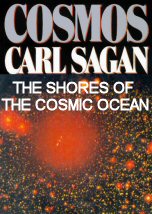
Cosmos Carl Sagan: The Shores of the Cosmic Ocean

   1980    Science
Carl Sagan opens the program with a description of the cosmos and the Spaceship of the Imagination. The ship journeys through the universe's hundred billion galaxies, the Local Group, the Andromeda Galaxy, the Milky Way, the Orion Nebula, our Solar System, and finally the planet Earth. Eratosthenes' successful calculation of the circumference of Earth leads to a description of the ancient Library of Alexandria. Finally, the Ages of Science are described, before pulling back to the full span of the Cosmic Calendar.
Series: Cosmos

The Electric Boy

   2014    Science
This episode provides an overview of the nature of electromagnetism, as discovered through the work of Michael Faraday. Tyson explains how the idea of another force of nature, similar to gravitational forces, had been postulated by Isaac Newton before. Tyson continues on Faraday, coming from poor beginnings, would end up becoming interested in studying electricity after reading books and seeing lectures by Humphry Davy at the Royal Institution. Davy would hire Faraday after seeing extensive notes he had taken to act as his secretary and lab assistant. After Davy and chemist William Hyde Wollaston unsuccessfully tried to build on Hans Christian Ørsted's discovery of the electromagnetic phenomena to harness the ability to create motion from electricity, Faraday was able to create his own device to create the first electric motor by applying electricity aligned along a magnet. Davy, bitter over Faraday's breakthrough, put Faraday on the task of improving the quality of high-quality optical glass, preventing Faraday from continuing his research. Faraday, undeterred, continued to work in the Royal Institution, and created the Christmas Lectures designed to teach science to children. Following Davy's death, Faraday returned to full time efforts studying electromagnetism, creating the first electrical generator by inserting a magnet in a coil of wires. Tyson continues to note that despite losing some of his mental capacity, Faraday concluded that electricity and magnetism were connected by unseen fields, and postulated that light may also be tied to these forces. Using a sample of the optical glass that Davy had him make, Faraday discovered that an applied magnetic field could affect the polarization of light passing through the glass sample (a dielectric material), leading to what is called the Faraday effect and connecting these three forces. Faraday postulated that these fields existed across the planet, which would later by called Earth's magnetic field generated by the rotating molten iron inner core, as well as the phenomena that caused the planets to rotate around the sun. Faraday's work was initially rejected by the scientific community due to his lack of mathematical support, but James Clerk Maxwell would later come to rework Faraday's theories into the Maxwell's equations that validated Faraday's theories. Their combined efforts created the basis of science that drives the principles of modern communications today.
Series: Cosmos: A Spacetime Odyssey

Cosmic Apocalypse

   2008    Science
The Universe as we know it is condemned to death. Space, matter and even time will one day cease to exist and there's nothing we can do about it. Harsh realities are revealed about the future of our Universe; it may collapse and burn or it might be gripped by a galactic ice age. Either of these scenarios might be a long way off. However, our Universe could suddenly be destroyed by a "random quantum fluctuation", a bubble of destruction that can obliterate the entire cosmos in the blink of an eye. No matter how it ends, life in our Universe is doomed.
Series: The Universe
Life In Cold Blood

Life In Cold Blood

2008  Nature
Dinosaur Planet

Dinosaur Planet

2003  Science
Prehistoric Planet

Prehistoric Planet

2022  Science
The Last Dance

The Last Dance

2020  Culture
Life Story

Life Story

2014  Nature
The Art of Germany

The Art of Germany

2010  Art
Sonic Highways

Sonic Highways

2014  Art