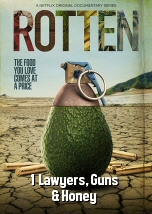
Everyone's still reeling from the council's decision and its implications: the money Jeremy's spent on cows for the restaurant, the locals who won't find work there now and the farmers' co-operative that's now defunct. Charlie sets out to find a legal team to help Jeremy appeal the decision, as Jeremy and Kaleb get to work on tagging the new calves and attempting to navigate a government helpline where you're supposed to register them. There are other useful distractions from the council in the shape of Diddly Squat's Hedge Laying Competition and a mouse that brings the whole farm to a standstill. The legal team that Charlie has assembled pay a visit. They outline their strategy for the appeal, but also the costs that come with it.
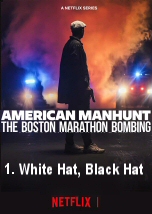
The series follows the tragedy that occurred when terrorists attacked at the annual Boston Marathon on April 15, 2013. They carried out the attack by placing two homemade pressure cooker bombs which detonated near the finish line of the race 14 seconds and 210 yards (190 m) apart. That resulted in three fatalities and hundreds injured, including 17 who lost limbs. With the help of archive footage, interviews with investigators, witnesses, survivors, and occasional reenactments, it offers details about the FBI investigation into what was quickly deemed a domestic terrorist attack. In the first episode, hours after the blasts, investigators pore over evidence. One photo and a few seconds of footage lead to a breakthrough - and an agonizing choice.
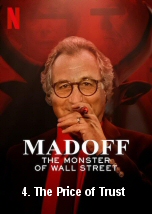
In the final episode, we hear how employees on the 17th floor were rewarded, and we see Madoff's $65 billion Ponzi scheme quickly collapses as investors begin to withdraw their money during the 2008 Financial Crisis. We see how Madoff's sons attempt to stop their father from writing bonus cheques for long-time investors, faithful employees, and extended family to help cushion the blow. Madoff confesses to the Ponzi scheme, and the FBI arrests him. After pleading guilty, Madoff is sentenced to 150 years in prison. Two years after learning of the Ponzi scheme, his eldest son Mark is found hanging from a pipe, dead of an apparent suicide. His other son dies of lymphoma six years later.
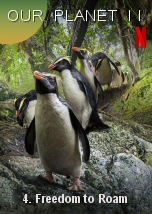
For many animals, the instinct to move is overwhelming, despite the dangers. But for every trip that ends in tragedy, countless millions reach their destination. Allowing them to reap the rewards of better conditions and fresh opportunities. However, we have now changed the planet. Cutting off ancestral routes and impacting even the most remote corners of the globe. But there is hope. We know more about these journeys than ever before. And with our help, many animals are now overcoming the challenges of our modern world. For a healthy and connected planet, we must preserve the freedom to move.
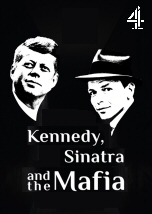
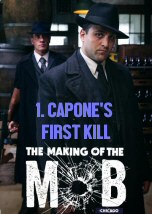
This featured documentary delves into the tangled web of politics, show business, and organized crime in post-World War II America. It traces the unlikely connections between President John F. Kennedy, iconic singer Frank Sinatra, and notorious mobsters, revealing a saga of mutual assistance amidst corruption and betrayal. The film highlights the complex interplay of fame, money, and power, illustrating how these forces helped these figures rise to prominence in a chaotic and corrupt American landscape, ultimately leading to personal and political tragedies. The documentary paints a vivid picture of Kennedy and Sinatra's ascent, influenced by their ties with the mafia. Kennedy, groomed for power from birth, and Sinatra, rising from humble beginnings, both relied on mafia connections for their successes. As Kennedy's political career and Sinatra's entertainment stature grew, so did their dependence on the underworld. The film culminates in the portrayal of Sinatra's deep involvement in Kennedy's 1960 presidential campaign and the subsequent betrayal of the mafia by the Kennedy administration, suggesting that this complex network of relationships may have played a role in Kennedy's assassination. This provocative tale is a stark reminder of the dark intersection of fame, power, and crime.
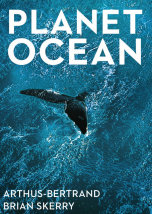
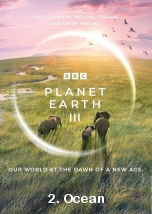
This second episode is a captivating exploration of the ocean's wonders and mysteries. It reveals how a significant part of our planet remains unexplored, primarily due to its vast water coverage. The film emphasizes the extraordinary discoveries awaiting every journey below the water's surface, with over a thousand new species identified annually. Home to 80% of all animal life on Earth, the ocean's diverse habitats host a range of surprising behaviors and life-and-death struggles, often hidden beneath a serene exterior. The shallow tropical seas, appearing as paradises, are actually arenas of intense survival battles. Predatory lionfish, with their patient hunting tactics, and clown frogfish, using a unique fishing rod-like dorsal fin as a lure, demonstrate the ocean's complex food web. The documentary also explores the kelp forests off the North American coast, revealing their role as nurseries for young horn sharks. Amidst these underwater forests lurk giant sea bass, wolf-eels, and various sharks like houndsharks and broadnose sevengills, posing significant threats to the smaller inhabitants. The episode takes viewers to the twilight and midnight zones of the ocean, unveiling alien-like creatures such as the siphonophore, glass squid, and gulper eel, adapted to the extreme conditions of deep waters. The journey concludes with the moving story of the pearl octopus, whose devotion to her eggs in the challenging deep-sea environment is both heartwarming and heartbreaking. This episode is not only a showcase of the ocean's diverse inhabitants but also a reminder of the urgent need to understand and protect this vast, mysterious, and vital part of our planet.



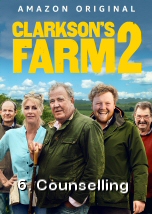




There are other useful distractions from the council in the shape of Diddly Squat's Hedge Laying Competition and a mouse that brings the whole farm to a standstill. The legal team that Charlie has assembled pay a visit. They outline their strategy for the appeal, but also the costs that come with it.