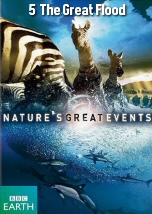
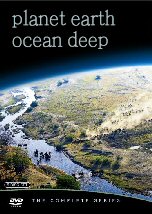
The great flood in the Okavango turns 4,000 square miles of arid plains into a beautiful wetland. Elephant mothers guide their families on an epic trek across the harsh Kalahari Desert towards it, siphoning fresh water from stagnant pools and facing hungry lions. Hippos battle for territory, as the magical water draws in thousands of buffalo and birds, and vast clouds of dragonflies. Will the young elephant calves survive to reach this grassland paradise? The experienced mother elephants time their arrival at the delta to coincide with the lush grass produced by the great flood. In a TV first, the programme shows the way they use their trunks to siphon clean water from the surface layers of a stagnant pool, while avoiding stirring up the muddy sediment on the bottom with their feet. Lechwe swamp deer, zebras, giraffes, crocodiles and numerous fish and thousands of birds arrive in the delta. And, in a phenomenon never before filmed in the Okavango, thousands of dragonflies appear - seemingly from nowhere - within minutes of the flood arrival, mating and laying eggs. As the flood finally reaches its peak, elephants and buffalo, near the end of their epic trek across the desert, face the final gauntlet of a hungry pride of lions. In a heart-wrenching sequence, a baby elephant is brought down by a lion in broad daylight.
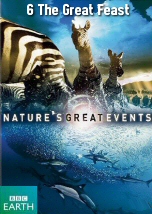
Every summer in the seas off Alaska humpback whales, sea lions and killer whales depend on an explosion of plant life, the plankton bloom. It transforms these seas into the richest on Earth. But will these animals survive to enjoy the great feast? The summer sun sparks the growth of phytoplankton, microscopic floating plants which can bloom in such vast numbers that they eclipse even the Amazon rainforest in sheer abundance of plant life. Remarkably, it is these minute plants that are the basis of all life here. But both whales and sea lions have obstacles to overcome before they can enjoy the feast. Humpback whales migrate 3,000 miles from Hawaii, and during their 3 month voyage lose a third of their body weight. In a heart-rending scene a mother sea lion loses her pup in a violent summer storm, while another dramatic sequence shows a group of killer whales working together to kill a huge male sea lion. In late summer the plankton bloom is at its height. Vast shoals of herring gather to feed on it, diving birds round the fish up into a bait ball and then a humpback whale roars in to scoop up the entire ball of herring in one huge mouthful. When a dozen whales work together they employ the ultimate method of co-operative fishing - bubble net feeding. One whale blows a ring of bubbles to engulf the fish and then they charge in as one. Filmed from the surface, underwater and, for the first time, from the air, we reveal how these giant hunters can catch a tonne of fish every day.
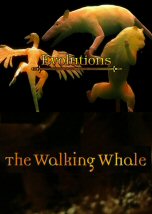
This series illuminates unique and bizarre evolutionary journeys that have brought forth some of the world’s most impressive animals. We unearth a 50-million-year-old mystery mammal sought out a new source of food in the water, starting a spectacular evolutionary journey so that today it looks like a fish. How did a creature built for land become master of the ocean?
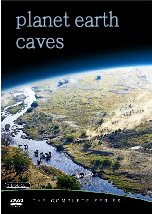
The Cave of Swallows in Mexico is a 400m vertical shaft, deep enough to engulf the Empire State Building. The Lechuguilla cave system in the USA is 193km long and 500m deep with astonishing crystal formations hanging from its chambers. Although often overlooked, caves are remarkable habitats with equally bizarre wildlife. Cave angel fish cling to the walls behind cave waterfalls with microscopic hooks on their flattened fins. Cave swiftlets navigate by echo-location and build nests out of saliva. The Texas cave salamander has neither eyes nor pigment. Unique access to a hidden world of stalactites, stalagmites, snotites and troglodytes brings a wealth of surprises.
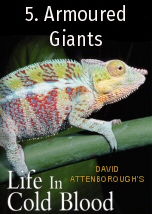
The world of the armoured creatures is equally fascinating and bizarre. Galapagos giant tortoises solve the problem of making love in a suit of armour; a heated sea turtle orgy leaves females in mortal danger and we witness the explosive arrival of a baby pig-nosed turtle. Giant salt-water crocodiles crowd a flooded river-run to fish for mullet and a caiman leads her brood in a touching trek to a communal crèche.
Life goes to extraordinary lengths to survive this immense realm. A 30 tonne whale shark gorges on a school of fish and the unique overhead heli-gimbal camera reveals common dolphins rocketing at more than 30km an hour. Descending into the abyss, deep sea octopus fly with wings and vampire squid use bioluminescence to create an extraordinary colour display. The first ever time-lapse footage taken from 2,000m down captures eels, crabs and giant isopods eating a carcass, completely consuming it within three hours.
























In a TV first, the programme shows the way they use their trunks to siphon clean water from the surface layers of a stagnant pool, while avoiding stirring up the muddy sediment on the bottom with their feet. Lechwe swamp deer, zebras, giraffes, crocodiles and numerous fish and thousands of birds arrive in the delta. And, in a phenomenon never before filmed in the Okavango, thousands of dragonflies appear - seemingly from nowhere - within minutes of the flood arrival, mating and laying eggs. As the flood finally reaches its peak, elephants and buffalo, near the end of their epic trek across the desert, face the final gauntlet of a hungry pride of lions. In a heart-wrenching sequence, a baby elephant is brought down by a lion in broad daylight.