




Last Watched

"Energy"  Sort by

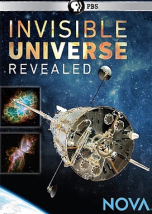
Invisible Universe Revealed 25 years of Hubble

   2015    Technology
25 years ago, NASA launched one of the most ambitious experiments in the history of astronomy: the Hubble Space Telescope. In honor of Hubble's landmark anniversary, know the remarkable story of the telescope that forever changed our understanding of the cosmos and our place in it". But amazingly, when the telescope first sent images back to earth, it seemed that the entire project was a massive failure; a one-millimeter engineering blunder had turned the billion-dollar telescope into an object of ridicule. It fell to five heroic astronauts in a daring mission to return Hubble to the cutting edge of science. Hear from the scientists and engineers on the front line who tell the amazing Hubble story as never before. This single telescope has helped astronomers pinpoint the age of the universe, revealed the birthplace of stars and planets, advanced our understanding of dark energy and cosmic expansion, and uncovered black holes lurking at the heart of galaxies. For more than a generation, Hubble's stunning images have brought the beauty of the heavens to millions, revealing a cosmos richer and more wondrous than we ever imagined. Join us for the story of this magnificent machine and its astonishing discoveries.
How the Universe Built Your Car

   2015    Science
See as never before in this series the inner workings of our world, and explore black holes, supernovae, neutron stars, dark energy, and all the titanic forces that make us. A users guide to the cosmos from the big bang to galaxies, stars, planets and moons. Where did it all come from and how does it all fit together. A primer for anyone who has ever looked up at the night sky and wondered". Beneath the hood of your car lies the history of the Universe. The iron in your chassis, the gold in your stereo and the copper in your electronics all owe their existence to violent cosmic events that took place billions of years ago.
Series: How the Universe Works Season 4

Dancing in the Dark

   2015    Science
Scientists genuinely don't know what most of our universe is made of. The atoms we're made from only make up four per cent. The rest is dark matter and dark energy (for 'dark', read 'don't know'). The Large Hadron Collider at CERN has been upgraded. When it's switched on in March 2015, its collisions will have twice the energy they did before. The hope is that scientists will discover the identity of dark matter in the debris. The stakes are high - because if dark matter fails to show itself, it might mean that physics itself needs a rethink.

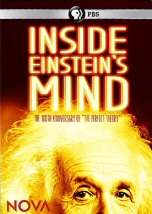
Inside Einstein Mind

   2015    Science
On November 25th, 1915, Einstein published his greatest work: General Relativity. The theory transformed our understanding of nature’s laws and the entire history of the cosmos, reaching back to the origin of time itself. Now, in celebration of the 100th anniversary of Einstein’s achievement, discover the inside story of Einstein’s masterpiece". The story begins with the intuitive thought experiments that set Einstein off on his quest and traces the revolution in cosmology that is still playing out in today’s labs and observatories. Discover the simple but powerful ideas at the heart of relativity, illuminating the theory—and Einstein’s brilliance—as never before. From the first spark of an idea to the discovery of the expanding universe, the Big Bang, black holes, and dark energy, NOVA uncovers the inspired insights and brilliant breakthroughs of “the perfect theory.”

2015 Year In Sci-Tech

   2015    Technology
Explore the latest science behind the headlines and the coolest scientific developments that impact our lives. Technology catapults to new heights in 2015, going faster and further than ever before. We have canvassed the world in search of the best and most fascinating science and tech stories of the year for 2015 YEAR IN SCI-TECH". This action-packed hour of fun and intrigue revisits the world’s first glimpse of Pluto and images of water on Mars while exploring what this all could mean for intelligent life in the universe – all while earthling’s inch closer to becoming actual space tourists. Throughout the hour, we revisit the year’s most amazing techological feats and scientific discoveries, including new and elusive animal species discovered deep under the ocean, as well as the hottest tech trends – from hover boards to driverless cars and trucks, and the newest advances in mind-blowing virtual reality.

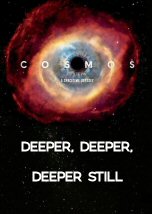
Deeper, Deeper, Deeper Still

   2014    Science
This episodes the nature of the cosmos on the micro and atomic scales, using the Ship of the Imagination to explore these realms. Tyson describes some of the micro-organism that live within a dew drop, demonstrating parameciums and tardigrades. He proceeds to discuss how plants use photosynthesis via their chloroplasts to convert sunlight into chemical reactions that convert carbon dioxide and water into oxygen and energy-rich sugars. Tyson then discusses the nature of molecules and atoms and how they relate to the evolution of species. He uses the example set forth by Charles Darwin postulating the existence of the long-tongued Morgan's sphinx moth based on the nature of the comet orchid with pollen far within the flower. He further demonstrates that scents from flowers are used to trigger olfactory centers in the brain, stimulating the mind to threats as to aid in the survival of the species. Tyson narrates how Greek philosophers Thales and Democritus postulated that all matter was made up of combinations of atoms in a large number of configurations, and describes how carbon forms the basic building block for life on earth due to its unique chemical nature. Tyson explains on the basic atomic structure of protons, neutrons, and electrons, and the nature of nuclear fusion that occurs in most stars. He then discusses the existence of neutrinos that are created by these nuclear processes in stars, and that detecting such sub-atomic particles which normally pass through matter require subterranean facilities like the Super-Kamiokande that were used to detect neutrinos from the supernova SN 1987A in the Large Magellanic Cloud before light from the explosion were observed due to their ability to pass through matter of the dying sun. Tyson compares how neutrinos were postulated by Wolfgang Pauli to account for the conservation of energy from nuclear reactions in the same manner as Darwin's postulate on the long-tongued moth. Tyson concludes by noting that there are neutrinos from the Big Bang still existing in the universe but due to the nature of light, there is a "wall of infinity" that cannot be observed beyond.
Series: Cosmos: A Spacetime Odyssey
The Sky at Night

The Sky at Night

2020  Science
Unknown

Unknown

2023  Science
The Rehearsal

The Rehearsal

2022  Culture
Universe

Universe

2021  Science
Generation Iron

Generation Iron

2018  History