











Last Watched

"Science"  Sort by

Death Of The Universe

   2008    Science
While scientists have previously theorised about a “Big Crunch” where the universe retracts back to its original size, the discovery of Dark Matter and Dark Energy has placed that hypothesis on the backburner. Some astronomers now believe that if Dark Matter offsets Dark Energy then as the universe slowly expands, stars will gradually fade, running out of fuel and leading to a dark, cold and lifeless universe. Others hypothesise a much more violent end where Dark Energy continues to expand the universe at a greater and greater speed. Stronger than gravity, Dark Energy would pull apart everything down to the fundamental particles – the universe’s very fibres. While the universe’s end may be 50 billion years away, great leaps in science will continue to alter how we believe the universe was formed – and how it will end.
Evolutions: The Walking Whale

   2008    Science
This series illuminates unique and bizarre evolutionary journeys that have brought forth some of the world’s most impressive animals. We unearth a 50-million-year-old mystery mammal sought out a new source of food in the water, starting a spectacular evolutionary journey so that today it looks like a fish. How did a creature built for land become master of the ocean?
Series: Evolutions

Dino Turkey

   2008    Science
From small viscous meat eaters to vegetarian giants, dinosaurs came in all shapes and sizes. Remarkable new evidence suggests that one dinosaur did not become extinct but evolved into a new animal species we all know today. Discover the missing link between the velociraptor and modern day birds.
Series: Evolutions

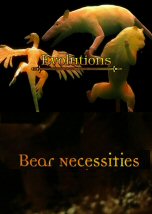
Bear Necessities

   2008    Science
One animal embodies all that is amazing about survival. It has adapted to wildly varying habitats and evolved unique weapons of survival; its greatest asset is its ferocious bite and it is evolutions ultimate survivor, but what species is it? Find out if a new bear species could be about to evolve before our very eyes.
Series: Evolutions

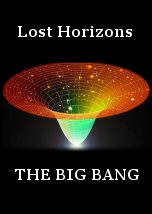
Lost Horizons: The Big Bang

   2008    Science
Professor Jim Al Khalili from the University of Surrey delves into over 50 years of the BBC science archive to tell the story behind the emergence of one of the greatest theories of modern science, the Big Bang. The remarkable idea that our universe simply began from nothing has not always been accepted with the conviction it is today and, from fiercely disputed leftfield beginnings, took the best part of the 20th century to emerge as the triumphant explanation of how the universe began. Using curious horn-shaped antennas, U-2 spy planes, satellites and particle accelerators, scientists have slowly pieced together the cosmological jigsaw, and this documentary charts the overwhelming evidence for a universe created by a Big Bang.

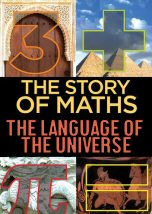
The Story of Maths The Language of the Universe

   2008    Science
This four-part British television series outlines aspects of the history of mathematics. Written and presented by University of Oxford professor Marcus du Sautoy, it is a co-production between the Open University and the BBC. In the first episode, Marcus du Sautoy in Egypt uncovers use of a decimal system based on ten fingers of the hand and discovers that the way we tell the time is based on the Babylonian Base 60 number system. In Greece, he looks at the contributions of some of the giants of mathematics including Plato, Archimedes and Pythagoras, who is credited with beginning the transformation of mathematics from a counting tool into the analytical subject of today. A controversial figure, Pythagoras’ teachings were considered suspect and his followers seen as social outcasts and a little be strange and not in the norm. There is a legend going around that one of his followers, Hippasus, was drowned when he announced his discovery of irrational numbers. As well as his work on the properties of right angled triangles, Pythagoras developed another important theory after observing musical instruments. He discovered that the intervals between harmonious musical notes are always in whole number intervals.
Series: The Story of Maths