Michael Wood embarks on a great historical adventure, exploring the stories, people and landscapes that have helped create China's distinctive character and genius over four thousand years. Is the history of the world's newest superpower, from its ancient past to the present day. Starting in Wuxi, Michael joins the Qin family reunion, when 300 relatives gather to worship their ancestors on Tomb Sweeping Day. 'Like the nation, the family has been through so much,' one says. 'Now everyone wants to know - what are our roots?' Looking for the origins of the Chinese state, he visits the excavations at Erlitou and sees an exquisite turquoise dragon sceptre from 2000 BC. China's first writing is found on 'oracle bones' dug up from the Shang royal tombs at Anyang in the 1920s. At the Beijing Planetarium, Michael travels back in time as astronomers plot the planetary conjunction that the ancients believed foretold the overthrow of the Shang Dynasty. Next, the Age of Philosophers and Confucius, whose book Analects has had greater influence worldwide than even the Bible, according to some. In Xi'an, we hear how the First Emperor united China and created the authoritarian Qin state that gave us the word China. Finally, Michael returns to the temple fair in Henan for a dramatic night ceremony to give thanks to the ancestors. China, Michael concludes, is rising again, not just because of its economic strength, but because of the incredible solidarity of the Han Chinese view of their own civilisation, their sense of family and, of course, the presence of the ancestors.
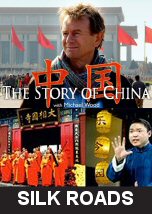
Michael Wood tells the tale of China's first great international age under the Tang Dynasty (618-907). From the picturesque old city of Luoyang, he travels along the Silk Road to the bazaars of central Asia and into India on the track of the Chinese monk who brought Buddhism back to China. This tale is still loved by the Chinese today and is brought to life by storytellers, films and shadow puppet plays. Then in the backstreets and markets of Xi'an, Michael meets descendants of the traders from central Asia and Persia who came into China on the Silk Road. He talks to Chinese Muslims in the Great Mosque and across town hears the amazing story of the first reception of Christianity in 635. Moving south, Michael sees the beginnings of China as an economic giant. On the Grand Canal, a lock built in 605 still handles 800 barges every day! The film tracks the rise of the silk industry and the world's favourite drink - tea. Michael looks too at the spread of Chinese script, language and culture across east Asia. 'China's influence on the East was as profound as Rome on the Latin West', he says, 'and still is today'. Finally, the film tells the intense drama of the fall of the Tang. Among the eyewitnesses were China's greatest poets. In a secondary school in a dusty village, where the Chinese Shakespeare - Du Fu - is buried in the grounds, the pupils take Michael through one famous poem about loss and longing as the dynasty falls. And in that ordinary classroom, there is a sense of the amazing drama and the deep-rooted continuities of Chinese culture.
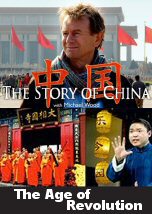
Between 1850 and 1950, three cataclysmic revolutions shook China to the core, but out of them, today's China emerged. The film begins in Canton with the meeting of a US missionary and a Chinese student. Inspired by the Christian story and calling himself God's second son, Hong unleashed the bloodiest war of the 19th century, the Taiping Rebellion. As imperial China weakened, foreign influence grew. Treaty ports expanded, bringing growth and wealth, trams, railways and western sensibilities. But this provoked another surge of violence, the Boxer Rebellion, an attack against the foreigners, which was crushed by those same foreigners, who extorted a huge indemnity - $60 billion in today's money. Then in 1912, the empire fell, and many groups contested China's future. In World War I, China sent 100,000 men to the western front, only to be humiliated at Versailles when German colonies in China were handed to Japan. Between the two world wars, the disparity between rich and poor, city and countryside increased. We visit Hong Kong's Peninsular Hotel in the jazz age and then follow Mao on the Long March to Yan'an, the heartland of revolution. World War II came to China two years earlier than it did in the west. Wood talks to a survivor of the Japanese massacre of Nanjing in 1937 and then charts the triumph of the communists, before ending the story with Mao's death and the boom time of the last 30 years. The series ends with the warmth of the Chinese family and, at Beijing's Altar of Heaven, a final haunting glimpse of eternal China.
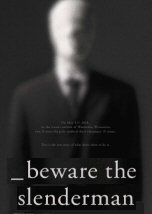
Lurking in the shadows of the Internet, a faceless modern-day bogeyman has attracted the attention and fear of a young generation who whisper his name online. Slenderman lives on the dark pages of the web, where impressionable youth create and cultivate his mythos in message boards, YouTube clips and various other digital incantations. But the online fairy tale becomes a shocking real-life horror as two 12-year-old girls, guided by their devotion to Slenderman, lure their friend into the woods to attempt a seemingly inexplicable, brutal murder. From the depths of one the Internet's most unsettling creations to the court case that must consider the consequences, Beware the Slenderman brings to light questions of accountability in an age where young, growing minds are only a few clicks away from creating and consuming something that may influence them to commit unspeakable crimes.
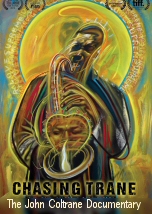
The definitive documentary about an outside-the-box thinker with extraordinary talent whose boundary-shattering music continues to impact and influence people around the world. This smart, passionate, thought-provoking and uplifting documentary is for anyone who appreciates the power of music to entertain, inspire and transform. the film is produced with the full participation of the Coltrane family and the support of the record labels that collectively own the Coltrane catalog. The film-maker John Scheinfeld brings his strong story-telling skills to the creation of a rich, textured and compelling narrative that takes the audience to unexpected places. Set against the social, political and cultural landscape of the times, 'Chasing Trane' brings John Coltrane to life as a fully dimensional being, inviting the audience to engage with Coltrane the man.
Horizon investigates the idea that the best way to lose weight successfully is a personalised approach, diets tailored to our individual biology and psychology. In a groundbreaking experiment, Dr Chris van Tulleken and Tanya Byron join a team of experts to put 75 overweight volunteers on diets designed to tackle the specific reasons why they eat too much. The volunteers are put through a series of tests at a residential clinic to understand how their genes, hormones and psychology influence their eating behaviour. They are then put on the diets the experts believe are best suited to them. Can science succeed where other diets have failed?






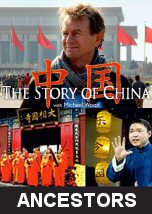





Starting in Wuxi, Michael joins the Qin family reunion, when 300 relatives gather to worship their ancestors on Tomb Sweeping Day. 'Like the nation, the family has been through so much,' one says. 'Now everyone wants to know - what are our roots?'
Looking for the origins of the Chinese state, he visits the excavations at Erlitou and sees an exquisite turquoise dragon sceptre from 2000 BC. China's first writing is found on 'oracle bones' dug up from the Shang royal tombs at Anyang in the 1920s. At the Beijing Planetarium, Michael travels back in time as astronomers plot the planetary conjunction that the ancients believed foretold the overthrow of the Shang Dynasty. Next, the Age of Philosophers and Confucius, whose book Analects has had greater influence worldwide than even the Bible, according to some. In Xi'an, we hear how the First Emperor united China and created the authoritarian Qin state that gave us the word China. Finally, Michael returns to the temple fair in Henan for a dramatic night ceremony to give thanks to the ancestors. China, Michael concludes, is rising again, not just because of its economic strength, but because of the incredible solidarity of the Han Chinese view of their own civilisation, their sense of family and, of course, the presence of the ancestors.