As NASA releases the first images from the James Webb Space Telescope, this film tells the inside story of the telescope's construction and the astronomers taking its first picture of distant stars and galaxies. Will it be the deepest image of our universe ever taken? The successor to Hubble, and 100 times more powerful, the James Webb is the most technically advanced telescope ever built. It will look further back in time than Hubble to an era around 200 million years after the Big Bang, when the first stars and galaxies appeared. Webb's primary mission is to capture the faint light from these objects on the edge of our visible universe so that scientists can learn how they formed, but its instruments are so sensitive it could also be the first telescope to detect signs of life on a distant planet. The James Webb Telescope is an £8 billion gamble on the skills of its engineering team. It’s the first telescope designed to unfold in space – a complicated two-week operation in which 178 release devices must all work - 107 of them on the telescope's sun shield alone. If just one fails, the expensive telescope could become a giant piece of space junk. From its conception in the late 1980s, the construction of Webb has posed a huge technical challenge. The team must build a mirror six times larger than Hubble’s and construct a vast sun shield the size of a tennis court, fold them up so they fit into an Ariane 5 rocket, then find a way to unfold them in space. This film tells the inside story of the James Webb Space Telescope in the words of the engineers who built it and the astronomers who will use it.
This highly anticipated psychedelic docuseries showcases what these substances teaches people about consciousness, dying, addiction, depression and transcendence. Filmmaker Alex Gibney and best-selling author Michael Pollan present it in four parts, each focused on a different mind-altering substance: LSD, psilocybin, MDMA, and mescaline. With Pollan as our guide, we journey to the frontiers of the new psychedelic renaissance -- and look back at almost-forgotten historical context -- to explore the potential of these substances to heal and change minds as well as culture. The first chapter is a great introduction to the topic of LSD, from its 1943 origins to today's microdosing trend, for those who don’t already know a lot about the subject, and a fun and entertaining refresher on LSD for even experts in the field. The show takes us on a journey through the history of the powerful compound, from its discovery and its early medical use, to secret CIA mind-control studies, the counterculture and its banning, and finally to our current renaissance. It includes amazing clips of LSD’s inventor Albert Hofmann and powerful personal testimonies of individuals who have healed their suffering through LSD.
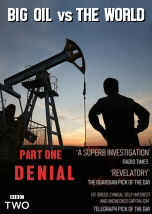
The most important story of our time. 2022 is set to be a year of unprecedented climate chaos across the planet. As the world’s leading climate scientists issue new warnings about climate change and the soaring cost of fuel highlights the world’s ongoing dependence on fossil fuels – how did we get here? The first part tells The story of what the fossil fuel industry knew about climate change more than four decades ago. Scientists who worked for the biggest oil company in the world, Exxon, reveal the warnings they sounded in the 1970s and early 1980s about how fossil fuels would cause climate change – with potentially catastrophic effects. Drawing on thousands of newly discovered documents, the film goes on to chart in revelatory and forensic detail how the oil industry went on to mount a campaign to sow doubt about the science of climate change, the consequences of which we are living through today
In March 2022, the Russian army was closing in on the Ukrainian capital of Kyiv, and it was expected to fall in a short period of time. But in fact, many citizens chose to remain in their beloved city and provide resistance in whatever way they could. Despite daily missile attacks and the fear of an impending urban war, they were united in their efforts to protect their freedom and democracy. This documentary looks at the people of Kyiv through the eyes of a Ukrainian filmmaker.
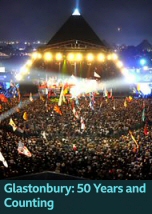
Three years in the making, Francis Whately’s film is a social and musical history of (probably) the world’s greatest music festival, as told by its principal curators, Michael and Emily Eavis, and many of the key artists who’ve appeared there between 1970 and 2019 – Billie Eilish, Thom Yorke, Florence Welch, Dua Lipa, The Levellers, Aswad, Orbital, Fatboy Slim, Linda Lewis, Noel Gallagher, Ed O’Brien, Chris Martin, Stormzy and more. Balancing the driving forces of social conscience and hedonism, Glastonbury has always been both a world apart and a barometer of the state of the nation. Looking at the hippie days, CND, the contribution of the travellers, dance music, Britpop, The Wall, the impact of television and the first black British solo headliner, this film takes viewers backstage and deep into the archive to reveal the forces that have driven this alternative nation between utopia and dystopia, the greatest night of your life and a muddy field in the middle of nowhere. This is not a chronological plod through the festival’s evolution so much as a thematic and story-driven exploration of the peaks and troughs, and the agonies and ecstasies, that have shaped Glastonbury’s 50 years and counting.
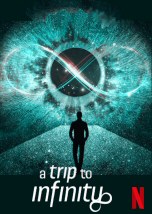
Does Infinity exist? Can we experience the Infinite? In an animated film created by artists from 10 countries, the world's most cutting-edge scientists and thinkers go in search of the infinite and its mind-bending implications for the universe. It doesn’t behave like we’re used to. It’s a monster that needs to be tamed. It creates and destroys mathematicians. It’s infinity! You know, the thing that goes on and on and on and never ends. Here we have theoretical physicists, mathematicians, philosophers, theoretical cosmologists talking about infinity – what it is, how it works, where we can find it, etc., and their concepts and explanations are illustrated by a variety of nifty animations in a variety of visual styles ranging from literal to metaphorical. Directors Jonathan Halperin and Drew Takahashi solicit experts to help them tackle the most maximal topic in the history of everything from a few different angles. Y when you think about it for a second, the only possible conclusion one can arrive at is a sublime and confounding realization that, on a cosmic scale, humans are naught but grand ignoramuses.












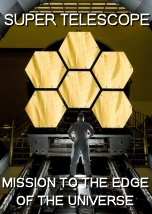



The James Webb Telescope is an £8 billion gamble on the skills of its engineering team. It’s the first telescope designed to unfold in space – a complicated two-week operation in which 178 release devices must all work - 107 of them on the telescope's sun shield alone. If just one fails, the expensive telescope could become a giant piece of space junk.
From its conception in the late 1980s, the construction of Webb has posed a huge technical challenge. The team must build a mirror six times larger than Hubble’s and construct a vast sun shield the size of a tennis court, fold them up so they fit into an Ariane 5 rocket, then find a way to unfold them in space. This film tells the inside story of the James Webb Space Telescope in the words of the engineers who built it and the astronomers who will use it.