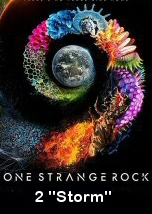
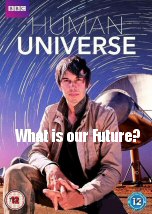
Professor Brian Cox concludes his exploration of our place in the universe by asking what next for the ape that went to space. Our future is far from certain. In Florida, Brian joins the latest efforts to protect Earth from potential catastrophic events. He joins a team of Nasa astronauts who are training for a future mission to an asteroid - should we ever discover one coming our way - under 30 feet of water in a submerged laboratory that simulates space. It is just one example of how, for our long-term survival, space exploration may well be vital. It is a view shared by Apollo 16 astronaut Charlie Duke, who tells Brian what it was like to escape the confines of the planet. It is a dream that both Nasa and now commercial companies share as they race to get humans back into deep space. But space travel, like every leap our civilisation has ever made, requires energy. Here too, scientists are hard at work attempting to safeguard our future. At the National Ignition Facility in California, Brian witnesses the world's most successful fusion experiment in action. He believes that if their mission succeeds, our civilisation will have unlocked a way to the stars that will not destroy the planet in the process. Brian concludes by returning to the top of the world in Svalbard, where he gains access to our civilisation's greatest treasure, locked away in a vault buried deep in the permafrost.
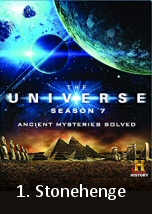
Perhaps the most mysterious structure on Earth, Stonehenge has stood on a plain in Southern England for 5000 years. Its foundations predate the Great Pyramids. It is one of mankind's most ancient mysteries. Why is it here? Is it a temple? A burial ground? A place for sacrifice? Or could the mystery of Stonehenge be revealed in its builders' desire to explore the unknown heavens and touch the universe? Using the cutting-edge computer-generated imagery that takes us into deep space, we'll also go inside a virtual Stonehenge to see what the ancients saw and push this prehistoric marvel to give up its age-old secrets. In this episode we explore the possibility that this was a prehistoric astronomical observatory. Here ancient astronomer priests may have divined the complex movements of the Sun and Moon, recognizing patterns that would not be discovered elsewhere for thousands of years. The primitive Shamans may have also been the first astronomers to predict eclipses.
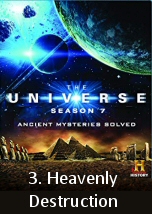
Sodom and Gomorrah, a tale of two cities incinerated by a hail of fire and brimstone. Is this a fantastic fable, or could it be a near apocalyptic disaster from space? In this episode, we will check into the mysteries relating to the destruction of both cities. Were they astronomical events? Newly discovered evidence might hold the secrets to one of the Bible's greatest mysteries.
Journey Through Space gives you an astronaut's eye view of the wonders of the universe, featuring imagery and specially-created animations based upon images from NASA and the European Space Agency and presented here on 720p HD. Your journey begins in Earth orbit and takes you past our moon and neighboring planets, before venturing into deep space for a stunning interstellar tour.
Join us in a journey through space and time. Since the birth of modern science and technology, the true nature of universe has been known and at this point of time, universe is so huge that our hearts are filled with awe and reverence more deeply than our ignorant ancestors felt. This is a wonderful, magical and fascinating phenomena spread over the unimaginable vastness and this documentary takes us to its journey thanks to modern CGI technology in HD.
The very heart of Africa is covered in dense tropical rainforest. The animals that live here find the most ingenious ways to carve out their space in a claustrophobic landscape. Danger lurks in every shadow, but some animals thrive here, from honey-stealing chimps to birds with a lineage as old as the dinosaurs, thundering elephants and kick-boxing frogs. Here in the Congo, no matter how tough the competition, you must stand up and fight for yourself and your patch.
















But space travel, like every leap our civilisation has ever made, requires energy. Here too, scientists are hard at work attempting to safeguard our future. At the National Ignition Facility in California, Brian witnesses the world's most successful fusion experiment in action. He believes that if their mission succeeds, our civilisation will have unlocked a way to the stars that will not destroy the planet in the process. Brian concludes by returning to the top of the world in Svalbard, where he gains access to our civilisation's greatest treasure, locked away in a vault buried deep in the permafrost.