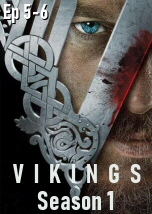
In episodes 5 and 6, Ragnar’s rise becomes a mortal threat to Earl Haraldson, as prophecy, fear and ambition turn Kattegat into the center of a brutal struggle for power. After the Seer warns that Ragnar seeks his death, Haraldson moves from suspicion to violence, attacking Ragnar’s home and torturing Rollo in an attempt to destroy the challenger before he can grow stronger. Wounded, hunted and betrayed, Ragnar must decide whether survival is enough, or whether the time has come to confront the man who has ruled his people through fear. The conflict explodes into a direct challenge that will decide the future of Kattegat. Still weakened but driven by destiny, Ragnar faces the Earl in a duel where honor, vengeance and leadership are at stake. What follows is not only a fight between two men, but the collapse of an old order and the birth of a new one. With funerals, rituals, loyalty and sacrifice surrounding the change of power, these episodes reveal the dark beauty of Viking tradition and the moment when Ragnar Lothbrok’s legend truly begins to rise.
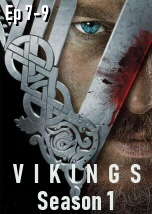
In the final three episodes of Season 1, Ragnar's ambition drives him toward his boldest gamble yet as a daring raid strikes at the heart of one of England's most powerful kingdoms. While victory promises unimaginable wealth and lasting fame, every decision carries devastating consequences, forcing alliances to shift and loyalties to be tested in ways no one expects. As the Vikings make their sacred pilgrimage to Uppsala, faith, sacrifice, and destiny collide in an unforgettable journey that changes the lives of Ragnar, Lagertha, and Athelstan forever. Political intrigue soon follows when Ragnar is sent to negotiate with the dangerous Jarl Borg, where diplomacy hangs by a thread and a single mistake could ignite a brutal conflict. Filled with epic battles, emotional turning points, and unforgettable characters, these episodes deliver a gripping conclusion that leaves you eager for the next season.
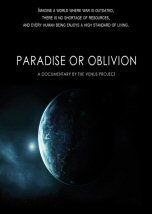
This documentary details the root causes of the systemic value disorders and detrimental symptoms caused by our current established system. This video presentation advocates a new socio-economic system, which is updated to present-day knowledge, featuring the life-long work of Social Engineer, Futurist, Inventor and Industrial Designer Jacque Fresco, which he calls a Resource-Based Economics.
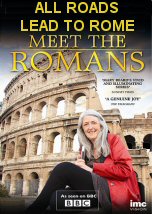
Professor Mary Beard looks beyond the stories of emperors, armies, guts and gore to meet the everyday people at the heart of Ancient Rome's vast empire. In this programme, Mary asks not what the Romans did for us, but what the empire did for Rome. She rides the Via Appia, climbs up to the top seats of the Colosseum, takes a boat to Rome's port Ostia and takes us into the bowels of Monte Testaccio. She also meets some extraordinary Romans: Eurysaces, an eccentric baker, who made a fortune out of the grain trade and built his tomb in the shape of a giant bread oven; Baricha, Zabda and Achiba, three prisoners of war who became Roman citizens; and Pupius Amicus, the purple dye seller making imperial dye from shellfish imported from Tunisia. This is Rome from the bottom up.
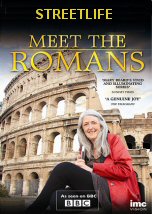
In this programme, Mary descends into the city streets to discover the dirt, crime, sex and slum conditions in the world's first high-rise city. This Rome is not the marble Rome we know, but a vast, messy metropolis with little urban planning, where most Romans lived in high-rise apartment blocks with little space, light, or even sanitation. Forced outdoors into the city streets, she reveals where they went to hang out, get drunk, have sex and get clean. She looks at the Forum as a place of gamblers, dentists and thieves, and she explores the lustiness of Roman bar life and jokes. Finally, exploring law and order from the bottom up, Mary examines how this city really worked. She meets Ancarenus Nothus, an apartment dweller who lived in fear of the rent collector; Notorious Primus, who wrote about his three great pleasures in life - baths, wine and sex; and Unlucky Doris, a seven-year-old girl killed in one of Rome's many fires.
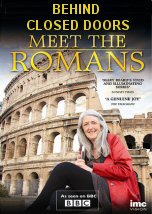
In this final episode, Mary Beard delves even deeper into ordinary Roman life by going behind the closed doors of their homes. She meets an extraordinary cast of characters - drunken housewives, teenage brides, bullied children and runaway slaves - and paints a more dynamic, lusty picture of Roman family life. Mary uncovers their preserved beds, furniture and cradles, tries on Roman wedding rings and meets some eccentric wives like Glyconis, praised by her husband for liking a drink or two, and Allia Potestas, who lived in a Roman menage a trois. Mary explores Roman parenting, childbirth and children, including Sulpicius Maximus, an 11-year-old schoolboy who was worked to death by his pushy parents, and Geminia Mater, a 5-year-old tomboy. Finally, Mary paints a more nuanced picture of Roman slavery and asks why if it was such a brutal institution did many Romans choose to be buried with their servants - living cheek by jowl in death, as in life













The conflict explodes into a direct challenge that will decide the future of Kattegat. Still weakened but driven by destiny, Ragnar faces the Earl in a duel where honor, vengeance and leadership are at stake. What follows is not only a fight between two men, but the collapse of an old order and the birth of a new one. With funerals, rituals, loyalty and sacrifice surrounding the change of power, these episodes reveal the dark beauty of Viking tradition and the moment when Ragnar Lothbrok’s legend truly begins to rise.