From the age of 15, Whitney Houston began to enter the world of music. In 1983, she signed a contract with Clive David from Arista Records. From then on, she began a life of excess, luxury, fame, drugs, and many scandals. The documentary pays special attention to her relationships with her mother, father, husband and daughter, as well as her former best friend Robyn Crawford. It also addresses the singer's history of drug use, including overdose allegations in the 1990s, her early days as a gospel singer, her discovery by Arista Records boss Clive Davis, and key moments such as the releases of her debut album in 1985 and the film The Bodyguard in 1992. The film tells the story of the life and death of Whitney Houston, who marked a before and after in the history of music. It has been made with archival footage of the artist, from her concerts, interviews and home videos.
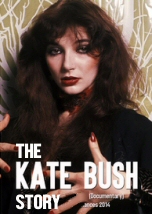
This documentary explores Kate Bush's career and music, from January 1978's Wuthering Heights to her 2011 album 50 Words for Snow, through the testimony of some of her key collaborators and those she has inspired. Contributors include the guitarist who discovered her (Pink Floyd's David Gilmour), the choreographer who taught her to dance (Lindsay Kemp) and the musician who she said 'opened her doors' (Peter Gabriel), as well as her engineer and ex-partner (Del Palmer) and several other collaborators (Elton John, Stephen Fry and Nigel Kennedy). Also exploring their abiding fascination with Kate are fans (John Lydon, Sidi Larbi Cherkaoui) and musicians who have been influenced by her (St Vincent's Annie Clark, Natasha Khan of Bat for Lashes, Tori Amos, Outkast's Big Boi, Guy Garvey and Tricky), as well as writers and comedians who admire her (Jo Brand, Steve Coogan and Neil Gaiman).
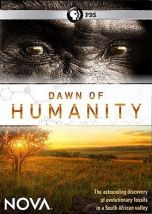
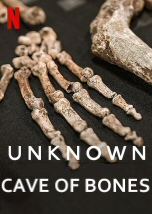
Located in an almost inaccessible chamber deep in a South African cave, the site required recruiting a special team of experts slender enough to wriggle down a vertical, pitch-dark, seven-inch-wide passage. Most fossil discoveries of human relatives consist of just a handful of bones. But down in this hidden chamber, the team uncovered an unprecedented trove—so far, over 1,500 bones—with the potential to rewrite the story of our origins". They may help fill in a crucial gap in the fossil record and tell us how Homo, the first member of the human family, emerged from ape-like ancestors like the famous Lucy. But how did hundreds of bones end up in the remote chamber? The experts are considering every mind-boggling possibility. Join us on the treacherous descent into this cave of spectacular and enigmatic finds, and discover their startling implications for the saga of what made us human.
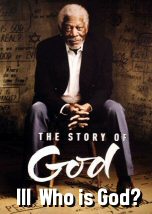
In the third episode of the series, Morgan Freeman examines different faiths' concepts of God, discovering how monotheism began in Egypt and Israel and allowing a neuroscientist to examine his own brain.
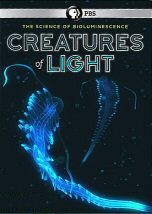
In the dark depths of the oceans, nearly 90% of all species light up the darkness from within. These creatures flash, sparkle, shimmer, or simply glow. Whether it’s to scare off predators, fish for prey, or lure a mate, the language of light is everywhere in the ocean depths, and scientists are finally starting to decode it. Discover surprising ways to harness nature’s light—from tracking cancer cells to detecting pollution, lighting up cities, and even illuminating the inner workings of our brains.
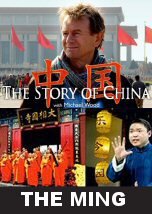
The tale of one of China's most famous dynasties begins with the amazing story of Hongwu, a peasant rebel who founded one of greatest eras in Chinese history. The film takes us to his great capital Nanjing, with its 21 miles of walls, each brick stamped with the name of the village that made it. Following the trail, we go to the Bao family village and see the villagers act a Ming murder story. Like many authoritarian states, the Ming were obsessive about architecture. We see the giant fortifications of the Great Wall, the ritual enclaves of the Forbidden City in Beijing and travel with bargeman Mr Hu down the Grand Canal, China's great artery of commerce right up to the present day. We then hear about Admiral Zheng He's voyages to Africa and the Gulf decades before Columbus, watch the construction of an ocean-going wooden boat 250ft long, and hitch a ride on a replica Ming junk in the South China Sea. As state prosperity grew, so did a rising middle class. Wood looks at Ming culture in Suzhou, the 'Venice of China'. Staying in a merchant's house, he discovers the silk, ceramic and lacquer-making industries, and visits one of the most beautiful gardens in the city. Then on to Macao and the arrival of Jesuit missionary Matteo Ricci, who hoped to convert China to Christianity. In the cathedral in Beijing, we learn more about these fateful exchanges with the west. Finally in Shaoxing, we visit the house of the 'Ming Proust' and at grassroots the Zhao family in Fujian where the film ends in an elegiac mood with the fall of the Ming in 1644.


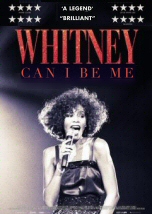



The documentary pays special attention to her relationships with her mother, father, husband and daughter, as well as her former best friend Robyn Crawford. It also addresses the singer's history of drug use, including overdose allegations in the 1990s, her early days as a gospel singer, her discovery by Arista Records boss Clive Davis, and key moments such as the releases of her debut album in 1985 and the film The Bodyguard in 1992.
The film tells the story of the life and death of Whitney Houston, who marked a before and after in the history of music. It has been made with archival footage of the artist, from her concerts, interviews and home videos.