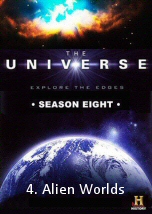
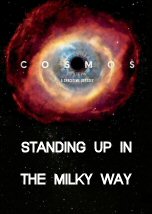
We are the generation of human beings that are going to know whether or not we're alone in the universe. This episode explores the search of exoplanets, from ancient Greek philosophers to the discoveries made possible with the Kepler Telescope. Unbelievable new worlds, planets made of diamond, planets of raining glass, worlds in collision, some plunging into stars, and others that just might harbor life. Thanks to today's planet hunters, our views of the universe and of our place in it are undergoing one of the greatest revolutions in scientific history.
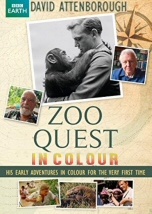
Thanks to a recent remarkable discovery in the BBC's Film Vaults, the best of David Attenborough's early Zoo Quest adventures can now be seen as never before - in colour - and with it the remarkable story of how this pioneering television series was made. First broadcast in December 1954, Zoo Quest was one of the most popular television series of its time and launched the career of the young David Attenborough as a wildlife presenter. Zoo Quest completely changed how viewers saw the world - revealing wildlife and tribal communities that had never been filmed or even seen before. Broadcast ten years before colour television was seen in the UK, Zoo Quest was thought to have been filmed in black and white. Until now. Using this extraordinary new-found colour film, together with new behind the scenes stories from David Attenborough and cameraman Charles Lagus, this 90 minute special showcases the very best of Zoo Quest to West Africa, Zoo Quest to Guiana and Zoo Quest for a Dragon in stunning HD colour for the very first time.
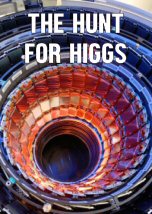
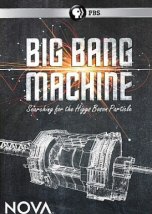
On July 4, 2012, scientists at the giant atom smashing facility at CERN announced the discovery of a subatomic particle that seems like a tantalizingly close match to the elusive Higgs Boson, thought to be responsible for giving all the stuff in the universe its mass. Since it was first proposed nearly fifty years ago, the Higgs has been the holy grail of particle physicists: finding it completes the 'standard model" that underlies all of modern particle physics. Now CERN's scientists are preparing for the Large Hadron Collider's second act, when they restart the history-making collider, running at higher energy--hoping to find the next great discovery that will change what we know about the particles and forces that make up our universe.
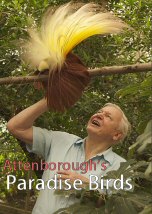
Birds of paradise are one of David Attenborough's lifelong passions. He was the first to film many of their beautiful and often bizarre displays, and over his lifetime he has tracked them all over the jungles of New Guinea. In this very personal film, he uncovers the remarkable story of how these 'birds from paradise' have captivated explorers, naturalists, artists, film-makers and even royalty. He explores the myths surrounding their discovery 500 years ago, the latest extraordinary behaviour captured on camera and reveals the scientific truth behind their beauty": the evolution of their spectacular appearance has in fact been driven by sex. And in a final contemporary twist to this story of obsession and royalty, he travels to the desert of Qatar, to a state-of-the-art facility which houses the largest breeding group of these birds in the world - a sheikh's very own private collection. There he has his closest ever encounter with a greater bird of paradise and its dramatic display, reliving the experience that captivated him in the forests of New Guinea more than 50 years ago.
It is time to see if personalised dieting will work in normal life. The volunteers have been given one of three diets to follow - based on their genes, their hormones and their psychology. But now they are back at home, trying to stick to their personalised diets with all the stresses and temptations of real life. Dr Chris van Tulleken and Professor Tanya Byron discover how our genetic makeup can make temptation difficult to resist, how understanding the brain reveals what makes us comfort eat and what science can tell us about why we make disastrous food choices.
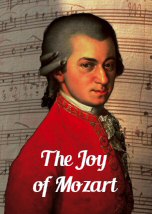
Tom Service plunges into the life and times of Mozart to try and rediscover the greatness and humanity of the living man in his moment. Mozart's prodigious output and untimely death have helped place him on a pedestal that can often blind us to the unique brilliance of his work in the context of his life and times. Service visits the key cities and rooms in which Mozart lived and worked, plays some of Mozart's original instruments and scores, and gradually uncovers the brilliance and originality of his work." There is the prodigious childhood when Mozart was feted as an infant phenomenon around Europe's most glittering courts, and his golden decade in Vienna in which masterpiece followed masterpiece - operas, symphonies, piano concertos, string quartets - as if this short, high-voiced man-child must have been taking dictation from some divine source, until his death at the age of just 35 in 1791. Even more than the music, Mozart's tragic demise sets the seal on his myth. The trajectory of Mozart's life sets the template for the romantic paradigm whose throes we are still in today, which requires our creative heroes to die young to prove that they were too good for this madding world, whether it be Wolfgang Amadeus or Jimi Hendrix. Service travels from London to Vienna and Salzberg, unpicking the living, breathing genius that was Mozart. With Sir John Eliot Gardiner, Nicola Benedetti, Paul Morley and others.



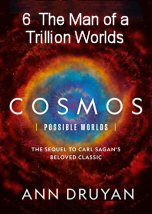







Thanks to today's planet hunters, our views of the universe and of our place in it are undergoing one of the greatest revolutions in scientific history.