Three years after the devastating fire, Lucy Worsley has exclusive access to the Cathedral of Notre-Dame de Paris at a key turning point of the restoration. Work to rebuild and restore the monument is being ramped up in a bid to meet the ambitious deadline to reopen it to the public in 2024. Scaffolding now fills the interior of the cathedral, giving Lucy and the team unprecedented close-up access to every inch of the structure. Lucy meets scientists, historians and craftspeople working to return the 850-year-old Gothic masterpiece to its former glory. The fire coated Notre-Dame with tons of toxic lead dust, so specialists are now decontaminating the site. Unique access to the stunning rose windows allows Lucy and the stained-glass historians to uncover the mysteries of these enigmatic 13th-century works of art. An unforeseen legacy of the fire threatens to destroy the remaining vaulting, so the team must develop an ingenious solution to save the stonework. The loss of the roof during the fire reveals hundreds of large iron staples embedded in the stone along the top of the walls. And the incredible task of sourcing and cutting two-thousand perfect oaks gets underway to rebuild the world's most complex medieval timber structure - Notre-Dame's extraordinary roof and spire.
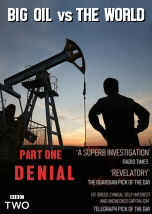
The most important story of our time. 2022 is set to be a year of unprecedented climate chaos across the planet. As the world’s leading climate scientists issue new warnings about climate change and the soaring cost of fuel highlights the world’s ongoing dependence on fossil fuels – how did we get here? The first part tells The story of what the fossil fuel industry knew about climate change more than four decades ago. Scientists who worked for the biggest oil company in the world, Exxon, reveal the warnings they sounded in the 1970s and early 1980s about how fossil fuels would cause climate change – with potentially catastrophic effects. Drawing on thousands of newly discovered documents, the film goes on to chart in revelatory and forensic detail how the oil industry went on to mount a campaign to sow doubt about the science of climate change, the consequences of which we are living through today
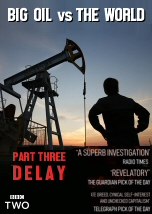
The last chapter explains how the 2010s became another lost decade in the fight against climate change – as the move to natural gas delayed a transition to more renewable sources of energy. Engineer Tony Ingraffea, in the 1980s, helped develop a new technique for extracting gas and oil from shale rock, which ultimately became known as 'Fracking'. It was to unleash vast new reserves of fossil fuels and was promoted as a cleaner energy source. But Ingraffea explains how he later came to regret his work when he realized that gas could be even worse for climate change than coal and oil. Dar-Lon Chang, a former ExxonMobil engineer, speaks for the first time on camera alleging that as the company increased its natural gas operations, it was not sufficiently monitoring methane leaks that were contributing to climate change. Now, after a year of unprecedented wildfires, drought and other climate-related disasters, multiple lawsuits are being brought in US courts in efforts to hold Big Oil legally accountable for the climate crisis.
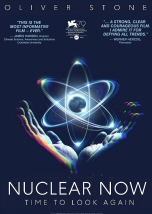
With unprecedented access to the nuclear industry in France, Russia, and the United States, director Oliver Stone delves deep into the groundbreaking technologies that promise a revolution in energy production. But this is not just a story of power and progress; it's a tale of dispelling myths and confronting the fears surrounding nuclear energy. From the passionate voices of those funding their ventures to the illuminating insights of visionaries like Stephen Hawking, 'Nuclear Now' challenges viewers to question their preconceptions. Join this journey to uncover the truths, understand the risks, and judge the possibilities. Imagine a tomorrow that is brighter than today, where humanity harnesses the primordial power of the atom to ensure a future we can all look forward to. Dive into the debate, and decide for yourself.
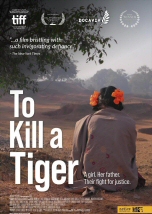
(Click CC for subtitles) Ranjit, a farmer in India, takes on the fight of his life when he demands justice for his 13-year-old daughter, the victim of a brutal gang rape. His decision to support his daughter is virtually unheard of, and his journey unprecedented. Nominated for Best Documentary Award, the film has an undeniable and unshakable power. It is one of those documentaries where anyone who watches it won’t be the same person by the end as they were when it started. To Kill a Tiger offers the viewer remarkable access to village life, not just in the modest home where Ranjit’s family make roti on an open fire, but in the fields where they herd goats and collect water from a pump. The camera finds quiet details, like Ranjit’s daughter carefully weaving ribbons into her hair. Women and men insist that the community, not the criminal court, should solve the issue with a forced marriage—to remove the ‘stain on her’. The men become increasingly hostile—to the family, and eventually to the film crew itself.
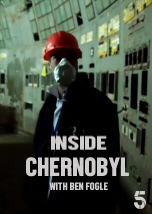
35 years after the Chernobyl disaster, Ben Fogle travels to the most radioactive place on Earth. He spends a week living alone inside the Chernobyl Exclusion Zone, gaining privileged access to the doomed Control Room 4 where the disaster first began to unfold. 'The planet faces unprecedented challenges - many of them, like Chernobyl, of our own making. What I've discovered in Chernobyl is that nature's reclaiming it. This is the greatest, accidental rewilding project of the globe. For me, the really exciting part of the Chernobyl story is the accidental hope that came from it. '







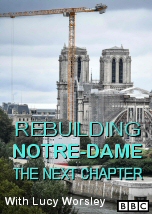







The fire coated Notre-Dame with tons of toxic lead dust, so specialists are now decontaminating the site. Unique access to the stunning rose windows allows Lucy and the stained-glass historians to uncover the mysteries of these enigmatic 13th-century works of art. An unforeseen legacy of the fire threatens to destroy the remaining vaulting, so the team must develop an ingenious solution to save the stonework. The loss of the roof during the fire reveals hundreds of large iron staples embedded in the stone along the top of the walls. And the incredible task of sourcing and cutting two-thousand perfect oaks gets underway to rebuild the world's most complex medieval timber structure - Notre-Dame's extraordinary roof and spire.