






Last Watched

"Planet"  Sort by

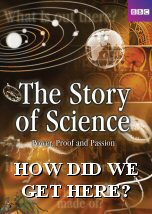
How Did We Get Here

   2010    Science
The question of our human origins is one of the most controversial science has wrestled with. This is the story of how scientists came to explain the beauty and diversity of life on earth, and reveal how its evolution is connected to the long and violent history of our planet. Featuring ocean adventurers, eccentric French aristocrats, mountain climbers, a secret Victorian publisher with 12 fingers, a ridiculed German meteorologist, and only a brief hint of Charles Darwin.
Series: The Story of Science
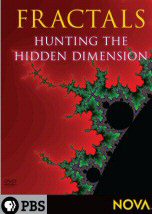
Fractals Hunting the Hidden Dimension

   2010    Science
The ultimate adventure in scientific inquiry, this fascinating program follows the exploits of a small group of pioneering mathematicians who discovered a whole area of study that is revolutionizing all branches of understanding in the world: fractal geometry. Fractals are most recognized as a series of circular shapes with a border surrounded by jagged "tail-like" objects. The program, aimed at the average viewer does a fine job of explaining the background of fractals, first by beginning with the story of Pixar co-founder, Loren Carpenter's work at Boeing, developing 3D terrain from scratch using fractals. From there the program starts at the beginning with an introduction to Benoit Mandelbrot and his revolutionary work. The explanations are full of solid factual information but never talk above the level of a viewer who has some understanding of basic mathematical principles. Once the concept is presented the program spends the rest of the time showing how prevalent the fractal is in life. For a program about a mathematical concept, "Fractals" is very engaging, showing how the process was applied to special effects as far back as the Genesis planet from "Star Trek II" all the way to the spectacular finale on Mustafar in "Star Wars: Episode III." I found myself astonished at how fractals were the source of the lava in constant motion and action during the Obi-Wan/Anakin fight. What is more amazing is when the program delves into practical applications such as cell phone antennas, and eventually the human body. For the average person who enjoys watching science related programs, even on a sporadic basis, "Fractals" will prove to be a very worthwhile experience. The program is well produced, integrating talking head interviews (including some with Mandelbrot himself) with standard "in the field" footage. The structure of the program is very logical and never finds itself jumping around without direction. In simplest terms, this is a program as elegant as the designs it focuses on.

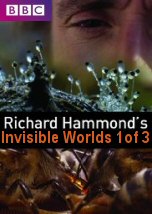
Speed Limits

   2010    Science
Richard Hammond explores the extraordinary wonders of the world of detail hidden in the blink of an eye. It takes our brain around a hundred and fifty milliseconds to process what we see. We're not aware of this time lag going on, but in those few milliseconds, there are extraordinary things happening that completely pass us by. But what if we could break through this speed limit? Bend and stretch time in ways never thought possible. What new marvels would we see? Now, using the latest high-speed cameras, Richard takes us on a journey beyond our eye's limits, letting us see secrets hidden in every element of our planet. A world where thin air can shatter rock. And water can tear through metal. A world where the fastest thing on earth lies right beneath our feet. And where a spectacular celestial display is finally captured, even though many have claimed it doesn't even exist.
Series: Invisible Worlds

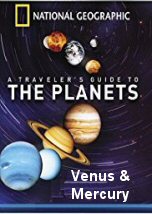
Venus and Mercury

   2010    Science
It is the ultimate in adventure travel, but it is not for the faint of heart. But the sights — from Jupiter’s churning red eye to Saturn’s glittering rings — are out of this world. The series takes viewers on a breath-taking journey through the planets in our Solar System. See stunning images of each planet including highly detailed images captured by today’s ultra high-tech telescopes. Advanced animation takes you up close and personal with these distant worlds, as we plunge through space to get a better look at the neighbours.
Series: A Traveler Guide to the Planets

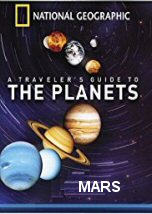
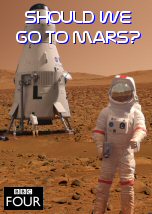
Mars

   2010    Science
Mars is filled with mysteries, Volcanoes 77 000 feet tall, Huge canyons, 3000 miles across and 6 miles deep, all kinds of interesting features. Awaiting you is some of the greatest scenery in our Solar System, on a world where water once ruled, then vanished into thin air. Where lost microbe empires may still survive underground. We've seen the postcards, and we do wish we were there.
Series: A Traveler Guide to the Planets

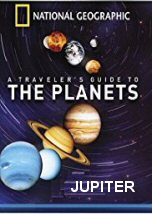
Jupiter

   2010    Science
Head beyond the Asteroid Belt for an out of this world experience. Welcome to Jupiter, home of high adrenaline adventure. Plunge into its mysterious depths. When you drop through the clouds it would get darker and hotter. At the center the temperatures are hotter than the surface of the sun and the pressures are unimaginably high.
Series: A Traveler Guide to the Planets
100 Foot Wave

100 Foot Wave

2021  Culture
Human

Human

2025  History
Dark Net

Dark Net

2016  Technology
The Big Think

The Big Think

2017  Technology
Space Race

Space Race

2005  Technology
Reel Rock

Reel Rock

2014  Culture