





Last Watched

"Mars"  Sort by

The Immortals

   2014    Science
This episode covers the nature of how life may have developed on Earth and the possibility of life on other planets. Tyson begins by explaining how the human development of writing systems enabled the transfer of information through generations, describing how Princess Enheduanna ca. 2280 BCE would be one of the first to sign her name to her works, and how Gilgamesh collected stories, including that of Utnapishtim documenting a great flood comparable to the story of Noah's Ark. Tyson explains how DNA similarly records information to propagate life, and postulates theories of how DNA originated on Earth, including evolution from a shallow tide pool, or from the ejecta of meteor collisions from other planets. In the latter case, Tyson explains how comparing the composition of the Nakhla meteorite in 1911 to results collected by the Viking program demonstrated that material from Mars could transit to Earth, and the ability of some microbes to survive the harsh conditions of space. With the motions of solar systems through the galaxy over billions of years, life could conceivably propagate from planet to planet in the same manner. Tyson then moves on to consider if life on other planets could exist. He explains how Project Diana performed in the 1960s showed that radio waves are able to travel in space, and that all of humanity's broadcast signals continue to radiate into space from our planet. Tyson notes that projects have since looked for similar signals potentially emanating from other solar systems. Tyson then explains that the development and lifespan of extraterrestrial civilizations must be considered for such detection to be realized. He notes that civilizations can be wiped out by cosmic events like supernovae, natural disasters such as the Toba disaster, or even self-destruct through war or other means, making probability estimates difficult. Tyson describes how elliptical galaxies, in which some of the oldest red dwarf stars exist, would offer the best chance of finding established civilizations. Tyson concludes that human intelligence properly applied should allow our species to avoid such disasters and enable us to migrate beyond the Earth before the Sun's eventual transformation into a red giant.
Series: Cosmos: A Spacetime Odyssey
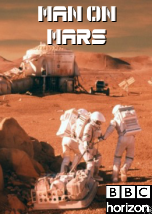
Man on Mars Mission to the Red Planet

   2014    Technology
Let's go behind the scenes at NASA to discover how it is preparing for its most ambitious and daring mission: to land men - and possibly women - on the surface of Mars. It's over 40 years since Neil Armstrong made the first human footprint on the moon. But getting to the red planet would involve a journey of at least three years. Meet the scientists and engineers who are designing new rockets, new space suits and finding ways to help astronauts survive the perils of this long voyage. And it turns out that having the 'right stuff' for a mission to mars might not be quite what you expect.

Space

   2014    Art
What if we could explore the vastness of Space? Science fiction has always fed upon our need to explore – to wonder what is out there. Space journeys from Jules Verne’s earliest ideas about attempts to leave our planet, to the Star Wars far away galaxy through to Nichelle Nichols revealing how her groundbreaking role as Lt. Uhura in Star Trek led to her participation in the recruitment of NASA’s astronauts. It explores the deep sea inspiration for Avatar, finds out why Ursula K Le Guin wrote The Left Hand of Darkness and discovers how Stanley Kubrick was able to make 2001: A Space Odyssey seem so believable. In addition, the program looks at the way Dune and The Mars Trilogy embraced the challenge of world building and discusses the appeal of the beaten up ‘dirty space’ of Dark Star and Firefly. From the horrifying scenes of Alien, to the epic spectacle of Star Wars, this is a journey to the stars and the alien encounters that await us there.
Series: The Real History of Science Fiction

The Real Garden of Eden

   2011    Culture
Can we find the Garden of Eden? Bible scholar Dr Francesca Stavrakopoulou thinks so. In the final episode of her series re-examining conventional readings of the Bible, she argues that the Garden of Eden has nothing to do with the origins of humanity, but is rather a story concealing dramatic events about a particular figure in a particular place, two and half thousand years ago. Marshalling compelling evidence from archaeology, Islam and the Bible text itself, she identifies and visits the exact site of Eden. It's a revolutionary theory which challenges some of the most cherished preconceptions about Eden in both Christianity and western culture.
Series: Bible's Buried Secrets

Catastrophes that Changed the Planets

   2011    Science
The planets of our solar system have experienced epic catastrophes throughout their long history, both raining down from outside and bubbling up from within. We'll voyage back in time to investigate the violent events that profoundly shaped the planets, including earth itself. We'll witness stunning revelations about what transformed Mars into a barren, hostile desert... The disaster that changed Venus from temperate to hellish... The impact that blew away Mercury's mantle, turning it into a planetary core... A colossal disturbance that rearranged the orbits of the gas giants... Titanic impacts on Jupiter... And how a lost moon may finally explain Saturn's rings.
Series: The Universe

Crash Landing on Mars

   2011    Technology
What might happen if the first manned mission to Mars crashes hundreds of miles from the rocket that would take them back home? Could they survive the crash, and travel across the brutal Martian surface to their home ship? We'll show what the astronauts would have to do to survive dust storms and space radiation, while extracting vital resources like water from the Martian soil itself. It's a dramatic vision of the very near future, where survival can depend on pre-industrial technology and human ingenuity.