







Last Watched

"Prehistory"  Sort by

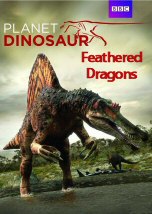
Feathered Dragons

   2011    Culture
In a late Jurassic forest in what is now China, an Epidexipteryx escapes from a juvenile Sinraptor by climbing a tree. It finds a beetle grub in the tree bark, being shown to use its elongated fingers in a similar way to a modern day aye-aye. However, its prey is stolen by another, larger Epidexipteryx, and after a brief bout of posturing, the smaller individual goes to find more food. It drops a second grub to the forest floor, where the other Epidexipteryx retrieves it, only to be killed by the juvenile Sinraptor. The episode then cuts to a desert in late Cretaceous Mongolia, where a Saurornithoides is shown brooding a nest of eggs. When it leaves the nest, an Oviraptor raids it, fleeing when the troodontid returns. The Saurornithoides is suddenly attacked and eaten by a Gigantoraptor, which then heads to compete in a breeding ritual for mates. The males use their feathers for display, a brief fight between two erupting at one point, allowing the females to choose the best suitor. The episode finally cuts to an early Cretaceous forest in China, where a Xianglong is being hunted by a Microraptor, which uses its feathers to pursue the gliding lizard in the air. A Sinornithosaurus attacks it, and after a brief chase the Microraptor manages a lucky escape. The Sinornithosaurus, alongside two other members of its species is then shown hunting a Jeholosaurus and its three young. The group brings down the parent, the narrator explaining that their possibly venomous bite allowed them to tackle animals much larger than themselves. A montage is then shown of the feathered dinosaurs featured in the programme, with the narrator saying that Microraptor not only hints at how flight might have developed, but also that dinosaurs still live amongst us today, as birds.
Series: Planet Dinosaur
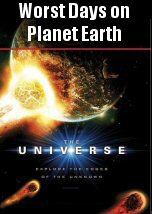
Worst Days on Planet Earth

   2011    Nature    3D    HD
Earth may seem like the most hospitable planet in the solar system. But look again. Startling new discoveries reveal the blue planet has been plagued by more chaos and destruction than scientists once imagined. Stand on the Earth billions of years ago as a primitive planet called Theia slams into it. Shiver as our entire globe is frozen over like a gigantic snowball. Feel the heat as mammoth volcanoes scorch the landscape and darken the sky. From a cosmic gamma ray burst frying away the ozone layer to an Everest-size asteroid slamming into the ocean, we'll reveal new information about how these unparalleled events drove life to the brink of total extinction. Out of this continuous devastation, how has our planet--and life--got to where it is today? Are the worst days behind us--or lurking in the distant future?
Series: The Universe

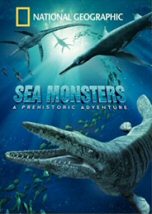
Sea Monsters

   2011    Science
The setting alternates between prehistory and modern day times in which scientists study the fossilized remains of the creatures in the film. In 2009, a group of paleontologists discover a rare fossil in Kansas. The fossil was previously exposed by a summer rain, and it appears to be a marine reptile, tracing back over 70 million years. It was a female Dolichorhynchops and will be the inspiration for telling the story of Dolly, who travels the Kansas Inland Sea, 80 million years ago during the late Cretaceous period with her family.
The film brings to life some of the most bizarre, ferocious and fascinating creatures to ever inhabit the ocean, incluing Tylosaurus, Xiphactinus, Cretoxyrhina, and Ammonite. It combines animation with recreations in a 3D prehistoric adventure. A journey to the bottom of the ancient oceans dramatizes awe-inspiring creatures.

Becoming Human: First Steps

   2010    History
Where did we come from? What makes us human? Groundbreaking investigation explores how new discoveries are transforming views of our earliest ancestors. Featuring interviews with world-renowned scientists, footage shot in the trenches as fossils were unearthed, and stunning computer-generated animation, Becoming Human brings early hominids to life, examining how they lived and how we became the creative and adaptable modern humans of today. In the first episode Selam, the amazingly complete remains of a 3 million year-old child, packed with clues to why we split from the apes, came down from the trees, and started walking upright.
Series: Becoming Human

Birth of Humanity

   2010    History
We will nvestigate the first skeleton that really looks like us –Turkana Boy– an astonishingly complete specimen of Homo erectus found by the famous Leakey team in Kenya. These early humans are thought to have developed key innovations that helped them thrive, including hunting large prey, the use of fire, and extensive social bonds. The program examines an intriguing theory that long-distance running –our ability to jog– was crucial for the survival of these early hominids. Not only did running help them escape from vicious predators roaming the grasslands, but it also gave them a unique hunting strategy: chasing down prey animals such as deer and antelope to the point of exhaustion. Birth of Humanity also probes how, why, and when humans' uniquely long period of childhood and parenting began.
Series: Becoming Human

Last Human Standing

   2010    History
xamines the fate of the Neanderthals, our European cousins who died out as modern humans spread from Africa into Europe during the Ice Age. Did modern humans interbreed with Neanderthals or exterminate them? The program explores crucial evidence from the recent decoding of the Neanderthal genome. How did modern humans take over the world? New evidence suggests that they left Africa and colonized the rest of the globe far earlier, and for different reasons, than previously thought. As for Homo sapiens, we have planet Earth to ourselves today, but that's a very recent and unusual situation. For millions of years, many kinds of hominids co-existed. At one time Homo sapiens shared the planet with Neanderthals, Homo erectus, and the mysterious "Hobbits"–three-foot-high humans who thrived on the Indonesian island of Flores until as recently as 12,000 years ago. "Last Human Standing" examines why "we" survived while those other ancestral cousins died out. And it explores the provocative question: In what ways are we still evolving today?
Series: Becoming Human
Top Science Stories

Top Science Stories

2020  Science
Reel Rock

Reel Rock

2014  Culture
Unknown

Unknown

2023  Science
Dark Net

Dark Net

2016  Technology
The Human Body

The Human Body

1998  Medicine
Bronze Age

Bronze Age

2016  History