


Last Watched

"House"  Sort by

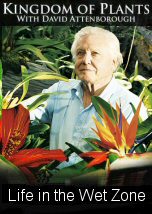
Kingdom of Plants Life in the Wet Zone

   2012    Nature
Written and presented by David Attenborough, who said: 'One of the most wonderful things about filming plants is that you can reveal hidden aspects of their lives, you can capture the moment as one plant strangles another, and as they burst into flower. But whilst time-lapse photography allows you to see things that no human being has ever seen before". David begins his journey inside the magnificent Palm House, a unique global rainforest in London. Here, he explores the extraordinary plants that are so well adapted to wet and humid environments and unravels the intimate relationships between wet zone plants and the animals that depend on them. It was in the wet zones of the world that plants first moved on to land and in the Waterlily House David reveals how flowers first evolved some 140 million years ago. Watching a kaleidoscope of breath-taking time-lapses of these most primitive of flowers swelling and blooming in 3D, he is able to piece together the very first evolutionary steps that plants took to employ a wealth of insects to carry their precious pollen for the first time. David discovers clues to answer a question that even had Charles Darwin stumped: how did flowering plants evolve so fast to go on to colonise the entire planet so successfully?
Series: Kingdom of Plants
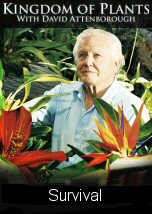
The Survival

   2012    Nature
David Attenborough discovers the plants that have evolved to shed their dependency on water enabling them to survive in the driest environments. The story begins at midnight in midsummer as David steps into the Princess of Wales Conservatory to witness the extraordinary nocturnal blooming of a cactus. The queen of the night, with its giant flowers, is the centre piece of a stunning symphony of cacti blooms that burst open in the desert (and at Kew) at night. In a mesmerizing 3D slow motion sequence, we discover the extraordinary connections between cacti and their natural pollinators: bats. As the sun rises, David meets other amazing plants. Species like the century plant, the Agave franzosini, which grows steadily for over 50 years, only to then flower itself to death with one mighty telegraph pole sized bloom which literally bursts out of the roof of Kew’s green house.
Series: Kingdom of Plants

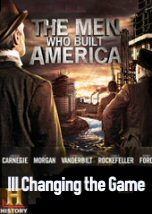
Changing the Game

   2012    History
J.P. Morgan proceeds to banish the dark with the direct current electric light of Thomas Edison, but the two soon face serious competition from the alternating current of George Westinghouse and Nikola Tesla. As the 19th century comes to a close, the titans of industry must try to work together to stop a new threat in budding politician William Jennings Bryan, who threatens to dissolve monopolies in America.
Series: The Men Who Built America

Frozen Planet: The Last Frontier

   2011    Culture
The documentary series reveals the extraordinary riches and wonders of the Polar Regions that have kept people visiting them for thousands of years. Today, their survival relies on a combination of ancient wisdom and cutting-edge science. Most Arctic people live in Siberia, either in cities like Norilsk - the coldest city on earth - or out on the tundra, where tribes like the Dogan survive by herding reindeer, using them to drag their homes behind them. On the coast, traditional people still hunt walrus from open boats - it is dangerous work, but one big walrus will feed a family for weeks. Settlers are drawn to the Arctic by its abundant minerals; the Danish Armed Forces maintain their claim to Greenland's mineral wealth with an epic dog sled patrol, covering 2,000 miles through the winter. Above, the spectacular northern lights can disrupt power supplies so scientists monitor it constantly, firing rockets into it to release a cloud of glowing smoke 100 kilometres high. In contrast, Antarctica is so remote and cold that it was only a century ago that the first people explored the continent. Captain Scott's hut still stands as a memorial to these men. Science is now the only significant human activity allowed; robot submarines are sent deep beneath the ice in search of new life-forms, which may also be found in a labyrinth of ice caves high up on an active volcano. Above, colossal balloons are launched into the purest air on earth to detect cosmic rays. At the South Pole there is a research base designed to withstand the world's most extreme winters. Cut off from the outside world for six months, the base is totally self-sufficient, even boasting a greenhouse.
Series: Frozen Planet

The Cities

   2011    Culture
Humans are so clever they’ve built their own habitat, designed to keep wild nature out. Yet as we discover the urban environment is totally dependant on the natural world. Over the three years of filming for Human Planet, the teams have spent time with over seventy different communities in countries across the planet. Despite seeing many different ways of living, there are some aspects of family life that remain the same whether you live in a tree house in West Papua, or a brick house in Bolton. These similarities became very clear when the urban team went to film on a rubbish dump in Kenya. Here on the Kibarani dump on the outskirts of Mombasa, Ali, Ashe and their family live and survive amongst the rubbish, and even here, just like anywhere on the planet, everything stops for a nice cup of tea!
Series: Human Planet

Never Sleep Again: The Elm Street Legacy 2

   2010    Art
Through interviews, the film shares how cast and crew brought their own worst nightmares to life on screen and examines the impact the series and its myths have had on pop culture and the horror genre in general. The documentary also explores the rise and fall of Robert Shaye's New Line Cinema and its reputation as "The House That Freddy Built".
Series: The Elm Street Legacy