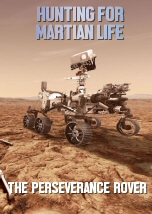
Meet Perseverance, NASA's latest rover, as it heads to Mars to answer one question: did life exist on the red planet? On the way, it will lay the foundation for human exploration of our closest neighbour. Today, Mars is hostile to life. It's too cold for water to stay liquid on the surface, and the thin atmosphere lets through high levels of radiation, potentially sterilizing the upper part of the soil. But it wasn't always like this. Some 3.5 billion years ago or more, water was flowing on the surface. It carved channels still visible today and pooled in impact craters. A thicker carbon dioxide atmosphere would have blocked more of the harmful radiation. The Mars 2020/Perseverance rover is designed to better understand the geology of Mars and seek signs of ancient life. The mission will collect and store a set of rock and soil samples that could be returned to Earth in the future. It will also test new technology to benefit future robotic and human exploration of Mars, as the Ingenuity Helicopter.
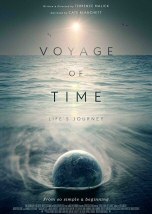
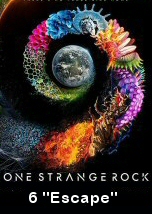
The second episode takes a look at how humans have always been voyagers and explorers, leaving the comfort of native shores to explore. Neil DeGrasse Tyson will show us a long-term vision of humanity's future worlds.
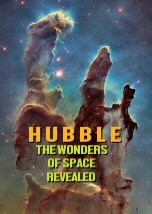
To celebrate the 30th anniversary of its launch, this film tells the remarkable story of how the Hubble Space Telescope revealed the awe and wonder of our universe and how a team of daring astronauts risked their lives to keep it working. Additionally, a team led by Greg Bacon and Dr Frank Summers has transformed many of Hubble's most awe-inspiring images into visualisations - from the spectacular Orion Nebula to the fabulous Whirlpool Galaxy and ethereal Horsehead Nebula. One of the most mind-blowing of the visualizations takes the viewer on a remarkable journey, flying across the Universe to witness almost 13 billion years of cosmic evolution. It's called the 'Hubble Ultra Deep Field' and was created when Hubble stared at a small patch of sky for the equivalent of more than 11 days to see some of the most distant galaxies ever observed.
Our universe reveals itself in ways we’ve never seen before, thanks to new discoveries in astrobiology. Today, the advent of cutting-edge observational instruments is shedding light on amazing facts about life and the universe. NASA's next-generation space telescope TESS (Exoplanet Survey Satellite) has begun its search for Earth-like planets belonging to other star systems. How many of these 'exoplanets' can host life, and what kind of life forms can evolve in these environments?
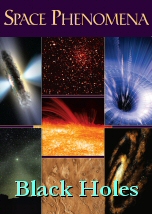
Astronomers are giving us astonishing news, visual proof of the reality of black holes. Stunning new findings are overturning conventional theories. The most common vision of black holes is that they are monstrous and mysterious bodies swallowing everything around them. However, the latest discoveries are drawing a link between black holes and the existence of life. A startling new picture is emerging. The existence of black holes is what made life on Earth possible.
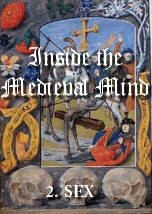
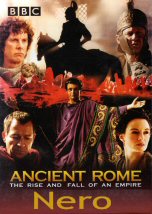
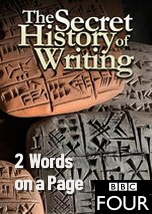
Writing itself is 5,000 years old, and for most of that time words were written by hand using a variety of tools. The Romans were able to run an empire thanks to documents written on papyrus. Scroll books could be made quite cheaply and, as a result, ancient Rome had a thriving written culture. With the fall of the Roman Empire, papyrus became more difficult to obtain. Europeans were forced to turn to a much more expensive surface on which to write: Parchment. Medieval handwritten books could cost as much as a house, they also represent a limitation on literacy and scholarship. No such limitations were felt in China, where paper had been invented in the second century. Paper was the foundation of Chinese culture and power, and for centuries how to make it was kept secret. When the secret was out, paper mills soon sprang up across central Asia. The result was an intellectual flourishing known as the Islamic Golden Age. Muslim scholars made discoveries in biology, geology, astronomy and mathematics. By contrast, Europe was an intellectual backwater. That changed with Gutenberg’s development of movable type printing. The letters of the Latin alphabet have very simple block-like shapes, which made it relatively simple to turn them into type pieces. When printers tried to use movable type to print Arabic texts, they found themselves hampered by the cursive nature of Arabic writing. The success of movable type printing in Europe led to a thousand-fold increase in the availability of information, which produced an explosion of ideas that led directly to the European Scientific Revolution and the Industrial Revolution that followed.






Today, Mars is hostile to life. It's too cold for water to stay liquid on the surface, and the thin atmosphere lets through high levels of radiation, potentially sterilizing the upper part of the soil. But it wasn't always like this. Some 3.5 billion years ago or more, water was flowing on the surface. It carved channels still visible today and pooled in impact craters. A thicker carbon dioxide atmosphere would have blocked more of the harmful radiation. The Mars 2020/Perseverance rover is designed to better understand the geology of Mars and seek signs of ancient life. The mission will collect and store a set of rock and soil samples that could be returned to Earth in the future. It will also test new technology to benefit future robotic and human exploration of Mars, as the Ingenuity Helicopter.