




Last Watched

"David Attenborough "  Sort by

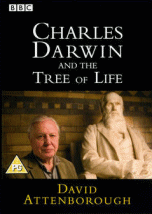
Charles Darwin and the Tree of Life

   2009    Science
David Attenborough asks three key questions: how and why did Darwin come up with his theory of evolution? Why do we think he was right? And why is it more important now than ever before? David starts his journey in Darwin's home at Down House in Kent, where Darwin worried and puzzled over the origins of life. David goes back to his roots in Leicestershire, where he hunted for fossils as a child, and where another schoolboy unearthed a significant find in the 1950s. And he revisits Cambridge University, where both he and Darwin studied, and where many years later the DNA double helix was discovered, providing the foundations for genetics. At the end of his journey in the Natural History Museum in London, David concludes that Darwin's great insight revolutionised the way in which we see the world. We now understand why there are so many different species, and why they are distributed in the way they are. But above all, Darwin has shown us that we are not set apart from the natural world, and do not have dominion over it. We are subject to its laws and processes, as are all other animals on earth to which, indeed, we are related.
The Cold Blooded Truth

   2008    Nature
David Attenborough reveals the surprising truth about the cold-blooded lives of reptiles and amphibians. These animals are as dramatic in combat, as colourful in their communication and as tender in their parental care as any other animals. Join giant courting crocodiles, jousting tortoises and bright red sumo-wrestling frogs in their sophisticated, solar-powered lives.
Series: Life In Cold Blood

Sophisticated Serpents

   2008    Nature
David Attenborough reveals the fascinating lives of snakes, the most misunderstood group of reptiles. A CCTV stakeout of wild rattlesnakes hunting shows, for the first time, what sophisticated predators they truly are. Attenborough is also on the receiving end of a spitting cobra's chemical weapons system, while the surprisingly beautiful and tender side of snakes is displayed in the sinuous courtship of kingsnakes, and the water birth of 15 beautiful yellow anaconda babies.
Series: Life In Cold Blood

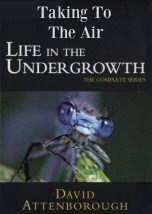
Taking To The Air

   2005    Nature
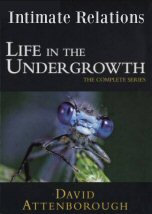
As the early June sun begins to set over a calm river in Central Hungary, masses of ghostly shapes emerge from their larval cases to take to the air for the first time. They are mayflies and in a spectacular display, thousands of them demonstrate how the very first wings were used. From the stunning aerobatics of hoverflies in an English garden to the mass migration of purple crow butterflies in the valleys of Taiwan, this episode tells the tale of the first animals ever to take to the air. Unique footage reveals the lightning fast reactions of bluebottles and hoverflies, filmed with one of the world's fastest cameras, and Sir David Attenborough handles the world's largest (and perhaps most ferocious) insect - the Titan beetle.
Series: Life in the Undergrowth

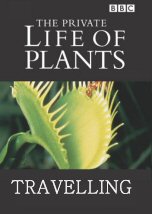
The Private Life of Plants: Travelling

   1994    Nature
Sir David Attenborough reveals plants as they have never been seen before - on the move and dangerously devious. About the major problems of life - growing, finding food, reproduction - and the varied ways plants have evolved to solve it. Filmed from the plant's point of view, using computer animations, fibre-optics and unique time-lapse photography. The first episode looks at how plants are able to move". The bramble is an aggressive example: it advances forcefully from side to side and, once settled on its course, there is little that can stand in its way. An altogether faster species is the birdcage plant, which inhabits Californian sand dunes. When its location becomes exposed, it shifts at great speed to another one with the assistance of wind — and it is this that allows many forms of vegetation to distribute their seeds. While not strictly a plant, the spores of fungi are also spread in a similar fashion. One of the most successful (and intricate) flowers to use the wind is the dandelion, whose seeds travel with the aid of 'parachutes'. They are needed to travel miles away from their parents, who are too densely packed to allow any new arrivals. Trees have the advantage of height to send their seeds further, and the cottonwood is shown as a specialist in this regard. The humidity of the tropical rainforest creates transportation problems, and the liana-species Alsomitra macrocarpa is one plant whose seeds are aerodynamic 'gliders'. Some, such as those of the sycamore, take the form of 'helicopters', while others, such as the squirting cucumber release their seeds by 'exploding'. Water is also a widely used method of propulsion. The tropical sea bean Entada gigas has one of the biggest fruits of all plants and is dispersed by water streams. However, most plants use living couriers, whether they be dogs, humans and other primates, ants or birds, etc., and to that end, they use colour and smell to signify when they are ripe for picking.
Series: The Private Life of Plants

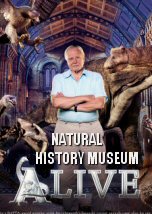
Natural History Museum Alive

       Science    3D    HD
In this ground-breaking film, Sir David Attenborough takes us on a journey through the world-famous Natural History Museum in London in a captivating tale of discovery, adventure, and magic, where state-of-the-art CGI, science, and research combine to bring the museum's now long-extinct inhabitants to life to discover how these animals once roamed the planet. As the doors are locked and night falls, Attenborough stays behind and meets some of the most fascinating extinct creatures which come alive in front of his eyes; dinosaurs, ice age beasts, and giant reptiles.
The film fulfils a lifelong dream of him, who said: 'I have been coming to the Natural History Museum since I was a boy. It's one of the great places to come to learn about natural history. In this film we have the technology to bring back to life some of the most romantic and extraordinary extinct creatures that can be conceived; some are relatively recent animals like the dodo, others older like the dinosaurs, and some we only know through fossil evidence. Using our current scientific knowledge, this film brings these creatures alive, allowing me to look at some of the biggest questions surrounding them.'
The Sky at Night

The Sky at Night

2018  Science
Ancient Apocalypse

Ancient Apocalypse

2024  History
Invisible Worlds

Invisible Worlds

2010  Science
The Putin Interviews

The Putin Interviews

2017  Culture
D-Day

D-Day

2013  History