



Last Watched

"Religions"  Sort by

Reformation

   2011    History
In the fourth part of the series, Diarmaid MacCulloch makes sense of the Reformation, and of how a faith based on obedience and authority gave birth to one based on individual conscience. He shows how Martin Luther wrote hymns to teach people the message of the Bible, and how a tasty sausage became the rallying cry for Swiss Reformer Ulrich Zwingli to tear down statues of saints, allow married clergy and deny that communion bread and wine were the body and blood of Christ.
Series: A History of Christianity
Protestantism The Evangelical Explosion

   2011    Culture
Diarmaid MacCulloch traces the growth of an exuberant expression of faith that has spread across the globe - Evangelical Protestantism. Today, it is associated with conservative politics, but the whole story is distinctly more unexpected. It is easily forgotten that the evangelical explosion has been driven by a concern for social justice and the claim that one could stand in a direct emotional relationship with God. It allowed the Protestant faith to burst its boundaries from its homeland in Europe. In America, its preachers marketed Christianity with all the flair and swashbuckling enterprise of American commerce. In Africa, it converted much of the continent by adapting to local traditions, and now it is expanding into Asia. But is Korean Pentecostalism and its message of prosperity in the here and now an adaptation too far?
Series: A History of Christianity

God in the Dock

   2011    Culture
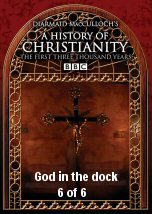
Diarmaid MacCulloch's own life story makes him a symbol of a distinctive feature about Western Christianity - scepticism, a tendency to doubt which has transformed both Western culture and Christianity. In the final programme in the series, he asks where that change came from. He challenges the simplistic notion that faith in Christianity has steadily ebbed away before the relentless advance of science, reason and progress, and shows instead how the tide of faith perversely flows back in. Despite the attacks of Newton, Voltaire, the French Revolutionaries and Darwin, Christianity has shown a remarkable resilience. The greatest damage to Christianity was actually inflicted to its moral credibility by the two great wars of the 20th century and by its entanglement with Fascism and Nazism. And yet it is during crisis that the Church has rediscovered deep and enduring truths about itself, which may even be a clue to its future.
Series: A History of Christianity
The Normans: Normans of the South

   2010    History
Professor Robert Bartlett explores the impact of the Normans on southern Europe and the Middle East. The Normans spread south in the 11th century, winning control of southern Italy and the island of Sicily. There they created their most prosperous kingdom, where Christianity and Islam co-existed in relative harmony and mutual tolerance. It became a great centre of medieval culture and learning. But events in the Middle East provoked the more aggressive side of the Norman character. In 1095, the Normans enthusiastically answered the Pope's call for holy war against Islam and joined the first crusade. They lay siege to Jerusalem and eventually helped win back the holy city from the muslims. This bloody conquest left a deep rift between Christianity and Islam which is still being felt to this day.

The End of God

   2010    Culture
Dr Thomas Dixon delves into the BBC's archive to explore the troubled relationship between religion and science. From the creationists of America to the physicists of the Large Hadron Collider, he traces the expansion of scientific knowledge and asks whether there is still room for God in the modern world. He looks at what happens when new scientific discoveries start to explain events that were once seen as the workings of God, and explains how some of our most famous scientists have seen God in the grandest laws of the universe. Finally, he finds intriguing evidence from brain science which hints that belief in God is here to stay.

The Buddha

   2010    History
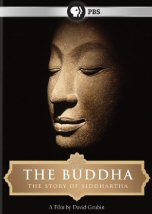
After 400 BC, a new philosophy was born in South east Asia, generated from the ideas of Buddha, a mysterious Prince from India who gained enlightenment while he sat under a large, shapely fig tree. He remains one of the most legendary and influential of all religious progenitors, but what of his actual life? In this biographical documentary, director David Grubin tells the historical tale of Gautama Buddha (563-483 BC), from his initial enlightenment through his death around the age of 80. In the process, Grubin makes an unusual point: that Gautama never once claimed to be God or God's emissary, but instead sought to find a way to bring peace and alleviation from suffering to others in a cruel and often insane world. In telling this story, Grubin combines a number of elements including original animations, testimony by contemporary Buddhists such as the 14th Dalai Lama Tenzin Gyatso, glimpses of sculptures and paintings that help tell Gautama's story, and much more. Narrated by Richard Gere
How the Universe Works

How the Universe Works

2014  Science
Nature Great Events

Nature Great Events

2009  Nature
Leaving Neverland

Leaving Neverland

2019  Culture
Inside the Medieval Mind

Inside the Medieval Mind

2008  History
Ancient Rome

Ancient Rome

2006  History
Ancient Apocalypse

Ancient Apocalypse

2024  History
Zeitgeist

Zeitgeist

2007  Culture