In 1984, horrifying images of famine in Ethiopia inspired Bob Geldof and Midge Ure to turn music into action. What began with Band Aid and the record-breaking “Do They Know It’s Christmas?” soon grew into Live Aid, the unprecedented 1985 concerts at Wembley Stadium and Philadelphia that brought together many of the world’s biggest stars, from Queen and David Bowie to U2, Elton John and Paul McCartney, while hundreds of millions watched around the globe. But the story did not end with one extraordinary day. The movement evolved into a wider campaign against poverty, debt and inequality in Africa, eventually leading to Live 8 and direct pressure on world leaders. Presented here with all three episodes combined into a single video, the series revisits the music, personalities, political battles and enduring legacy of the moment when rock ’n’ roll tried to change the world.
Dementia is one of the fastest-growing health conditions in the UK, yet its earliest warning signs can be difficult to recognise. NHS GP Dr Claire Taylor meets people living with Alzheimer’s and other forms of dementia, explores how the disease changes the brain, and puts herself through innovative tests designed to detect subtle problems with memory, hearing and cognition before more obvious symptoms appear. Along the way, she investigates why some people develop dementia at a younger age, how lifestyle and social isolation may influence risk, and what the latest research says about prevention and treatment. With moving personal stories and access to scientists working at the cutting edge of dementia research, the documentary asks a question that concerns millions: how much can we really know about our own future brain health?
In the final episode of the series, the Civil War reaches its bloodiest and most decisive stage. After the Union victories at Gettysburg and Vicksburg, Abraham Lincoln becomes increasingly frustrated by generals who fail to destroy Robert E. Lee’s army and finally turns to Ulysses S. Grant, a commander willing to fight relentlessly until the Confederacy is defeated. At the same time, Lincoln pushes the nation beyond simply preserving the Union, supporting Black soldiers, confronting Frederick Douglass over their unequal treatment and making emancipation central to the meaning of the war. As casualties continue to mount, Lincoln faces the election of 1864, the fight to abolish slavery permanently through the 13th Amendment and the final collapse of the Confederacy. Lee’s surrender at Appomattox finally brings the long struggle toward its end, leaving Lincoln to consider how a divided nation can be reunited and what freedom will mean for millions of formerly enslaved people. But just as victory opens the possibility of a new beginning, his assassination transforms triumph into national tragedy and seals his place in American history.
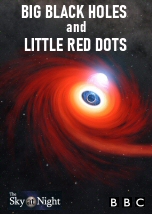
Professor Brian Cox joins Chris Lintott and the team to investigate one of the most intriguing new mysteries in modern astronomy. Observations from the James Webb Space Telescope have revealed hundreds of compact, extraordinarily bright objects known as “little red dots”, appearing less than a billion years after the Big Bang. Many may hide rapidly growing supermassive black holes, raising a profound question: how could such enormous objects have formed so early in cosmic history? The journey begins with the strange physics of black holes themselves, from event horizons and singularities to the supermassive black hole at the centre of the Milky Way and the gigantic black hole in the galaxy M87. With cosmologist Emma Chapman and Professor Sadegh Khochfar, the programme explores radical explanations for these ancient monsters, including primordial black holes born soon after the Big Bang and massive black holes formed directly from collapsing clouds of gas, bypassing stars altogether. Cutting-edge computer simulations recreate the first billion years of the universe and reveal how the earliest galaxies and black holes may have emerged within the cosmic web. These discoveries are forcing astronomers to reconsider not only how supermassive black holes grow, but how galaxies and the early universe itself evolved.
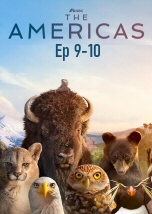
In the final two episodes, the journey reaches the Pacific edge of North America and the remote wilderness of Patagonia, two spectacular regions shaped by powerful oceans, towering forests and extreme weather. Along the West Coast, wolves comb the shoreline for food, sea otters battle crashing surf, blue whales gather in a rare display of speed and movement, and giant Pacific octopuses devote everything to protecting the next generation. High in the redwood canopy, even tiny salamanders perform extraordinary leaps to survive, revealing how life has adapted to one of the continent’s most dramatic coastal environments. The series then travels to the far south of the Americas, where Patagonia delivers a fittingly wild finale. Pumas stalk guanacos through snowy mountains, rockhopper penguins fight their way through violent waves to reach their colonies, giant stag beetles climb immense trees to compete for mates, and elephant seals clash for dominance along the coast. In one of the most remarkable scenes, a family of orcas passes down a dangerous hunting technique from one generation to the next, showing how survival here depends not only on strength, but also on experience, cooperation and learning.
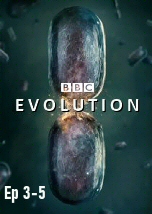
In the final three episodes of the series, Chris Packham follows three extraordinary evolutionary journeys to discover how the relentless demands of survival transformed simple early animals into some of the most remarkable creatures alive today. In Borneo, the voracious appetite of the bat leads back more than half a billion years to the origins of the through-gut, the first anus, heads and jaws, revealing how the need to find and consume food helped reshape animal life and ultimately produced the bat’s extraordinary powers of hearing. In the Bahamas, the intelligence of dolphins opens an even deeper story: from ancient cells able to sense light to the evolution of eyes, complex brains, sophisticated senses and the remarkable minds of modern dolphins. The journey culminates with one of nature’s supreme athletes. Tracing the horse’s ancestry through hundreds of millions of years, Packham reveals how primitive muscle cells evolved into increasingly powerful systems for movement, how beating hearts supplied those muscles with oxygen, and how limbs became ever more effective tools for locomotion. Slithering, swimming, walking and running eventually converge in an animal built for extraordinary speed and endurance. Together, these final episodes reveal a breathtaking truth: hunger, perception and movement were not merely necessities of survival—they were powerful evolutionary forces that helped create the astonishing complexity of animal life.


















But the story did not end with one extraordinary day. The movement evolved into a wider campaign against poverty, debt and inequality in Africa, eventually leading to Live 8 and direct pressure on world leaders. Presented here with all three episodes combined into a single video, the series revisits the music, personalities, political battles and enduring legacy of the moment when rock ’n’ roll tried to change the world.