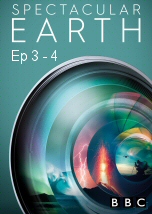
In the final two episodes, the documentary investigates the immense geological forces that continue to reshape our planet. Scientists and adventurers travel to Guatemala's Volcán de Fuego, one of the most active volcanoes on Earth, capturing spectacular eruptions, rivers of lava, and towering ash clouds from astonishingly close range. Along the way, the series reveals how volcanoes are formed, how tectonic plates trigger earthquakes and tsunamis, and how volcanic activity can even create entirely new islands in the middle of the ocean. The journey then turns to one of nature's most breathtaking displays: the Aurora Borealis. In the frozen landscapes of northern Sweden, scientists uncover how powerful storms on the Sun send streams of charged particles towards Earth, illuminating the night sky with vast curtains of color. Combining stunning footage with cutting-edge research, the documentary explores solar activity, space weather, eclipses, and the remarkable connection between our planet and the forces that originate far beyond its atmosphere.
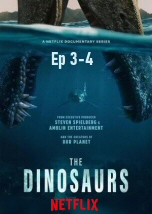
In the final two episodes of the series, produced by Steven Spielberg and narrated by Morgan Freeman, the Age of Dinosaurs reaches its most spectacular and dangerous chapter. After a harsh freeze reshapes life on Earth, the Cretaceous world emerges with rising seas, scattered islands and new hunting grounds where giant reptiles thrive. Pterosaurs glide across the skies searching for food while powerful predators patrol land and ocean in a planet completely ruled by dinosaurs. Among these rulers stands the most formidable hunter of all — Tyrannosaurus rex. Yet while these giants dominate the Earth, the planet itself is slowly changing. Continents drift apart, ecosystems evolve and an unseen threat begins its silent journey through space, foreshadowing the catastrophic event that will one day end the age of dinosaurs.
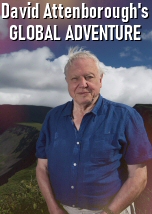
In his mid-eighties, when many believed his journey was winding down, David Attenborough embarked on a bold new chapter in natural history filmmaking. This adventure traces the epic story of life on Earth, from the first organisms that flourished on ancient seabeds hundreds of millions of years ago to the astonishing biodiversity of today. Revisiting iconic landscapes and harnessing cutting-edge technology, Attenborough reveals how our planet’s living tapestry was shaped across deep time. The three episodes can be enjoyed together in a single continuous viewing, creating one sweeping journey across continents and oceans. From the Galápagos Islands to the caves of Borneo, from China’s ancient tropics to the Great Barrier Reef, the series follows Attenborough’s global quest to understand how life rose, adapted, and endured. It is a grand exploration of evolution, resilience, and the fragile beauty of the world we inherit.
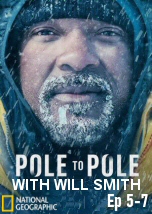
In the final three episodes, the journey deepens into a powerful exploration of culture, survival, and science at the planet’s edges. On a remote Pacific island threatened by rising seas, Will Smith joins Dr. Walworth and John Aini to document a dying language spoken by only five people, turning marine research into an intimate race against time to preserve human memory. The mission reveals how climate change erodes not just coastlines, but identities. The adventure then shifts to extremes of land and ice. In the Kalahari Desert, Will learns survival from the San people, confronting the limits of his endurance during a traditional hunt with guide Kane Motswana. The odyssey culminates beneath the ice of the North Pole, where, alongside polar ecologist Allison Fong, a daring dive to collect critical samples is jeopardized by a sudden storm and equipment failure. What follows is a gripping test of courage and teamwork that redefines heroism at the end of a 100-day quest.
In the final two episodes, the focus shifts to forests and humanity’s defining role in the planet’s future. Ancient woodlands emerge as powerful engines of climate balance, storing vast amounts of carbon while sustaining intricate webs of life. Through striking visuals and frontline science, the documentary reveals how the health of the world’s forests is inseparable from the stability of Earth’s climate—and how their decline accelerates global risk. The story then turns inward, asking what responsibility humans bear in shaping what comes next. From indigenous stewardship to bold restoration projects, these episodes explore how human choices can either deepen the crisis or unlock nature’s capacity to heal. It’s a compelling conclusion that reframes our relationship with the natural world, showing that the future of nature is, ultimately, the future of humanity itself.
In this ground-breaking film, Sir David Attenborough takes us on a journey through the world-famous Natural History Museum in London in a captivating tale of discovery, adventure, and magic, where state-of-the-art CGI, science, and research combine to bring the museum's now long-extinct inhabitants to life to discover how these animals once roamed the planet. As the doors are locked and night falls, Attenborough stays behind and meets some of the most fascinating extinct creatures which come alive in front of his eyes; dinosaurs, ice age beasts, and giant reptiles. The film fulfils a lifelong dream of him, who said: 'I have been coming to the Natural History Museum since I was a boy. It's one of the great places to come to learn about natural history. In this film we have the technology to bring back to life some of the most romantic and extraordinary extinct creatures that can be conceived; some are relatively recent animals like the dodo, others older like the dinosaurs, and some we only know through fossil evidence. Using our current scientific knowledge, this film brings these creatures alive, allowing me to look at some of the biggest questions surrounding them.'














The journey then turns to one of nature's most breathtaking displays: the Aurora Borealis. In the frozen landscapes of northern Sweden, scientists uncover how powerful storms on the Sun send streams of charged particles towards Earth, illuminating the night sky with vast curtains of color. Combining stunning footage with cutting-edge research, the documentary explores solar activity, space weather, eclipses, and the remarkable connection between our planet and the forces that originate far beyond its atmosphere.