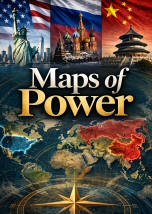
Geography has shaped the rise and fall of nations long before modern borders existed. Across the United States, Russia and China, mountains, rivers, deserts, oceans and natural resources have influenced migration, settlement, warfare, trade and political ambition. From the first peoples of North America and the waterways that helped build the United States into a superpower, to Russia’s vast exposed landmass and centuries-long search for secure borders and warm-water ports, the series reveals how physical geography repeatedly becomes political destiny. China completes the global picture, showing how the Himalayas, the Gobi Desert, the Yellow and Yangtze rivers and its position at the heart of Eurasian trade helped shape one of the world’s oldest civilizations and its modern rise. Presented here with all three episodes combined into a single video, the documentary connects ancient history with today’s struggle for global influence, revealing why the geography of the USA, Russia and China still plays a decisive role in the balance of world power.
Artificial intelligence has moved from a fringe scientific dream to a technology capable of reshaping work, politics, creativity and even human survival. Through rare interviews and archival footage, pioneers such as Geoffrey Hinton and Demis Hassabis trace the breakthroughs that made modern AI possible, while former OpenAI staff and other researchers reveal the fierce rivalry, ambition and commercial pressure driving the race toward ever more powerful systems. But the deeper the film goes, the more unsettling the questions become. Hinton explains why he left Google to warn about the technology he helped create, while examples of deceptive behaviour, threatening chatbots and real-world harm expose how little even experts fully understand or control these systems. Moving with the tension of a thriller, the documentary asks whether humanity is building its greatest tool or creating something it may one day be unable to contain.
Filmmaker Alex Gibney examines how Elon Musk rose from the Silicon Valley start-up world to become one of the most powerful and influential figures of the 21st century. Through archival footage, interviews with former colleagues, partners and people who knew him closely, the documentary follows the creation of Zip2, PayPal, Tesla and SpaceX, exploring the ambition, risk-taking and carefully constructed image of the visionary entrepreneur who promised to transform life on Earth and beyond. But the film increasingly asks a more unsettling question: how did one businessman accumulate so much economic, technological and political power? Musk declined to be interviewed, so Gibney builds a simulated conversation from his own public statements while examining his takeover of Twitter/X, Starlink, artificial intelligence, his relationship with Donald Trump and his involvement with DOGE (Department of Government Efficiency). The result is a provocative portrait of innovation, wealth, influence and personal mythology, questioning where technological ambition ends and unchecked power begins.
In 1984, horrifying images of famine in Ethiopia inspired Bob Geldof and Midge Ure to turn music into action. What began with Band Aid and the record-breaking “Do They Know It’s Christmas?” soon grew into Live Aid, the unprecedented 1985 concerts at Wembley Stadium and Philadelphia that brought together many of the world’s biggest stars, from Queen and David Bowie to U2, Elton John and Paul McCartney, while hundreds of millions watched around the globe. But the story did not end with one extraordinary day. The movement evolved into a wider campaign against poverty, debt and inequality in Africa, eventually leading to Live 8 and direct pressure on world leaders. Presented here with all three episodes combined into a single video, the series revisits the music, personalities, political battles and enduring legacy of the moment when rock ’n’ roll tried to change the world.
In the final episode of the series, the Civil War reaches its bloodiest and most decisive stage. After the Union victories at Gettysburg and Vicksburg, Abraham Lincoln becomes increasingly frustrated by generals who fail to destroy Robert E. Lee’s army and finally turns to Ulysses S. Grant, a commander willing to fight relentlessly until the Confederacy is defeated. At the same time, Lincoln pushes the nation beyond simply preserving the Union, supporting Black soldiers, confronting Frederick Douglass over their unequal treatment and making emancipation central to the meaning of the war. As casualties continue to mount, Lincoln faces the election of 1864, the fight to abolish slavery permanently through the 13th Amendment and the final collapse of the Confederacy. Lee’s surrender at Appomattox finally brings the long struggle toward its end, leaving Lincoln to consider how a divided nation can be reunited and what freedom will mean for millions of formerly enslaved people. But just as victory opens the possibility of a new beginning, his assassination transforms triumph into national tragedy and seals his place in American history.
Professor Jerry Brotton reveals that maps are far more than neutral guides to places: they are expressions of the societies that create them and powerful instruments for shaping territory, belief and authority. Beginning with some of the earliest known maps, he traces how cartography evolved from marking land and ownership to serving kings, empires, scientists and governments. From Henry VIII’s coastal surveys and the Cassini family’s scientific breakthroughs to the drawing of modern national borders, the series shows how maps can define who controls land, who belongs where and even how entire peoples understand the world around them. Across the three episodes, presented here together in a single uninterrupted video, the journey moves from ancient and medieval worldviews to imperial expansion and the digital age. Brotton explores religious maps, Aztec symbolism, Victorian attempts to classify societies, the politics behind projections of the globe, and the rise of Google Earth and data-driven mapping. He then follows the mapmakers and explorers who turned distant lands into targets for conquest and profit, from Ptolemy and Columbus to Walter Raleigh and the trading empires that followed. The story ends in the Arctic, where new maps are once again being used to stake claims over oil, gas and minerals, proving that even in the twenty-first century, cartography remains inseparable from power, plunder and possession.









Presented here with all three episodes combined into a single video, the documentary connects ancient history with today’s struggle for global influence, revealing why the geography of the USA, Russia and China still plays a decisive role in the balance of world power.