





Last Watched

"Atom"  Sort by

Hiroshima

   2020    History
The final hours of WW2 changed the course of history. As the Americans inch closer to Japan the Japanese fight with greater intensity. The question now is how to end the conflict. Starve them into capitulation? Many in US command believe the Japanese will never surrender. The alternative is to stage a massive invasion that would dwarf D-Day? The massacre of millions would be inevitable. But then a third and far darker option becomes available: the atom bomb.
Series: Greatest Events of WWII in Colour
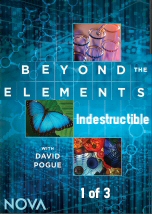
Indestructible

   2020    Science
In this series, David Pogue explores the fantastic chemistry behind the everyday and sets out on a worldwide quest to find the key molecules and chemical reactions that have paved the way for human civilization, life, and even the universe as we know it.
In the first episode, glass so strong you can jump on it, rubber so tough it protects a clay pot dropped from 50 feet, endless varieties of plastic. Scientists and engineers have created virtually indestructible versions of common materials by manipulating the chains of interlocking atoms that give them strength—but have they made them too tough?
Series: Beyond the Elements

Einstein Quantum Riddle

   2019    Science
Join scientists as they grab light from across the universe to prove quantum entanglement is real. Einstein called it 'spooky action at a distance,' but today quantum entanglement is poised to revolutionize technology from computers to cryptography. Physicists have gradually become convinced that the phenomenon—two subatomic particles that mirror changes in each other instantaneously over any distance is real. But a few doubts remain.
The film follows a ground-breaking experiment in the Canary Islands to use quasars at opposite ends of the universe to once and for all settle remaining questions.

AlphaGo

   2017    Technology
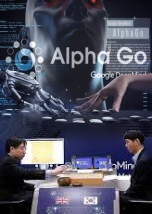
With more board configurations than there are atoms in the observable universe, the ancient Chinese game of 'Go' has long been considered a grand challenge for artificial intelligence. On March 9, 2016, the worlds of Go and AI collided in South Korea for an extraordinary best-of-five-game competition, coined the Google DeepMind Challenge Match. Hundreds of millions of people around the world watched as a legendary Go master took on an unproven AI challenger for the first time in history.
AlphaGo chronicles a journey from the halls of Cambridge, through the backstreets of Bordeaux, past the coding terminals of DeepMind in London, and, ultimately, to the seven-day tournament in Seoul. As the drama unfolds, more questions emerge: What can artificial intelligence reveal about a 3000-year-old game? What can it teach us about human mind?

Weirder and Weirder

   2018    Science
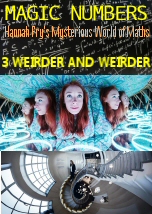
Dr Hannah Fry explores a paradox at the heart of modern maths, discovered by Bertrand Russell, which undermines the very foundations of logic that all of maths is built on. These flaws suggest that maths isn't a true part of the universe but might just be a human language - fallible and imprecise. However, Hannah argues that Einstein's theoretical equations, such as E=mc2 and his theory of general relativity, are so good at predicting the universe that they must be reflecting some basic structure in it. This idea is supported by Kurt Godel, who proved that there are parts of maths that we have to take on faith.
Hannah then explores what maths can reveal about the fundamental building blocks of the universe - the subatomic, quantum world. The maths tells us that particles can exist in two states at once, and yet quantum physics is at the core of photosynthesis and therefore fundamental to most of life on earth - more evidence of discovering mathematical rules in nature. But if we accept that maths is part of the structure of the universe, there are two main problems: firstly, the two main theories that predict and describe the universe - quantum physics and general relativity - are actually incompatible; and secondly, most of the maths behind them suggests the likelihood of something even stranger - multiple universes.
We may just have to accept that the world really is weirder than we thought, and Hannah concludes that while we have invented the language of maths, the structure behind it all is something we discover. And beyond that, it is the debate about the origins of maths that has had the most profound consequences: it has truly transformed the human experience, giving us powerful new number systems and an understanding that now underpins the modern world.
Series: Magic Numbers

Einstein Nightmare

   2014    Science
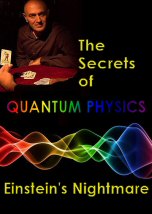
Professor Jim Al-Khalili investigates the most accurate and yet perplexing scientific theory ever - quantum physics. At the beginning of the 20th century scientists were led into the hidden workings of matter, into the sub-atomic building blocks of the world around us. They discovered phenomena unlike any encountered before - a realm where things can be in many places at once, where chance and probability call the shots and where reality appears to only truly exist when we observe it. Albert Einstein hated the idea that nature, at its most fundamental level, is governed by chance. Jim reveals how, in the 1930s, Einstein thought he'd found a fatal flaw in quantum physics because it implies that sub-atomic particles can communicate faster than light in defiance of the theory of relativity. In the 1960s the scientist John Bell showed there was a way to test if Einstein was right and quantum mechanics was actually mistaken. Jim repeats this critical experiment - with shocking results.
Series: The Secrets of Quantum Physics