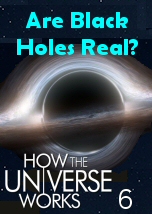
Various eminent scientists explain the current knowledge of Black Holes and try to answer the question, do they really exist? New discoveries are challenging everything we know about black holes -- astronomers are beginning to question if they even exist. The latest science tries to explain how they work & what they look like, despite the fact we've never actually seen one. The two great theories of Einstein's General Relativity and Quantum Mechanics don't work together to explain Black Holes which is a big problem. Other theoretical constructs such as Gravastars and Planck stars have been postulated but proving their existence is just as difficult as that of Black Holes. So where next?
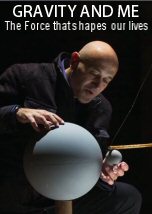
Professor Jim Al-Khalili investigates the amazing science of gravity. A fundamental force of nature, gravity shapes our entire universe. It sculpts galaxies and warps space and time. But gravity’s strange powers also affect our daily lives in the most unexpected ways. This is a story with surprises in store for Jim himself. In telling the story of gravity, his own understanding of the nature of reality comes to be challenged. Finally, Jim discovers that, despite incredible progress, gravity still has many secrets to unveil.
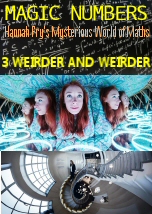
Dr Hannah Fry explores a paradox at the heart of modern maths, discovered by Bertrand Russell, which undermines the very foundations of logic that all of maths is built on. These flaws suggest that maths isn't a true part of the universe but might just be a human language - fallible and imprecise. However, Hannah argues that Einstein's theoretical equations, such as E=mc2 and his theory of general relativity, are so good at predicting the universe that they must be reflecting some basic structure in it. This idea is supported by Kurt Godel, who proved that there are parts of maths that we have to take on faith. Hannah then explores what maths can reveal about the fundamental building blocks of the universe - the subatomic, quantum world. The maths tells us that particles can exist in two states at once, and yet quantum physics is at the core of photosynthesis and therefore fundamental to most of life on earth - more evidence of discovering mathematical rules in nature. But if we accept that maths is part of the structure of the universe, there are two main problems: firstly, the two main theories that predict and describe the universe - quantum physics and general relativity - are actually incompatible; and secondly, most of the maths behind them suggests the likelihood of something even stranger - multiple universes. We may just have to accept that the world really is weirder than we thought, and Hannah concludes that while we have invented the language of maths, the structure behind it all is something we discover. And beyond that, it is the debate about the origins of maths that has had the most profound consequences: it has truly transformed the human experience, giving us powerful new number systems and an understanding that now underpins the modern world.
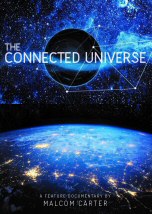
This fascinating journey of exploration of the connection of all things in the Universe is narrated by the legendary Sir Patrick Stewart. With the lens of science, the film reveals the mechanism linking everything in the cosmos.
Professor Jim Al-Khalili investigates the most accurate and yet perplexing scientific theory ever - quantum physics. At the beginning of the 20th century scientists were led into the hidden workings of matter, into the sub-atomic building blocks of the world around us. They discovered phenomena unlike any encountered before - a realm where things can be in many places at once, where chance and probability call the shots and where reality appears to only truly exist when we observe it. Albert Einstein hated the idea that nature, at its most fundamental level, is governed by chance. Jim reveals how, in the 1930s, Einstein thought he'd found a fatal flaw in quantum physics because it implies that sub-atomic particles can communicate faster than light in defiance of the theory of relativity. In the 1960s the scientist John Bell showed there was a way to test if Einstein was right and quantum mechanics was actually mistaken. Jim repeats this critical experiment - with shocking results.
On November 25th, 1915, Einstein published his greatest work: General Relativity. The theory transformed our understanding of nature’s laws and the entire history of the cosmos, reaching back to the origin of time itself. Now, in celebration of the 100th anniversary of Einstein’s achievement, discover the inside story of Einstein’s masterpiece". The story begins with the intuitive thought experiments that set Einstein off on his quest and traces the revolution in cosmology that is still playing out in today’s labs and observatories. Discover the simple but powerful ideas at the heart of relativity, illuminating the theory—and Einstein’s brilliance—as never before. From the first spark of an idea to the discovery of the expanding universe, the Big Bang, black holes, and dark energy, NOVA uncovers the inspired insights and brilliant breakthroughs of “the perfect theory.”












The two great theories of Einstein's General Relativity and Quantum Mechanics don't work together to explain Black Holes which is a big problem. Other theoretical constructs such as Gravastars and Planck stars have been postulated but proving their existence is just as difficult as that of Black Holes. So where next?