




Last Watched

"Isru"  Sort by

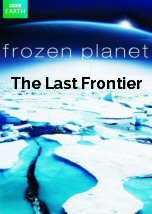
Frozen Planet: The Last Frontier

   2011    Culture
The documentary series reveals the extraordinary riches and wonders of the Polar Regions that have kept people visiting them for thousands of years. Today, their survival relies on a combination of ancient wisdom and cutting-edge science. Most Arctic people live in Siberia, either in cities like Norilsk - the coldest city on earth - or out on the tundra, where tribes like the Dogan survive by herding reindeer, using them to drag their homes behind them. On the coast, traditional people still hunt walrus from open boats - it is dangerous work, but one big walrus will feed a family for weeks. Settlers are drawn to the Arctic by its abundant minerals; the Danish Armed Forces maintain their claim to Greenland's mineral wealth with an epic dog sled patrol, covering 2,000 miles through the winter. Above, the spectacular northern lights can disrupt power supplies so scientists monitor it constantly, firing rockets into it to release a cloud of glowing smoke 100 kilometres high. In contrast, Antarctica is so remote and cold that it was only a century ago that the first people explored the continent. Captain Scott's hut still stands as a memorial to these men. Science is now the only significant human activity allowed; robot submarines are sent deep beneath the ice in search of new life-forms, which may also be found in a labyrinth of ice caves high up on an active volcano. Above, colossal balloons are launched into the purest air on earth to detect cosmic rays. At the South Pole there is a research base designed to withstand the world's most extreme winters. Cut off from the outside world for six months, the base is totally self-sufficient, even boasting a greenhouse.
Series: Frozen Planet
China Has a Plan

   2019    Technology
From fears about work and privacy to a rivalry between the U.S. and China, the series explores the promise and perils of AI. It traces a new industrial revolution that will reshape and disrupt our lives, our jobs and our world, and allow the emergence of the surveillance society.
Today, China leads the world in e-commerce and is a society that bypassed credit cards. Now shops in stores are without cashiers, where the currency is facial recognition. No country has ever moved that fast. And in a short two-and-a-half years, China's A.I. implementation really went from minimal amount to probably about 17 or 18 unicorns, that is, billion-dollar companies. The progress was powered by a new generation of ambitious young techs pouring out of Chinese universities, competing with each other for new ideas, and financed by a new cadre of Chinese venture capitalists.
Series: In the Age of AI

The Persistence of Memory

   1980    Science
The idea of intelligence is explored in the concepts of computers (using bits as their basic units of information), whales (in their songs and their disruptions by human activities), DNA, the human brain (the evolution of the brain stem, frontal lobes, neurons, cerebral hemispheres, and corpus callosum under the Triune Brain Model), and man-made structures for collective intelligence (cities, libraries, books, computers, and satellites). The episode ends with speculation on alien intelligence and the information conveyed on the Voyager Golden Record.
Series: Cosmos

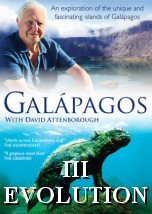
Evolution

   2013    Nature    3D    HD
No two islands in the Galapagos are the same. The imperceptible drift of a continental plate keeps each island biologically isolated. David Attenborough explores this evolutionary crucible, encountering tortoises that weigh up to half a tonne, finches that use tools and lizards that communicate using press-ups; for Darwin, this was all evidence for his theory of evolution. We see the final footage of the world famous tortoise fondly known as Lonesome George, the last survivor of his species. David Attenborough was the last person to have ever filmed with him. Darwin’s famous visit had a downside – the arrival of man. David investigates the impact we’ve had in these islands, as our influence is a double-edged sword. We’ve disrupted the natural balance but he also believes Darwin would be thrilled with the advances we have made in science. We’re also now uncovering evidence that evolution is more rapid than Darwin could ever have imagined. Whatever wonders the Galapagos Islands hold today, they are only a hint of what awaits them in the future.
Series: Galapagos with David Attenborough

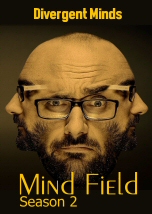
Divergent Minds

   2018    Medicine
Autistic minds provide windows into how we all think, feel, and behave. A complete brain science should be able to account for all kinds of minds and brains. As long as some minds remain a mystery, so too will all minds.
Michael Stevens travels to London to meet a blind, autistic savant with astonishing musical abilities, and volunteers to have his brain's function temporarily disrupted at UCLA's Neuromodulation Lab.
Series: Mind Field Season 2

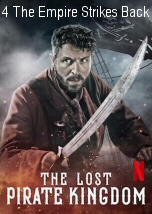
The Empire Strikes Back

   2021    History
In 1717, the seas of the Caribbean are ruled by the Flying Gang: Black Sam Bellamy, Edward Thatch and Benjamin Hornigold. From their base in the Bahamas, these pirates steal a fortune from the wealthiest empires in Europe and disrupt the lucrative slave trade. English authorities tap Woodes Rogers to put a stop to the pirate attacks. He is on a mission to destroy the Flying Gang of the Caribbean.
Series: The Lost Pirate Kingdom
Inside the Medieval Mind

Inside the Medieval Mind

2008  History
Racism: A History

Racism: A History

2007  Culture
In the Age of AI

In the Age of AI

2019  Technology
The Last Dance

The Last Dance

2020  Culture
The Wehrmacht

The Wehrmacht

2007  History
The Germanic Tribes

The Germanic Tribes

2007  History