










Last Watched

"Africa"  Sort by

Last Human Standing

   2010    History
xamines the fate of the Neanderthals, our European cousins who died out as modern humans spread from Africa into Europe during the Ice Age. Did modern humans interbreed with Neanderthals or exterminate them? The program explores crucial evidence from the recent decoding of the Neanderthal genome. How did modern humans take over the world? New evidence suggests that they left Africa and colonized the rest of the globe far earlier, and for different reasons, than previously thought. As for Homo sapiens, we have planet Earth to ourselves today, but that's a very recent and unusual situation. For millions of years, many kinds of hominids co-existed. At one time Homo sapiens shared the planet with Neanderthals, Homo erectus, and the mysterious "Hobbits"–three-foot-high humans who thrived on the Indonesian island of Flores until as recently as 12,000 years ago. "Last Human Standing" examines why "we" survived while those other ancestral cousins died out. And it explores the provocative question: In what ways are we still evolving today?
Series: Becoming Human

A Savage Legacy

       History
Examines the impact of racism in the 20th century. By 1900 European colonial expansion had reached deep into the heart of Africa. Under the rule of King Leopold II, the Belgian Congo was turned into a vast rubber plantation. Men, women and children who failed to gather their latex quotas would have their limbs dismembered. The country became the scene of one of the century's greatest racial genocides, as an estimated 10 million Africans perished under colonial rule.
Series: Racism: A History

Sahara

   2012    Nature
Northern Africa is home to the greatest desert on Earth, the Sahara. On the fringes, huge zebras battle over dwindling resources and naked mole rats avoid the heat by living a bizarre underground existence. Within the desert, where the sand dunes 'sing', camels seek out water with the help of their herders and tiny swallows navigate across thousands of square miles to find a solitary oasis. This is a story of an apocalypse and how, when nature is overrun, some are forced to flee, some endure, but a few seize the opportunity to establish a new order.
Series: Africa with David Attenborough

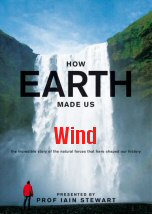
Wind

   2010    Science
Iain sets sail on one of the fastest racing boats ever built to explore the story of our turbulent relationship with the wind. Travelling to iconic locations including the Sahara desert, the coast of West Africa and the South Pacific, Iain discovers how people have exploited the power of the wind for thousands of years. The wind is a force which at first sight appears chaotic. But the patterns that lie within the atmosphere have shaped the destiny of continents, and lie at the heart of some of the greatest turning points in human history.
Series: How Earth Made Us

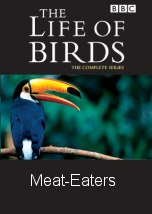
Meat-Eaters

   1998    Nature
This episode examines those birds whose sustenance comes from flesh and their methods of hunting. In New Zealand, Sir Attenborough observes Keas, parrots that do not eat meat exclusively, raiding a shearwater's burrow for a chick. However, it is the dedicated birds of prey, such as owls, buzzards, eagles, falcons and vultures, to which much of the programme is devoted. In order to spot and pursue their victims, senses of sight and hearing are very acute. Vultures are the exception, in that they eat what others have left, and once a carcass is found, so many birds descend on it that the carrion seems submerged beneath them. The Turkey Vulture is an anomaly within its group, as it also has a keen sense of smell. Eagles defend their territory vigorously, and a pair of sea eagles are shown engaging in an aerial battle. The Galápagos Hawk hunts Marine Iguanas, but can only do so when its quarry is vulnerable, during the breeding season. The African Harrier Hawk has adapted to extracting burrowing animals by virtue of an especially long, double-jointed pair of legs. By contrast, a shrike is not equipped with the requisite sharp beak and talons needed for butchery, and so dismembers its kill by impaling it on the thorns of acacias. The Lammergeier eats bones, and will drop them on to rocks from a great height in order to break them down to a digestible size. Also featured are the Eurasian Sparrowhawk, Goshawk and Peregrine Falcon.
Series: The Life of Birds

Mormon Lost Boys

   2013    Culture
'Mormon Lost Boys' Young men have been thrown out of their homes because of an edict allowing polygamist church elders to monopolize young girls. 'The Fat Farms of Mauritania' In the West African country of Mauritania, parents send their daughters to rural fattening camps. 'Mumbai Slumscraper' A visit to Mumbai, where slums sit below billion-dollar, single-family skyscrapers.
Series: Vice
The Crusades

The Crusades

2012  History
Cosmos: Possible Worlds

Cosmos: Possible Worlds

2020  Science
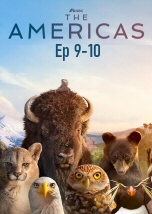
The Americas

The Americas

2026  Nature
Love On The Spectrum

Love On The Spectrum

2019  Culture
Maps of Power

Maps of Power

2026  History