
Last Watched

"Creation"  Sort by

What are We Really Made of

   2011    Science
What is the universe made of? If you answered stars, planets, gas and dust, you'd be dead wrong. Thirty years ago, scientists first realized that some unknown dark substance was affecting the way galaxies moved. Today, they think there must be five times our understanding of the universe and the nature of reality itself has drastically changed over the last 100 years - and it's on the verge of another seismic shift. In a 17-mile-long tunnel buried 570 feet beneath the Franco-Swiss border, the world's largest and most powerful atom smasher, the Large Hadron Collider, is powering up. Its goal is nothing less than recreating the first instants of creation, when the universe was unimaginably hot and long-extinct forms of matter sizzled and cooled into stars, planets, and ultimately, us. These incredibly small and exotic particles hold the keys to the greatest mysteries of the universe. What we find could validate our long-held theories about how the world works and what we are made of -- or, all of our notions about the essence of what is real will fall apart.
Series: Through the Wormhole
The Spark of Life

       Science
The final part reveals how our knowledge of cells has brought us to the brink of one of the most important moments in history. Scientists are close to repeating what has happened only once in four billion years - the creation of a new life form.
Series: The Cell

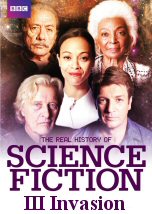
Invasion

   2014    Art
What if aliens landed on Earth? Much of science fiction explores the moment of first contact – what will people do when the aliens land? From H. G. Wells’ pioneering The War of the Worlds to Independence Day, Men in Black, and District 9, Invasion deals with our fears of alien invasions of earth. David Tennant explains the appeal of Doctor Who’s Daleks and Cybermen while John Carpenter and Chris Carter explore the rich appeal of the paranoia fuelled by hidden aliens with The Thing and The X-Files. It also asks, what if the monsters were our own creation? With the aid of rarely seen animation tests, Phil Tippett takes us behind the scenes in the creation of the dinosaurs of Jurassic Park. But not all invasions are hostile. Peter Coyote and Richard Dreyfuss discuss the creation of Spielberg’s spellbinding classics E.T. the Extra-Terrestrial and Close Encounters of the Third Kind. There is more than one kind of invasion.
Series: The Real History of Science Fiction

Smashing the Mould

   2009    Art
The final part examines political revolution and how art was at the forefront of throwing out 1,000 years of royal rule, from its earliest revolutionary days of enthusiasm and optimism when painting died, the poster was king and the machine-made triumphed over the handmade to the dead hand of Socialist Realism. Andrew roots out great portraits of Stalin now hidden in museum storerooms and never on public view, looks at the transformation of the Moscow metro into a great public art gallery and visits the most stunning creation of post-war Communist rule, the Space Monument. Finally, he comes to the confusion and chaos of Russia today and how it is producing some of the world's strangest art - from heroic sculptures of Russian leader Vladimir Putin to the insides of a giant erotic apple; from the recreation of the Imperial royal family facing the firing squad to sculpture in liquid oil; from Russia's embrace of the commercial art market to a return to Socialist Realism. Russia seems to stand on another brink of revolution.
Series: The Art of Russia

Extreme Orbits - Clockwork and Creation

   2012    Science
Orbits are the dynamics that drive the universe. From the smallest asteroid to the largest super-cluster, everything in the universe is in orbit. We owe our very existence to the stability of earth's orbit — it gave us life and keeps us safe. But we are the freaks. Everywhere else we look we find orbits are chaotic, unstable, and violent. Beyond our solar system we find planets that are blow-torched, stars that eat each other, and black holes that destroy everything in their path. Yet on the very largest scale, orbits are also a creative force. clashing galaxies give birth to new stars and new worlds. on the galactic scale orbits even construct the fabric of the universe itself.
Series: How the Universe Works

Cosmic Dawn: The Real Moment of Creation

   2015    Science
Forget the Big Bang. The real moment of creation was the Cosmic Dawn - the moment of first light. It's the moment the first stars were born, the moment that lit up the Universe, and made the first structure and the first ingredients of life. This is the scientific version of the story of Genesis. The Big Bang gets all the credit for creating our universe. But in fact, the universe it gave was dark and boring. There were no stars, no galaxies, just a vast, black fog of gas - the cosmic dark ages". But, after a hundred million years of nothing, came a dramatic moment of transformation - the Cosmic Dawn. Astronomers are now trying to witness this cosmic dawn. For the first time they have the tools to explore the very first stars of the universe and to tell the scientific story of our creation.
Top Gear

Top Gear

2012  Technology
The Last Czars

The Last Czars

2019  History
Desert War

Desert War

  History
Clash of the Gods

Clash of the Gods

2009  History
Capitalism A Love Story

Capitalism A Love Story

2009  Culture
The Big Conn

The Big Conn

2022  Culture
Human Universe

Human Universe

2014  History