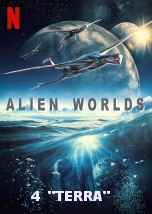
What sort of alien civilizations might exist in the vastness of space? Terra is the fictional world imagined in Episode 4, a planet nine billion years old, twice as old as Earth. Old enough that a truly advanced intelligence could evolve. It was once a fertile world, now it is barren. But life can still thrive here in artificial domes. Over time, they've evolved not to need their bodies. They exist only as neural tissue. They never age, they never die. They're monitored and maintained by robots. If alien civilizations are statistically so likely, why haven't astronomers found any sign of them? Where is everyone? Every time we look at an individual star, that's like dropping a bucket in the ocean. We're going to have to look at a lot of stars and to search through a lot of data until we find the clue that leads us to another civilization.
The world's deserts are lands of extremes that force animals to come up with ingenious ways of coping with hostile conditions, giving rise to the most incredible survival stories on earth. A pride of desert lions are so hungry they risk hunting a giraffe several times their size, while male sandgrouse fly 120 miles each day to the nearest waterhole and dice with death to collect water for their chicks. Filmed for the first time, a tiny bat does battle with one of the world's deadliest scorpions, and in Madagascar, a locust swarm of biblical proportions is seen as never before.
Rasputin is gone, but Nicholas II continues his catastrophic policies in war and at home. When Nicholas goes back to military headquarters, he is in fact leaving control of government, exactly when Russia needed to be held together by its Czar. The war by this time is deeply unpopular. It's not only unpopular, it's also arguably the engine that's causing enormous economic crisis, that's causing general unrest. Deprivation pushes the population from unrest to revolution.
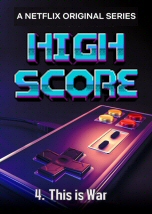
Nintendo was like an impossibly huge wall. But if Mario was the undisputed king, an underdog was about to declare war. For Japanese game maker Sega, mainly known for its arcade cabinets, the battle was about winning the home console market. Sega's Genesis console and its speedy character, Sonic, hit the market. In the early '80s, sports video games existed, but they didn't really look real. And one visionary entrepreneur had already started tackling the challenge of taking sports from the stadium onto the screen. Electronic Arts kicks off a partnership with football legend John Madden.
Without the chemistry of photosynthesis, ozone, and a molecule called Rubisco, none of us would be here. So how did we get so lucky? To find out, host David Pogue investigates the surprising molecules that allowed life on Earth to begin, and ultimately thrive. Along the way, he finds out what we’re all made of—literally.



















If alien civilizations are statistically so likely, why haven't astronomers found any sign of them? Where is everyone? Every time we look at an individual star, that's like dropping a bucket in the ocean. We're going to have to look at a lot of stars and to search through a lot of data until we find the clue that leads us to another civilization.