




Last Watched

"NES"  Sort by

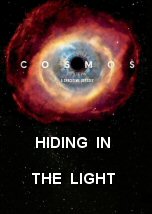
Hiding in the Light

   2014    Science
This episode explores the wave theory of light as studied by mankind, noting that light has played an important role in scientific progress, with such early experiments from over 2000 years ago involving the camera obscura by the Chinese philosopher Mozi. Tyson describes the work of the 11th century Arabic scientist Ibn al-Haytham, considered to be one of the first to postulate on the nature of light and optics leading to the concept of the telescope, as well as one of the first researchers to use the scientific method. Tyson proceeds to discuss the nature of light as discovered by mankind. Work by Isaac Newton using diffraction through prisms demonstrated that light was composed of the visible spectrum, while findings of William Herschel in the 19th century showed that light also consisted of infrared rays. Joseph von Fraunhofer would later come to discover that by magnifying the spectrum of visible light, gaps in the spectrum would be observed. These Fraunhofer lines would later be determined to be caused by the absorption of light by electrons in moving between atomic orbitals when it passed through atoms, with each atom having a characteristic signature due to the quantum nature of these orbitals. This since has led to the core of astronomical spectroscopy, allowing astronomers to make observations about the composition of stars, planets, and other stellar features through the spectral lines, as well as observing the motion and expansion of the universe, and the existence of dark matter.
Series: Cosmos: A Spacetime Odyssey
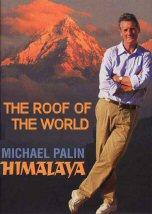
The Roof of the World

   2004    Culture
Leaving Everest base camp to take the high road to Lhasa to see what the Chinese have done to Tibet. He sees that religion is once again tolerated, while the old Tibetan centre of the city is being replaced with modern Chinese shopping malls and nightclubs. Following the pilgrims to the holy Namtso Lake, he gets warm in a hot spring before learning how to milk a yak with a nomad family.
Series: Himalaya with Michael Palin

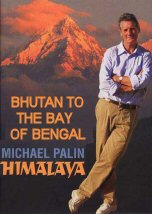
Bhutan to the Bay of Bengal

   2004    Culture
In Bhutan, Palin finds himself back in the land of yaks for a last look at the high Himalaya. Trekking to Chomolhari base camp he meets a nomad with a penchant for yak songs before heading down to Paro to witness the Buddhist festival or Tsechu. In a bar in Thimphu, he discusses reincarnation and the pursuit of happiness with Benji and Khendum, two of the king's cousins, and en route to Bangladesh is taken by Benji to see the rare black-neck cranes. On his journey south through Bangladesh, Michael visits the ship-breaking beaches of Chittagong and grid-locked Dhaka. He meets a man who made a fortune in Birmingham in the poultry business, and a woman who lends money only to women. On a 1920s paddle steamer he is serenaded with the words of Bengal's Shakespeare, and he completes his epic Himalayan journey aboard a fishing boat that carries him out into the Bay of Bengal and a westering sun.
Series: Himalaya with Michael Palin

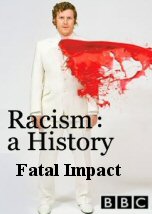
Fatal Impact

   2007    Culture
This episode examines the idea of scientific racism, an ideology invented during the 19th century that drew on now discredited practices such as phrenology and provided an ideological justification for racism and slavery. The episode shows how these theories ultimately led to eugenics and Nazi racial policies of the master race.
Series: Racism: A History

A Savage Legacy

       History
Examines the impact of racism in the 20th century. By 1900 European colonial expansion had reached deep into the heart of Africa. Under the rule of King Leopold II, the Belgian Congo was turned into a vast rubber plantation. Men, women and children who failed to gather their latex quotas would have their limbs dismembered. The country became the scene of one of the century's greatest racial genocides, as an estimated 10 million Africans perished under colonial rule.
Series: Racism: A History

Unafraid of the Dark

   2014    Science
Tyson describes the discovery of cosmic rays by Victor Hess through high-altitude balloon trips. Swiss Astronomer Fritz Zwicky, in studying supernovae, postulated that these cosmic rays originated from these events instead of electromagnetic radiation. Also tells how Vera Rubin observed that the rotation of stars at the edges of observable galaxies did not follow expected rotational behavior leading to consider the existence of dark matter. This further led to the discovery of dark energy to account for the increasing rate of expansion of the universe. Tyson then describes the interstellar travel of the two Voyager probes. Tyson tells the Carl Sagan's role in the Voyager program, including creating the Voyager Golden Record to encapsulate humanity and Earth's position in the universe. Tyson concludes the series by emphasizing Sagan's message on the human condition in the vastness of the cosmos, and to encourage viewers to continue to explore and discover what else the universe has to offer.
Series: Cosmos: A Spacetime Odyssey
Leaving Neverland

Leaving Neverland

2019  Culture
In Search of

In Search of

2018  Technology
Dirty Money

Dirty Money

2018  Culture
Planet Dinosaur

Planet Dinosaur

2011  Science
Black Hole Apocalypse

Black Hole Apocalypse

2018  Science
Warrior Graveyard

Warrior Graveyard

  History
Life on Our Planet

Life on Our Planet

2023  Science