






Last Watched

"Sly"  Sort by

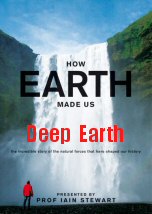
Deep Earth

   2010    Science
Our planet has amazing power, and yet that's rarely mentioned in our history books. This series tells the story of how the Earth has influenced human history, from the dawn of civilisation to the modern industrial age. It reveals how geology, geography and climate have been a far more powerful influence on the human story than has previously been acknowledged. A combination of epic story telling, visually stunning camerawork, extraordinary locations and passionate presenting combine to form a highly original version of human history" In the first episode professor Iain Stewart explores the relationship between the deep Earth and the development of human civilisation. He visits an extraordinary crystal cave in Mexico, drops down a hole in the Iranian desert and crawls through seven-thousand-year-old tunnels in Israel. His exploration reveals that throughout history, our ancestors were strangely drawn to fault lines, areas which connect the surface with the deep interior of the planet. These fault lines gave access to important resources, but also brought with them great danger.
Series: How Earth Made Us
Is Everything We Know about the Universe Wrong

   2010    Science
There's something very odd going on in space - something that shouldn't be possible. It is as though vast swathes of the universe are being hoovered up by a vast and unseen celestial vacuum cleaner. Sasha Kaslinsky, the scientist who discovered the phenomenon, is understandably nervous: 'It left us quite unsettled and jittery' he says, 'because this is not something we planned to find'. The accidental discovery of what is ominously being called 'dark flow' not only has implications for the destinies of large numbers of galaxies - it also means that large numbers of scientists might have to find a new way of understanding the universe. Dark flow is the latest in a long line of phenomena that have threatened to rewrite the textbooks. Does it herald a new era of understanding, or does it simply mean that everything we know about the universe is wrong?

Goya: Crazy Like A Genius

   2007    Art
Written and presented by Robert Hughes, one of the world’s most prominent art commentators, this program explores the life and work of Francisco Goya—focusing on the painter’s subversive, often gruesome outlook. The video provides in-depth visual and intellectual analysis of dark Goya masterpieces, including The Dream of Reason, Witches in the Air, and The Third of May, as well as examples of his portraiture and early work—such as The Duchess of Alba, both Majas, and a gratuitously violent tapestry painting. Links between Goya’s work, deafness, and political stance are explored in detail, while observations from painter Leon Golub highlight Goya’s continuing relevance.

Science Britannica: Frankenstein Monsters

   2013    Culture
Professor Brian Cox grapples with science's darker side, asking why, when science has done so much for us, it often gets such a bad press. Starting with the original Frankenstein - the grisly 19th century tale of George Foster's hanging and subsequent 'electrocution', Brian confronts the idea that science can go 'too far'. From the nuclear bomb to genetic modification, British science has always been at the cutting edge of discovery, but are British scientists feckless meddlers, or misunderstood visionaries whose gifts to humanity are corrupted by the unscrupulous?

Death Of The Universe

   2008    Science
While scientists have previously theorised about a “Big Crunch” where the universe retracts back to its original size, the discovery of Dark Matter and Dark Energy has placed that hypothesis on the backburner. Some astronomers now believe that if Dark Matter offsets Dark Energy then as the universe slowly expands, stars will gradually fade, running out of fuel and leading to a dark, cold and lifeless universe. Others hypothesise a much more violent end where Dark Energy continues to expand the universe at a greater and greater speed. Stronger than gravity, Dark Energy would pull apart everything down to the fundamental particles – the universe’s very fibres. While the universe’s end may be 50 billion years away, great leaps in science will continue to alter how we believe the universe was formed – and how it will end.

Genesis. Where Are We Coming From

   2005    Nature
The cycle of life of a handful of different animals is captured on film in a whole new way in this documentary. Using special motion-control photography equipment, Genesis allows filmgoers to view animal behaviors which are too small, too slow, or too difficult to normally be seen with the naked eye, including a chick hatching its way out from inside an egg, jellyfish drying into nothing under the heat of the sun, or a snake slowly swallowing prey bigger than itself. This footage is accompanied by narration from Sotigui Kouyate, who uses simple props and easily understandable analogies to explain the science behind what its shown on screen. Genesis was directed by Claude Nuridsany and Marie Perennou, who previously created another acclaimed scientific documentary, Microcosmos.
Unknown

Unknown

2023  Science
Ancient Apocalypse

Ancient Apocalypse

2024  History
Vikings Season 2

Vikings Season 2

2014  History
The Story of India

The Story of India

2007  History
Marilyn and the Mob

Marilyn and the Mob

2026  History
Mourinho

Mourinho

2026  History