


Last Watched

"NES"  Sort by

The Last Dance Episode VI

   2020    History
Sam Smith's book 'The Jordan Rules' exposes the darker side of Michael Jordan's competitiveness, and questions arise about whether he has a serious gambling problem, but he remains focused on winning a new title in 1993. Dealing with the pitfalls of fame and attempting to complete the first three-peat leave Jordan increasingly exhausted and isolated.
Series: The Last Dance

Austin

   2014    Art
Foo Fighters prepare to record at the Austin City Limits Studio, with blues guitarist Gary Clark, Jr. In this episode is examined the roots of Austin's music scene, with interviews featuring Billy Gibbons from ZZ Top, and Roky Erickson from 13th Floor Elevators, who is considered one of the American fathers of psychedelic rock. Dave also chats with Terry Lickona, the executive producer of Austin City Limits. The song 'What Did I Do? / God As My Witness' is recorded during this chapter.
Series: Sonic Highways

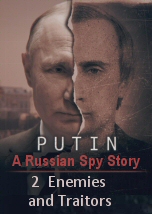
Enemies And Traitors

   2020    History
This second instalment looks at how Vladimir Putin arrived in the Kremlin as a vulnerable and unknown president, whom the Russian oligarchs expect to control. The programme reveals how he asserted his hold on power and ultimately surrounded himself with his KGB peers, as well as his philosophy as regards traitors and enemies. The film also examines the stories of businessman Boris Berezovsky and defector Alexander Litvinenko, who both stood up to Putin and wound up dead on British soil.
Series: Putin: A Russian Spy Story

New York

   2014    Art
The last episode of the series talks about the most important city in the States. Stories that go from the early 40s until today. Interviews with Rick Rubin, Emmylou, Chris Martin, LL Cool J and Barack Obama. And a real statement about what is happening with the studios business nowadays. The song 'I Am A River' is recorded during this episode.
Series: Sonic Highways

Words on a Page

   2020    History
Writing itself is 5,000 years old, and for most of that time words were written by hand using a variety of tools. The Romans were able to run an empire thanks to documents written on papyrus. Scroll books could be made quite cheaply and, as a result, ancient Rome had a thriving written culture. With the fall of the Roman Empire, papyrus became more difficult to obtain. Europeans were forced to turn to a much more expensive surface on which to write: Parchment. Medieval handwritten books could cost as much as a house, they also represent a limitation on literacy and scholarship.
No such limitations were felt in China, where paper had been invented in the second century. Paper was the foundation of Chinese culture and power, and for centuries how to make it was kept secret. When the secret was out, paper mills soon sprang up across central Asia. The result was an intellectual flourishing known as the Islamic Golden Age. Muslim scholars made discoveries in biology, geology, astronomy and mathematics. By contrast, Europe was an intellectual backwater.
That changed with Gutenberg’s development of movable type printing. The letters of the Latin alphabet have very simple block-like shapes, which made it relatively simple to turn them into type pieces. When printers tried to use movable type to print Arabic texts, they found themselves hampered by the cursive nature of Arabic writing. The success of movable type printing in Europe led to a thousand-fold increase in the availability of information, which produced an explosion of ideas that led directly to the European Scientific Revolution and the Industrial Revolution that followed.
Series: The Secret History of Writing

Changing the Script

   2020    History
The written word is so important in everyday life that there can be few more radical acts than forcing an entire nation to learn a new script. Yet that is what happened in Turkey in 1928 when Mustafa Kemal decreed that the Arabic script would be replaced by the letters of the Latin alphabet. Communication with computers using human language is usually made with Latin letters. This is how most Chinese people interact with their computers and smart phones, using a Latin-based phonetic script called Pinyin. As a result, even highly educated Chinese are losing the ability to write using Chinese characters. Could what is happening in China be the future of writing everywhere?
Series: The Secret History of Writing
Natural World

Natural World

2017  Nature
Bronze Age

Bronze Age

2016  History
Top Gear

Top Gear

2012  Technology
The Last Czars

The Last Czars

2019  History
Planet Dinosaur

Planet Dinosaur

2011  Science
Prehistoric America

Prehistoric America

2003  Nature