


Last Watched

"Han"  Sort by

Pluto and Beyond

   2011    Science
Pluto is one of the Smaller than our own Moon, Pluto has never had a single visitor from Earth - until now. We keep saying, 'This is it, this is humanity's trip to Pluto. For the first time in human history, Pluto is about to be revealed. We can expect surprises, it's almost guaranteed. Until then, we can only guess what Pluto looks like. And recently, astronomers decided not to call it a planet any more. Once thought to be an isolated oddity, Pluto now marks the beginning of a whole new frontier. it's as if the explorers had climbed up to the top of the Rockies and were looking over and could see the lands of California on the other side. There has never been a better time to venture where no human has gone before. To follow in the footsteps of our robot pioneers and explore beyond the planets of our Solar System.
Series: A Traveler Guide to the Planets
Victory and Defeat

   2012    History
Dr. Thomas Asbridge explains how in the thirteenth century, after almost two hundred years of Holy Wars, the titanic conflict between Christianity and Islam, known to history as The Crusades, reached a decisive and shocking conclusion – a chapter that despite its drama has been virtually forgotten. He explains how, in the end, the fate of the Holy Land was decided not on the hallowed ground of Jerusalem, but in Egypt; and how the ultimate outcome of the Crusades was dictated not by Christians, but by the Mongol successors to Genghis Khan, and by a Muslim slave – a fearsome warrior whose story is now all but lost to western history.
Series: The Crusades

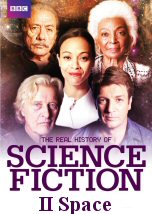
Space

   2014    Art
What if we could explore the vastness of Space? Science fiction has always fed upon our need to explore – to wonder what is out there. Space journeys from Jules Verne’s earliest ideas about attempts to leave our planet, to the Star Wars far away galaxy through to Nichelle Nichols revealing how her groundbreaking role as Lt. Uhura in Star Trek led to her participation in the recruitment of NASA’s astronauts. It explores the deep sea inspiration for Avatar, finds out why Ursula K Le Guin wrote The Left Hand of Darkness and discovers how Stanley Kubrick was able to make 2001: A Space Odyssey seem so believable. In addition, the program looks at the way Dune and The Mars Trilogy embraced the challenge of world building and discusses the appeal of the beaten up ‘dirty space’ of Dark Star and Firefly. From the horrifying scenes of Alien, to the epic spectacle of Star Wars, this is a journey to the stars and the alien encounters that await us there.
Series: The Real History of Science Fiction

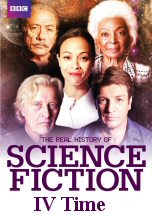
Time

   2014    Art
What if we could travel not just through space, but through time itself? If you could travel through time, would you change the past or the future? What if you found it couldn’t be changed? What price does the time traveller -- and the people they are closest to -- pay? This is a journey from H. G. Wells' The Time Machine through ideas like The Grandfather Paradox and The Butterfly Effect to the professional time traveller that is the ever popular Doctor Who. Steven Moffat, David Tennant, Karen Gillan, and Neil Gaiman offer a unique perspective on the Doctor. Edward James Olmos reveals the hidden meaning of the language he created for the vision of the future that is Blade Runner. Bob Gale and Christopher Lloyd take us behind the scenes of Back to the Future, while Ed Solomon describes the joy of solving a time travel conundrum for Bill & Ted’s Excellent Adventure. But what would be the physical and emotional cost to the time traveller? Audrey Niffenegger explains what inspired her novel The Time Traveller’s Wife. And what if someone from the future tried to travel back in time to warn us? Would we believe them? From the apocalyptic tones of 12 Monkeys to the drama of Quantum Leap and the comedy of Groundhog Day, time travel is a subject that has been irresistible to the creators of every type of science fiction.
Series: The Real History of Science Fiction

Building the Sun The 250 Million Degree Problem

   2017    Technology
Scientists investigate the way the Sun builds its power -- through fusion -- hoping to find a way to use fusion as a less dangerous and less radioactive waste-producing path to energy than fission. But there are some major difficulties along the way. Fusion really is the perfect way to make energy. We have millions of years worth of fuel. It produces no long-lived radioactive waste. If we can solve the engineering challenges, energy will become cheaper, more available for everybody.
Series: Catalyst

Catholicism The unpredictable rise of Rome

   2011    Culture
Over one billion Christians look to Rome, more than half of all Christians on the planet. But how did a small Jewish sect from the backwoods of 1st-century Palestine, which preached humility and the virtue of poverty, become the established religion of western Europe - wealthy, powerful and expecting unfailing obedience from the faithful? Amongst the surprising revelations, Professor MacCulloch tells how confession was invented by monks on a remote island off the coast of Ireland, and how the Crusades gave Britain the university system. Above all, it is a story of what can be achieved when you have friends in high places.
Series: A History of Christianity
Leaving Neverland

Leaving Neverland

2019  Culture
Secrets of the Bees

Secrets of the Bees

2026  Nature
The Toys that Made Us

The Toys that Made Us

2017  Technology
Out of the Cradle

Out of the Cradle

2019  History
Chemistry

Chemistry

2010  Science
Conquest of the Skies

Conquest of the Skies

2015  Nature