Episode three explores the mind of one of the most fanatical of all Nazis and the insight that gives into the psychology of dictatorship. Hess is brought to Nuremberg from the UK where he had flown 4 years earlier much to the bemusement of the British. Overy explains that they must have quickly realised he was not normal. In the intervening time Hess’s mental state has further deteriorated and when interviewed by Chief Interrogator Colonel John Amen proclaims amnesia. Chief Interpreter Richard Sonnenfeldt explains that they brought in Göring to confront Hess but that he too failed to make an impression. Psychopathologist Prof. Edgar Jones proposes Hess’s behaviour patterns may be his way of escaping reality as he is forced to face the extent of the atrocities and choose between accepting his part of the blame or forsaking his Führer. However, as history Professor Robert Gellatel explains it is difficult to construct a case against Hess as he was imprisoned in England when the worst of the atrocities were carried out so British Prosecutor Mervyn Griffith-Jones must argue a conspiracy charge linking the pre-1939 persecutions to the post-1939 atrocities and a crimes against peace charge proving the flight to Scotland was merely a ruse.
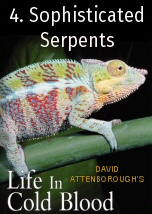
David Attenborough reveals the fascinating lives of snakes, the most misunderstood group of reptiles. A CCTV stakeout of wild rattlesnakes hunting shows, for the first time, what sophisticated predators they truly are. Attenborough is also on the receiving end of a spitting cobra's chemical weapons system, while the surprisingly beautiful and tender side of snakes is displayed in the sinuous courtship of kingsnakes, and the water birth of 15 beautiful yellow anaconda babies.
Dr Janina Ramirez shows how medieval manuscripts gave power to the king and united the kingdom in an age of plague, warfare and rebellion, discovers that Edward III used the manuscripts he read as a boy to prepare him for his great victory at the battle of Crecy and reveals how a vigorous new national identity bloomed during the 100 Years War with France. In the British Library's Royal Manuscripts collection Dr Ramirez finds out that magnificent manuscripts like the Bedford Hours, taken as war booty from the French royal family, were adapted for the education of English princes. She also explores how knowledge spread through a new form of book - the encyclopaedia.
The story of the British Library's Royal Manuscripts collection reaches its end with the last great flowering of illumination, in the magnificent courts of the Tudors. Dr Janina Ramirez investigates astrological texts created for Henry VII, and unwraps his will - still in its original, extravagantly-decorated velvet and gold cover. She hears music written for Henry VIII, which went unperformed for centuries; and reads love notes between the king and Anne Boleyn, written in the margins of a prayer book. Nina also visits Bruges, the source of many of the greatest manuscripts, where this medieval art form collided with the artistic innovations of the Renaissance.
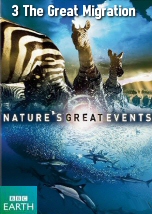
Each year more than one million wildebeest and zebra invade the Serengeti grasslands, making it a paradise for the predators that live there. But what happens when the herds move off again? We follow the moving story of one lion family's struggle to survive until the return of the great migration. Nature's Great Events tells the story of the epic trek of herds that follow the rains to fresh pastures, and the tale of the predators they leave behind. The crew captures the desperate plight of a single pride of lions, revealing a different side to the Serengeti. Rather than being a predators' paradise, it is a land in constant change, with wildebeest following the rains and leaving the lions to tough it out. The Ntudu pride has seven cubs, and is already suffering as the wildebeest leave to find fresh pastures. The four pride females struggle to find enough food for their hungry offspring. As weeks turn to months, the pride members become more emaciated and frailer, and the number of cubs dwindles to just two. As the herds begin to return, the plains reveal one final secret. For the first time since 1967 the Serengeti's only active volcano, Ol Doinyo Lengai, begins to billow ash and smoke. Filmed from the air, the team captures the exciting action. Fertilised by the volcanic ash over millions of years, these short grass plains are among the most productive grasslands in the world. After months of hardship, the pride's tragic story, through sickness, drought and fire, is over as the herds return, providing plentiful food.
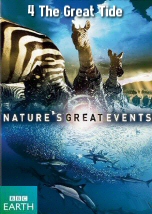
A mighty army of dolphins, sharks, whales, seals and gannets hunt down the billions of sardines along South Africa's east coast each winter. This is the Sardine Run: an underwater Armageddon, the greatest gathering of predators anywhere on the planet, and the most spectacular event in the world's oceans. From intimate moments of the creatures caught up in the run, to the dramatic finale of this spectacular event, The Great Tide is an action-packed feeding-frenzy, filmed underwater, on the ocean's surface, and in the air. However, in recent years the sardine run has become less predictable, perhaps due to the warming effects of climate change. If the sardine run does not happen, the lives of the animals caught up in the drama hang in the balance. Pioneering a unique boat stabilised camera mount for surface filming, Nature's Great Events crew capture all the high octane action as the predators compete for sardines, filmed with aerial, underwater and above water cameras. Super slow motion cameras also capture the very moment gannets plunge into the water, hitting it at sixty miles an hour. A violent winter storm is the trigger for the sardines to begin their desperate dash. They are followed by a super-pod of 5,000 dolphins and further up the coast more predators gather. A shoal of sardines 15 miles long is pushed into the shallows and aerial shots show thousands of sharks gathering to feed on them. The climax to the sardine run is a spectacular feeding frenzy as the dolphins round the sardines up into balls on which all the predators feast. Gannets rain down in their thousands, sharks pile in scattering the fish and a Bryde's whale lunges in taking great mouthfuls of sardines.







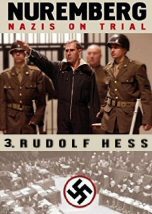






Psychopathologist Prof. Edgar Jones proposes Hess’s behaviour patterns may be his way of escaping reality as he is forced to face the extent of the atrocities and choose between accepting his part of the blame or forsaking his Führer. However, as history Professor Robert Gellatel explains it is difficult to construct a case against Hess as he was imprisoned in England when the worst of the atrocities were carried out so British Prosecutor Mervyn Griffith-Jones must argue a conspiracy charge linking the pre-1939 persecutions to the post-1939 atrocities and a crimes against peace charge proving the flight to Scotland was merely a ruse.