Quinto sets out to discover whether aliens exist and what evidence we have to prove it. He meets with several who say they have encountered extra-terrestrial life–a man who has been abducted by aliens several times since childhood; a man who claims to have extracted an alien implant; and a woman who shows Zachary what it feels like to be abducted into a spacecraft. Zachary also meets with the world's leading scientists at SETI in Green Banks, West Virginia. There, utilizing the world's largest telescope, they show him the methods they employ to communicate with potential other-worldly visitors and what this research has taught them about a mysterious radio signal they picked up 3 billion light years away.
Moral psychology isn't always an easy thing to study. Experiments that actually puts people in what feels like a real scenario may get realistic results, but researchers must always balance the benefits of what we could learn with the safety and well-being of the people they study. Often what we learn from moral psychology experiments doesn't make humans look good. We are imperfect creatures. But the more we learn about why and how we make the moral choices that we do, the better we'll be able to tackle difficult questions in the future.
We're going to see if forcing your facial expression can change the way you feel. If you remove the ability to make facial expressions with botox, will it affect how the people perceive emotions in them? How do facial expressions affect emotion, and how does emotion affect facial expressions? Michael Stevens finds out when he explores the face.
Autistic minds provide windows into how we all think, feel, and behave. A complete brain science should be able to account for all kinds of minds and brains. As long as some minds remain a mystery, so too will all minds. Michael Stevens travels to London to meet a blind, autistic savant with astonishing musical abilities, and volunteers to have his brain's function temporarily disrupted at UCLA's Neuromodulation Lab.
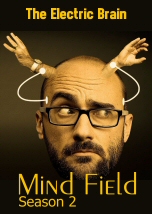
The nervous system is fundamentally electric. When we move our arm, it moves because a electric signal has been sent to the muscle that controls it. Now, because the brain is electric, we could also use electricity to record what the brain is doing or bypass it entirely, and control a body. That means that we could restore movement to people who are paralyzed, feel through an artificial hand as if it was our own, and even read people's minds. Michael Stevens explores how electricity can be used to move cockroaches, control other peoples' limbs and even read peoples' thoughts.
When Homo sapiens, which means 'wise ones,' discovered and controlled fire hundreds of thousands of years ago, everything changed. Fire allowed us to cook food and heat dwellings, and it served as a focal point for storytelling and sharing cultural identity among community members. We don't yet have established parameters for what it means to be 'distinctly human,' It would seem the only thing that separates us from other animals, Neil deGrasse Tyson ponders, is our neurotic need to feel 'special'. Against the backdrop of the Halls of Extinction, Tyson insists that there must be a clear distinction between ourselves and animals that justifies our eating them, wearing them and even bringing an end to their species. From the birth of the devil in ancient Persia to a searing story of saintliness among macaque monkeys, this episode is an exploration of human potential for change. It concludes with the story of how one of history's greatest monsters was transformed into one of its shining lights.























Zachary also meets with the world's leading scientists at SETI in Green Banks, West Virginia. There, utilizing the world's largest telescope, they show him the methods they employ to communicate with potential other-worldly visitors and what this research has taught them about a mysterious radio signal they picked up 3 billion light years away.