


Last Watched

"Law"  Sort by

Peril and Promise

   2013    History
In the 80s the nature of the Latino Diaspora changes again. From Cuba a second wave of refugees to United States – the Mariel exodus – floods Miami . The same decade sees the sudden arrival of hundreds of thousands of Central Americans (Salvadorans, Guatemalans, and Nicaraguans) fleeing death squads and mass murders at home like activist, Carlos Vaquerano. By the early 1990s, a political debate over illegal immigration – has begun. Globalization, empowered by NAFTA, means that as U.S. manufacturers move south, Mexican workers head north in record numbers. A backlash ensues: tightened borders, anti-bilingualism, state laws to declare all illegal immigrants felons. But a sea change is underway: the coalescence of a new phenomenon called Latino American culture-as Latinos spread geographically and make their mark in music, sports, politics, business, and education.
Series: Latino Americans
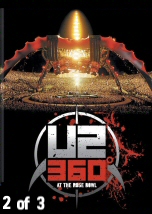
U2 Live at the Rose Bowl 2of3

   2010    Art
The tour was designed by Willie Williams, who has worked on every U2 tour since 1982. Williams had been toying with ideas for 360-degree stadium staging for U2 for a number of years, and presented sketches of a four-legged design to the group near the end of their Vertigo Tour in 2006. The inspiration for the 'spaceship-on-four-legs' design, nicknamed 'the Claw', came from the landmark Theme Building at Los Angeles International Airport.
Series: U2 Live at the Rose Bowl

Is Luck Real

   2014    Science
Do you make your own luck, or does luck make you? Some scientists believe luck is strictly a matter of statistics and probabilities…but others believe unseen forces are at work, and randomness is built into every particle of the universe. We’ll find luck, good and bad, in casinos, basketball courts, genetics labs and the subatomic world. How much does the genetic lottery rule your fate? Are lucky streaks and unfortunate accidents merely our own minds fooling us? It’s a scientific journey that will radically revise your understanding of the laws of nature and the workings of the human brain.
Series: Through the Wormhole Season 5

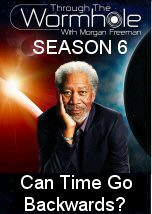
Can Time Go Backwards

   2015    Science
We move around in space, but we are stuck in a prison of time moving ever forwards. Einstein said, 'The distinction between past, present and future is only a stubbornly persistent illusion.' Is our experience of the ticking clock merely a trick of the mind? Could science ever make the clock move backwards? Experiments in quantum physics are showing that the future influences the present: what happens later limits the choices we think we have now. The laws of physics say visiting or talking to ourselves in the past is possible – but changing history once we get there is not.
Series: Through the Wormhole Season 6

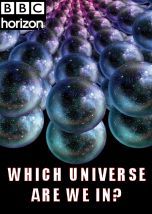
Which Universe Are We In

   2015    Science
Imagine a world where infinite copies of you are playing out every storyline of your life. It sounds like a plot stolen straight from Hollywood, but far from it. This is the multiverse. Until very recently the whole idea of the multiverse was dismissed as a fantasy, but now this strangest of ideas is at the cutting edge of science. And for a growing number of scientists, the multiverse is the only way we will ever truly make sense of the world we are in. Do multiple universes exist? And if so, which one are we actually in?" Imagine a world where dinosaurs still walk the earth. A world where the Germans won World War II and you are president of the United States. Imagine a world where the laws of physics no longer apply.

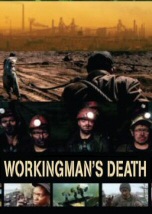
Workingman Death

   2005    Culture
Austrian director Michael Glawogger travels to five countries to focus on some of the worst jobs imaginable: Ukrainian miners crawl into tiny cracks in old coal pits to scratch out a few bags of winter fuel; Indonesian workers trudge long distances carrying baskets with hundreds of pounds of sulfur chunks extracted from a steaming mountain; Pakistanis risk explosions and burial under tons of scrap iron as they dismantle huge carrier ships. The visuals are everything here. Despite the hardships depicted, many sequences have a dreamlike beauty. In addition, the director has a bone-dry sense of irony; during the Ukraine scenes, he frequently cuts away to a statue of Stakhanov, the "hero" lauded by the Soviets for his superhuman work habits. He also shows us an old German smelting works that's been converted into a theme park.