






Last Watched

"Tree"  Sort by

Never Sleep Again: The Elm Street Legacy 1

   2010    Art
Discover photographs, storyboards, conceptual art, publicity materials, archival documents, and behind-the-scenes footage of the original film and all its sequels that have never been shared before. Never Sleep Again expands on Wes Craven's behind creating the first Elm Street film.
Series: The Elm Street Legacy

Never Sleep Again: The Elm Street Legacy 2

   2010    Art
Through interviews, the film shares how cast and crew brought their own worst nightmares to life on screen and examines the impact the series and its myths have had on pop culture and the horror genre in general. The documentary also explores the rise and fall of Robert Shaye's New Line Cinema and its reputation as "The House That Freddy Built".
Series: The Elm Street Legacy

Never Sleep Again: The Elm Street Legacy 3

   2010    Art
Farrands, Hutson, and Kasch first worked together on the documentary film His Name Was Jason. According to Farrands, who reunited with Hutson, they jointly decided that it was time to tell the stories behind why the various Elm Street films were created and why they decided to fund the entire project independently.
Series: The Elm Street Legacy

Over the Rainbow

   2013    Culture
With optional Hebrew subtitles. Simon Schama's history of the Jewish experience plunges into the lost world of the shtetl, the Jewish towns and villages sewn across the hinterlands of Eastern Europe which became the seedbed of a uniquely Jewish culture. Shtetl culture would make its mark on the modern world, from the revolutionary politics of the Soviet Union to the mass culture of Tin Pan Alley and Hollywood. It was also the birthplaces of Hasidism, the most visible, iconic and, arguably, most misunderstood expression of Jewish faith and fervour. This chapter of the story travels from the forests of Lithuania, where Simon's own family logged wood and fought wolves, to the streets of the Lower East Side where the sons of shtetl immigrants wrote the American songbook. With grim inevitability, the story returns to Eastern Europe in 1940 - where the genocidal mechanisms of the 'final solution' were beginning to grind the shtetl world into dust and ash.
Series: The Story of the Jews

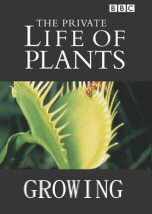
Growing

   1994    Nature
The second episode is about how plants gain their sustenance. Sunlight is one of the essential requirements if a seed is to germinate, and Attenborough highlights the cheese plant as an example whose young shoots head for the nearest tree trunk and then climb to the top of the forest canopy, developing its leaves en route. Using sunshine, air, water and a few minerals, the leaves are, in effect, the "factories" that produce food. However, some, such as the begonia, can thrive without much light. To gain moisture, plants typically use their roots to probe underground. Trees pump water up pipes that run inside their trunks, and Attenborough observes that a sycamore can do this at the rate of 450 litres an hour — in total silence. Too much rainfall can clog up a leaf's pores, and many have specially designed 'gutters' to cope with it. However, their biggest threat is from animals, and some require extreme methods of defence, such as spines, camouflage, or poison. Some can move quickly to deter predators: the mimosa can fold its leaves instantly when touched, and the Venus flytrap eats insects by closing its leaves around its prey when triggered. Another carnivorous plant is the trumpet pitcher that snares insects when they fall into its tubular leaves. Attenborough visits Borneo to see the largest pitcher of them all, Nepenthes rajah, whose traps contain up to two litres of water and have been known to kill small rodents.
Series: The Private Life of Plants

The Social Struggle

   1995    Nature
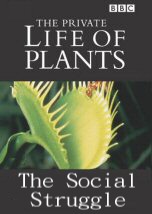
Fourth episode examines how plants either share environments harmoniously or compete for dominance within them. Attenborough highlights the 1987 hurricane and the devastation it caused. However, for some species, it was that opportunity for which they had lain dormant for many years. The space left by uprooted trees is soon filled by others who move relatively swiftly towards the light. The oak is one of the strongest and longest-lived, and other, lesser plants nearby must wait until the spring to flourish before the light above is extinguished by leaves. Tropical forests are green throughout the year, so brute force is needed for a successful climb to the top of the canopy: the rattan is an example that has the longest stem of any plant. As its name suggests, the strangler fig 'throttles' its host by growing around it and cutting off essential water and light. Some can take advantage of a fallen tree by setting down roots on the now horizontal trunk and getting nutriment from the surrounding moss and the fungi on the dead bark. The mountain ash (eucalyptus regnans) grows so tall, that regeneration becomes a considerable problem. It is easily flammable, so its solution is to shed its seeds during a forest fire and sacrifice itself. It therefore relies on the periodic near-destruction of its surroundings in order to survive. Attenborough observes that catastrophes such as fire and drought, while initially detrimental to wildlife, eventually allow for deserted habitats to be reborn.
Series: The Private Life of Plants
The Crime of the Century

The Crime of the Century

2021  Medicine
Dynasties

Dynasties

2018  Nature
The Art Mysteries

The Art Mysteries

2020  Art
The Last Dance

The Last Dance

2020  Culture
Art of Spain

Art of Spain

2008  Art
Leaving Neverland

Leaving Neverland

2019  Culture
Spectacular Earth

Spectacular Earth

2022  Nature