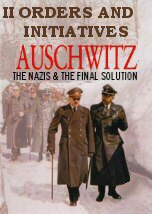
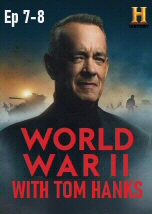
In episodes 7 and 8, we see how World War II descends into one of the darkest chapters in human history while the Allies prepare to strike back for the first time on a new front. As Hitler’s power spreads across Europe, Nazi hatred turns persecution into policy, pushing Jewish families from discrimination and public humiliation into ghettos, deportations, mass murder, and the horror that will become known as the Holocaust. The war is no longer only a struggle for territory, armies, and empires; it becomes a confrontation with an ideology built on cruelty, fear, and the destruction of an entire people. The story then shifts to North Africa, where the Western Allies must prove they can fight Germany on land. In Operation Torch, inexperienced American troops and their untested commander, Dwight D. Eisenhower, join British forces in a dangerous gamble against the battle-hardened Afrika Korps and the legendary Erwin Rommel. Across deserts, ports, and unforgiving battlefields, the campaign becomes a harsh lesson in modern war, exposing Allied weaknesses while opening the road toward Europe. These two episodes combine moral catastrophe and military turning point, showing both the depths of Nazi evil and the first difficult steps toward its defeat.
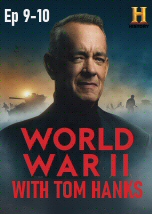
In episodes 9 and 10 of this series, the war moves from the secrecy of codebreaking rooms to one of the most brutal battlefields in history. Far from the front lines, in the quiet English countryside, a hidden struggle unfolds at Bletchley Park, where brilliant mathematicians, linguists and intelligence officers race to crack Germany’s Enigma code. Every intercepted message could save ships, reveal enemy plans and alter the fate of entire campaigns, turning silence, patience and genius into weapons as powerful as tanks or bombers. The story then shifts to the Eastern Front, where Hitler launches Operation Blue in a desperate drive toward the Soviet oil fields and the city of Stalingrad. What begins as a strategic offensive becomes a nightmare of street-by-street combat, starvation, freezing conditions and unimaginable sacrifice. As German forces are pulled deeper into the ruins and Soviet resistance hardens, Stalingrad becomes more than a battle for a city; it becomes a turning point in World War II, where ambition, endurance and catastrophe collide on a scale that changed the course of the war.
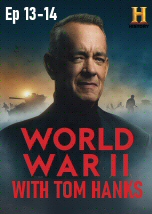
In episodes 13 and 14, the war reaches a decisive new stage as the Allies prepare to launch Operation Overlord and open the long-awaited second front in Nazi-occupied France. Behind the invasion of Normandy lies an enormous gamble of planning, deception, weather, timing and nerve, with Dwight D. Eisenhower carrying the weight of one of the most dangerous military decisions in history. From the beaches of D-Day to the struggle to break through Hitler’s Atlantic Wall, the episode captures the fear, scale and sacrifice of the operation that begins the liberation of Western Europe. The story then moves to World War II’s often overlooked Asian theater, where Allied forces and Japan fight across jungles, mountains, plains and impossible supply routes. In Burma, India and China, commanders such as Joseph Stilwell, William Slim and Lord Mountbatten face a brutal war of disease, exhaustion, monsoon terrain and relentless Japanese resistance. From the Burma Road and the deadly airlift over the Hump to the fighting at Myitkyina, Imphal and Saipan, these episodes reveal a vast and punishing conflict far from Europe’s headlines, where survival itself becomes a battle and victory demands endurance on a staggering scale.
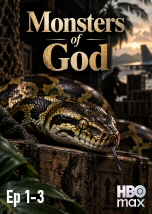
What begins as a fascination with rare and dangerous reptiles grows into a lucrative global underground built on smuggling, obsession and rivalry. From the eccentric dealers who helped create the exotic animal trade to the investigators determined to stop it, the series exposes a hidden world where protected species, major zoos, criminal networks and enormous sums of money collide. At its center are men such as Tommy Crutchfield and Hank Molt, whose bitter feud reveals how quickly passion for reptiles can turn into betrayal, trafficking and environmental damage. The documentary also shows how this trade helped reshape ecosystems and drove entire species closer to extinction. In the first three episodes, the story traces the rise of the reptile-smuggling world from the 1970s onward. The obsession with owning animals no one else could obtain fuels a booming illegal market, while authorities begin taking notice of dealers operating across borders. In Florida, Ray Van Nostrand enters the business and becomes entangled with Miami’s darker underworld of drug trafficking and gun-running, drawing the attention of the DEA. Later, his son Mike attempts to transform the family operation into a legitimate international import-export empire, only for old criminal connections and his father’s return to threaten everything he has built.


















The story then shifts to North Africa, where the Western Allies must prove they can fight Germany on land. In Operation Torch, inexperienced American troops and their untested commander, Dwight D. Eisenhower, join British forces in a dangerous gamble against the battle-hardened Afrika Korps and the legendary Erwin Rommel. Across deserts, ports, and unforgiving battlefields, the campaign becomes a harsh lesson in modern war, exposing Allied weaknesses while opening the road toward Europe. These two episodes combine moral catastrophe and military turning point, showing both the depths of Nazi evil and the first difficult steps toward its defeat.