Explore the extremes of North America in this fascinating documentary, where the continent's wildlife faces daunting challenges and embraces opportunities presented by its ever-changing seasons. From the resilient lynx navigating the harsh Yukon winter to the enchanting spectacle of fireflies lighting up Mississippi nights, witness the ingenious survival strategies of animals in the face of extreme weather. Encounter the drama of tornadoes sweeping the Great Plains and the strategic pursuits of predators like the American badger. With stunning visuals and compelling narratives, this documentary unveils the relentless spirit of North America's diverse inhabitants in the midst of nature's trials and triumphs.
The second episode of the series immerses the viewer in a fascinating journey through the history of life on our planet, focusing on the evolution and adaptation of life in the seas. It begins billions of years ago, when the Earth was an inhospitable place and life was impossible on the surface due to a hostile environment. The documentary highlights how, beneath the waves, life began to flourish, protected from storms and other elements of nature. It addresses the development of photosynthesis by plankton and how this led to a significant change in the Earth's atmosphere, allowing the emergence of animal life. This visually stunning narrative chronicles the evolution of various forms of marine life, from the earliest complex life forms to the appearance of the first fish and cephalopods. The documentary shows how marine life has influenced terrestrial life, emphasizing the impact of the 'greening' of planet Earth.
The fourth episode of the series takes you on an epic journey through time, beginning 252 million years ago, in a world devastated by the greatest mass extinction in history. Discover how, from the ashes of this cataclysm, fungi become the dominant form of life in an almost apocalyptic landscape. Witness the astonishing story of survival and adaptation of the Lystrosaurus, curious ancestors of mammals, who emerge as the unlikely heirs of the Earth and transform into the dominant creatures, only to be eventually dethroned by new giant predators like the Erythrosuchus. The documentary culminates with the impressive era of dinosaurs and how they adapted to a constantly changing world, and the reigns of the plesiosaurs and pterosaurs, rulers of the oceans and the air. Finally, learn how these titans gave way to modern reptiles and current birds, leaving a legacy that endures to this day. This documentary is a window into the fascinating evolutionary history of our planet, showing the resilience and diversity of life through the ages. Prepare to be amazed, informed, and deeply moved by this spectacular chronicle of life on our planet.
The seventh episode of the series takes us on an epic journey to discover the extraordinary dynasty of mammals. From their humble origins in the Jurassic forests to their dominance in the modern world, mammals have evolved and survived through cataclysmic events and drastic environmental changes. From the small coati in the jungle to the majestic Megacerops, passing through the elusive snow leopard in the Himalayas and the gigantic marine mammals like whales, the documentary illustrates the adaptability and diversity of these incredible beings. With stunning images and masterful narration, the documentary is a window to the resilience and beauty of life on Earth, celebrating the tenacity and ingenuity of mammals throughout the ages.
The final episode begins with a description of the extreme cold conditions that characterized the beginning of the Holocene period, and how species like the bison and the wolf adapted to survive in these hostile environments. We will witness the majesty of the woolly mammoth and the fierce cave lion, with a vivid reconstruction of their struggles for survival. We'll see the impact of climate change during this period, from the expansion of the deserts to the transformation of the tropical rainforests of Africa into grasslands, deeply affecting primates and other animals. It highlights how these changes forced primates to adapt to life on the ground, facing new challenges and predators. A crucial turn occurred with the emergence of humans as dominant predators and their influence on the extinction of large mammals. The documentary describes humanity's transition from hunter-gatherers to farmers, a change that radically altered the landscape and biodiversity of the planet. Finally, it poses a reflection on the current challenges of climate change and the sixth mass extinction, inviting viewers to consider humanity's crucial role in shaping the future of the Earth.
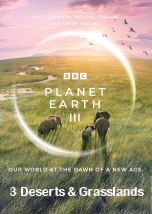
The third episode takes viewers on a riveting journey to some of the world's most extreme and breathtaking deserts and grasslands, where nature puts on its most dramatic show. It begins in the arid landscapes of Central Africa's Guelta d'Archei and the Namib Desert in Southwest Africa, places where water is scarce, and survival is a daily battle. The focus then shifts to the remarkable adaptability of creatures like ostriches, who brave the scorching heat and predators to raise their young and a handful of leopards who learned to hunt from trees on the African plains. In Australia, viewers witness the intricate courtship rituals of the spotted bowerbird, a species facing challenges due to climate change. The narrative then takes us to the vast Eurasian Steppe, home to the unique Saiga antelope, and to Brazil's Cerrado, a biodiverse grassland where the elusive maned wolf plays a crucial role in maintaining the ecosystem. The episode highlights not only the resilience and beauty of these creatures but also the fragility of their habitats, emphasizing the urgent need for conservation efforts.
























With stunning visuals and compelling narratives, this documentary unveils the relentless spirit of North America's diverse inhabitants in the midst of nature's trials and triumphs.