The meteoric rise of renewable energy has consequences for our electricity supply. While coal and gas fired power stations can generate electricity whenever you need it, renewables are intermittent by nature. So we need a backup plan for when the wind stops or the sun goes down. All over the world, engineers and scientists are racing to solve one key problem; how to safely and efficiently store electricity at a huge scale but at a low cost. The quest is producing some truly remarkable ideas and this episode details three of them.
Even as the science grew more certain, the oil industry continued to block action to tackle climate change in the new millennium. In a revelatory interview, Christine Todd Whitman, George W. Bush's former environment chief, tells the story of how the industry successfully lobbied President Bush to reverse course on his campaign promise to regulate carbon emissions. Tensions grew between two of the world's biggest oil companies, ExxonMobil and BP, after the latter publicly called for action to tackle climate change. The election of Barack Obama provided hope for supporters of climate action, but the billionaire Koch brothers made an effort to block the new president's attempts to pass climate change legislation, and climate denialism became the mainstream position of the Republican Party. A lawyer who worked for Koch brothers through this period speaks on camera for the first time.
The last chapter explains how the 2010s became another lost decade in the fight against climate change – as the move to natural gas delayed a transition to more renewable sources of energy. Engineer Tony Ingraffea, in the 1980s, helped develop a new technique for extracting gas and oil from shale rock, which ultimately became known as 'Fracking'. It was to unleash vast new reserves of fossil fuels and was promoted as a cleaner energy source. But Ingraffea explains how he later came to regret his work when he realized that gas could be even worse for climate change than coal and oil. Dar-Lon Chang, a former ExxonMobil engineer, speaks for the first time on camera alleging that as the company increased its natural gas operations, it was not sufficiently monitoring methane leaks that were contributing to climate change. Now, after a year of unprecedented wildfires, drought and other climate-related disasters, multiple lawsuits are being brought in US courts in efforts to hold Big Oil legally accountable for the climate crisis.
All of our pets survived for thousands of years in the wild without any help from us, and this has led them to develop astonishing athletic abilities which we sometimes take for granted. As greyster dogs and endurance champ tortoises. Dog scootering uses one or more dogs to pull a human riding an unmotorized scooter. Greysters are a naturally-athletic breed that can run at 20 miles per hour for five miles while handling these carriages. No other animal can run at this speed, exerting this power, and expending this energy for so long. So, what's their secret? Greysters' stride length can be a staggering 16 feet and they are super efficient at absorbing and using oxygen. Greyster dogs have nearly twice mitochondria inside their cells than humans.
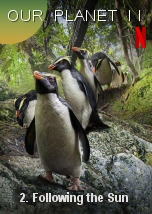
As summer spreads across our planet, honey bees toil, snow geese breed, tadpoles awaken and lions stalk wildebeest in search of lush grass. Our planet is solar-powered. But due to the Earth's tilt, it doesn't strike its surface evenly. This solar energy arrives in varying amounts at different times of the year. The huge increase that comes with summer also triggers countless migrations.
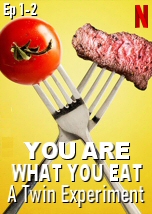
This eye-opening documentary puts a simple but provocative question to the test: how much does what we eat really shape our bodies and our health? In a tightly controlled scientific experiment, identical twins adopt radically different diets and lifestyles for eight weeks, allowing researchers to isolate the impact of food itself. By combining cutting-edge science with deeply personal experiences, the series reveals how diet influences everything from energy and metabolism to long-term wellbeing. In the first two episodes, the experiment begins as each pair of twins commits to either a plant-based or an omnivorous diet. As they adjust to unfamiliar routines, some changes feel surprisingly easy while others expose cravings, doubts, and unexpected challenges. Along the way, questionable dietary advice is put under the microscope, and a celebrity chef rethinks his approach to cooking, highlighting how habits, culture, and taste all collide when science meets the dinner table.





















All over the world, engineers and scientists are racing to solve one key problem; how to safely and efficiently store electricity at a huge scale but at a low cost. The quest is producing some truly remarkable ideas and this episode details three of them.