





Last Watched

"Tor"  Sort by

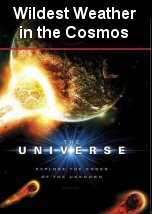
Wildest Weather in the Cosmos

   2008    Science
Imagine a tornado so powerful, it can form a planet, or winds sweeping across a planet but blowing at 6,000 miles per hour! How about rain....made of iron? Sounds like science fiction, but this type of weather is occurring daily in our solar system. Scientists are just beginning to unlock the secrets of these planets and their atmospheres. Can this research help scientists solve long unanswered questions that we have about Earth? As our own planet churns with the effects of global warming, it's natural to look into the heavens and wonder about the rest of the real estate.
Series: The Universe
Biggest Things in Space

   2008    Science
We can't compare anything on earth to the biggest things known in space. The Cosmic Web may connect objects in the universe with threads of Dark Matter. The Lyman-alpha blob is a bubble like structure containing countless galaxies--perhaps the biggest object in the entire universe. Regions of radio-emitting gas called "radio lobes" could be even bigger. Then there are super galaxy clusters which are hundreds of galaxies merged together due to cosmic collisions. Discover which is the largest planet, star, star cluster, constellation, black hole, volcano, galaxy, explosions, moon, storm, impact crater and "void" in space.
Series: The Universe

Harmony of the Worlds

   1980    Science
Beginning with the separation of the fuzzy thinking and pious fraud of astrology from the careful observations of astronomy, Sagan follows the development of astronomical observation. Beginning with constellations and ceremonial calendars (such as those of the Anasazi), the story moves to the debate between Earth and Sun-centered models: Ptolemy and the geocentric worldview, Copernicus' theory, the data-gathering of Tycho Brahe, and the achievements of Johannes Kepler (Kepler's laws of planetary motion and the first science-fiction novel).
Series: Cosmos

Heaven and Hell

   1980    Science
Sagan discusses comets and asteroids as planetary impactors, giving recent examples of the Tunguska event and a lunar impact described by Canterbury monks in 1178. It moves to a description of the environment of Venus, from the previous fantastic theories of people such as Immanuel Velikovsky to the information gained by the Venera landers and its implications for Earth's greenhouse effect. The Cosmos Update highlights the connection to global warming.
Series: Cosmos

Encyclopaedia Galactica

   1980    Science
Questions are raised about the search for intelligent life beyond the Earth, with UFOs and other close encounters refuted in favor of communications through SETI and radio telescope such as the Arecibo Observatory. The probability of technically advanced civilizations existing elsewhere in the Milky Way is interpreted using the Drake equation and a future hypothetical Encyclopedia Galactica is discussed as a repository of information about other worlds in the galaxy. The Cosmos Update notes that there have been fewer sightings of UFOs and more stories of abductions, while mentioning the META scanning the skies for signals.
Series: Cosmos

The New Latinos

   2013    History
Until World War II, Latino immigration to the United States was overwhelmingly Mexican-American. Now three new waves bring large-scale immigration from Puerto Rico, Cuba, and the Dominican Republic. As the Puerto Rican government implements a historic overhaul over a million Puerto Ricans are encouraged to leave for the US mainland, to alleviate the economic pressure. A young Juanita Sanabria arrives in New York, works hard in the garment district, but encounters hostility and discrimination. Ethnic tensions explode in youth gang warfare depicted in films like West Side Story, etching the stereotype of the knife wielding Puerto Rican in the American consciousness.
Series: Latino Americans