Shocking new evidence has convinced some of the world's greatest physicists that the universe is a hologram. Using cutting-edge technology, they investigate the secrets of black holes and space-time to build the case for this game-changing discovery. The holographic principle is a supposed property of quantum gravity that states that the description of a volume of space can be thought of as encoded on a lower-dimensional boundary to the region like a gravitational horizon. First proposed by Gerard 't Hooft, it was given a precise string-theory interpretation by Leonard Susskind. The holographic principle was inspired by black hole thermodynamics, which conjectures that the maximal entropy in any region scales with the radius squared, and not cubed as might be expected. In the case of a black hole, the insight was that the informational content of all the objects that have fallen into the hole might be entirely contained in surface fluctuations of the event horizon.
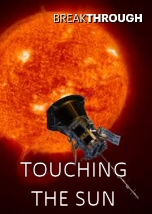
For all of human history, the Sun, our home star, has measured our days and our seasons while fueling all life on Earth. Yet it remains an enigma. NASA's Parker Probe Plus is on a mission to change that, flying through dangerous radiation to become the closest spaceship to orbit our Sun. It's a journey to the center of our solar system, a mission to gather information about the most critical celestial body in the sky, our star.
Looking back on the major stories of the year - from the New Horizons mission to the most distant world we have ever visited to the release of the first-ever picture of a black hole. The team relive the highlights and uncover the latest developments.
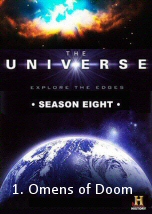
Why were the most fearsome warriors our planet has ever known stopped by a flaming light in the sky? How did Columbus use secret knowledge of the heavens to cheat death in the New World? Our ancestors saw a universe
filled with bad omens. The film examines the interpretations by ancient peoples of celestial phenomena as bad omens, and the impact that the perceived omens may have had on history.
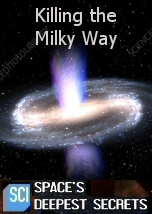
Across the universe, galaxies are going dark, and scientists don't know why the stars are losing their shine. Something is slowly drawing the curtains closed on the universe. Our milky way is under threat. Astronomers race against time to uncover the truth behind how galaxies are born and how they die before all of the lights go out.
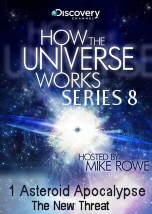
How is the universe put together? How is it built? And how does it actually work? How the Universe Works Series 8 shows the inner workings of our planet, the solar system, the galaxies and the universe itself. In the first episode, if a massive asteroid collides with earth, it could end life on our planet as we know it. New discoveries and cutting-edge tech reveal just how close we are to apocalypse and what it would take for the world's leading space agencies to stop it.















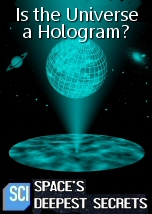







The holographic principle is a supposed property of quantum gravity that states that the description of a volume of space can be thought of as encoded on a lower-dimensional boundary to the region like a gravitational horizon. First proposed by Gerard 't Hooft, it was given a precise string-theory interpretation by Leonard Susskind.
The holographic principle was inspired by black hole thermodynamics, which conjectures that the maximal entropy in any region scales with the radius squared, and not cubed as might be expected. In the case of a black hole, the insight was that the informational content of all the objects that have fallen into the hole might be entirely contained in surface fluctuations of the event horizon.