





Last Watched

"ELA"  Sort by

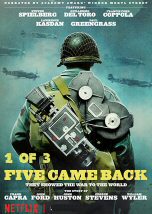
The Mission Begins

   2017    Art
The wartime contributions of five prominent Hollywood film directors during World War II are profiled. The documentary focuses on five directors – John Ford, William Wyler, John Huston, Frank Capra, and George Stevens – whose war-related works are analysed by modern filmmakers, respectively Paul Greengrass, Steven Spielberg, Francis Ford Coppola, Guillermo del Toro, and Lawrence Kasdan. In the first episode, John Ford's The Battle of Midway was approved directly by President Franklin D. Roosevelt while Frank Capra fights to get Why We Fight made.
Series: Five Came Back
Neanderthal Apocalypse

   2015    History
40,000 years ago the steppes of Eurasia were home to our closest human relative, the Neanderthals. Recent genetic and archaeological discoveries have proven that they were not the dim-witted cave dwellers we long thought they were. In fact, they were cultured, technologically savvy and more like us than we ever imagined! So why did they disappear? We accompany scientists on an exciting search for an answer to this question and come to a startling conclusion... A climate change due to a cataclysmic event.

Rats

   2016    Culture
The film goes deep beneath the surface to explore the lives of man's greatest parasite. Morgan Spurlock unveils a new form of documentary horror storytelling, journeying around the world to bring viewers face to face with rats while delving into our complicated relationship with these creepy creatures. Taking us into the rats nests in ways never before captured on film, RATS dives deep into New York City's parks, subway tunnels, and sewers; venture to rice paddies in Cambodia and Vietnam where rats are caught and sold as food, cross worldly streets in India paroled by the revered Night Rat Killers, journey to English countryside where packs of terriers kill hundreds of rats per day, and look inside a New Orleans lab, where scientists are studying how flooding and abandoned neighbourhoods are making rats more invasive than ever.

Einstein Nightmare

   2014    Science
Professor Jim Al-Khalili investigates the most accurate and yet perplexing scientific theory ever - quantum physics. At the beginning of the 20th century scientists were led into the hidden workings of matter, into the sub-atomic building blocks of the world around us. They discovered phenomena unlike any encountered before - a realm where things can be in many places at once, where chance and probability call the shots and where reality appears to only truly exist when we observe it. Albert Einstein hated the idea that nature, at its most fundamental level, is governed by chance. Jim reveals how, in the 1930s, Einstein thought he'd found a fatal flaw in quantum physics because it implies that sub-atomic particles can communicate faster than light in defiance of the theory of relativity. In the 1960s the scientist John Bell showed there was a way to test if Einstein was right and quantum mechanics was actually mistaken. Jim repeats this critical experiment - with shocking results.
Series: The Secrets of Quantum Physics

Kingdom of Plants Life in the Wet Zone

   2012    Nature    3D    HD
Written and presented by David Attenborough, who said: 'One of the most wonderful things about filming plants is that you can reveal hidden aspects of their lives, you can capture the moment as one plant strangles another, and as they burst into flower. But whilst time-lapse photography allows you to see things that no human being has ever seen before". David begins his journey inside the magnificent Palm House, a unique global rainforest in London. Here, he explores the extraordinary plants that are so well adapted to wet and humid environments and unravels the intimate relationships between wet zone plants and the animals that depend on them. It was in the wet zones of the world that plants first moved on to land and in the Waterlily House David reveals how flowers first evolved some 140 million years ago. Watching a kaleidoscope of breath-taking time-lapses of these most primitive of flowers swelling and blooming in 3D, he is able to piece together the very first evolutionary steps that plants took to employ a wealth of insects to carry their precious pollen for the first time. David discovers clues to answer a question that even had Charles Darwin stumped: how did flowering plants evolve so fast to go on to colonise the entire planet so successfully?
Series: Kingdom of Plants

The Vikings Uncovered

   2016    History
Dan Snow uncovers the lost Vikings in America with space archaeologist Dr Sarah Parcak. Sarah uses satellites 383 miles above the earth to spot ruins as small as 30cm buried beneath the surface. As Sarah searches for Viking sites from Britain to America, Dan explores how they voyaged thousands of miles when most ships never left the shoreline. He also tracks their expansion west, first as raiders and then as settlers and traders throughout Britain and beyond to Iceland and Greenland. In North America they excavate what could be the most westerly Viking settlement ever discovered.
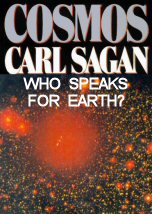
Cosmos

Cosmos

1980  Culture
Tiger

Tiger

2020  History
Modern Masters

Modern Masters

2024  Art
Prehistoric Planet II

Prehistoric Planet II

2023  Science
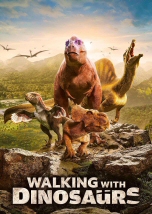
Walking with Dinosaurs

Walking with Dinosaurs

2025  Science
The Last Dance

The Last Dance

2020  Culture