




Last Watched

"Eve"  Sort by

Total Eclipse

   2010    Science
Once they were dreaded and thought to be dragons eating the sun--but modern science has dispelled mythology and we now look forward to total Solar Eclipses as one of the most spectacular phenomena in the heavens. Explore the complex movements of Earth, Moon and Sun that produce these unusual events and hear details why we may be the only intelligent beings in the known Universe to witness eclipses like we see on Earth. Man-made eclipses also figure into the science in the form of instruments called "coronagraphs." They blot out the sun and reveal its corona, uncovering secrets which, while enlightening, also warn of a disaster that could make our advanced technology crash and burn. Finally, travel into deep space, where the tiny eclipses caused by planets circling distant stars is now beginning to reveal hundreds more stars where "exoplanets" exist... perhaps even those in habitable zones like the Earth.
Series: The Universe
The End of the Earth

   2007    Science
Find out what is being done to prevent the end of the world from threats from outer space such as comets and asteroids. Also discussed are apocalyptic scenarios.
Series: The Universe

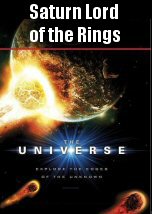
Saturn Lord of the Rings

   2007    Science
Are the rings of Saturn a real celestial phenomenon or merely a cosmic Illusion? Technology allows the experts to get closer to the furthest planet visible to the naked eye. Old questions are answered and new ones arise. Does Saturn hold the key to Earth's weather and will one of its moons supply us with all the oil we'll ever need?
Series: The Universe

The Most Dangerous Place in the Universe

   2007    Science
Take a tour of the cosmic hot zones--black holes, galaxy mergers, gamma ray bursts and magnetars. Super black holes can literally lasso Earth out of the solar system. A clash between two galaxies can result in a ritual called galactic cannibalism. Magnetars are a cosmic magnetic force so strong it could wipe out data on every credit card.
Series: The Universe

Beyond the Big Bang

   2007    Science
The universe began with a massive expansion, billions and billions of years ago, and it continues to expand with every passing second. The idea that the universe, and man's very existence, began with a "Big Bang" is no longer a topic of debate among most scientists--it is essentially taken as fact.
Series: The Universe

Cosmic Holes

   2007    Science
Today, we know black holes exist, and now scientists are trying to confirm that other holes lurk in hyperspace. Our infinite cosmos could contain a variety of "holes" such as black, white, "mini" and wormholes. White holes are the reverse of black holes; instead of matter being sucked into it, matter is ejected out. Wormholes are gateways in the fabric of space and time. They are included in Einstein's field equations as possibilities for their existence. Neither white holes nor wormholes have ever been found. Learn about new discoveries including, colliding binary black holes, intermediate black holes and manufacturing mini black holes.
Series: The Universe