
















Last Watched

"Hunt"  Sort by

Human Planet: The Jungles

   2011    Culture
The rainforest is home to more species of plants and animals than any other habitat on the planet. But for humans, life there is not as easy as it looks. Life in the trees requires great skill, ingenuity and sheer bravery. The Matis of Brazil carve 4-metre-long blow-pipes to hunt monkeys - in near total silence. Deep in the Congo forests, Tete defies death by scaling a giant tree using nothing more than a liana vine, and he must then negotiate an angry swarm of bees - all to collect honey for his family. Three children from Venezuela's Piaroa tribe venture deep into the jungle to hunt tarantulas - to toast for lunch! In West Papua the Korowai tribe show-off their engineering skills by building a high-rise home 35 metres up in the tree tops. Most memorable of all, in Brazil we join a unique monitoring flight in search an un-contacted tribe...
Series: Human Planet

The Mountains

   2011    Culture
From lush cloud forests to bare summits that take your breath away, the higher you climb the tougher life gets on a mountain. Human Planet explores the extraordinary ways in which people survive at extreme altitudes where nature becomes utterly unforgiving. In the Altai Mountains in Western Mongolia the vast open spaces make hunting for animals almost impossible, so the locals have forged an astonishing partnership with golden eagles which can do the hunting for them. On the precipitous cliffs of the Simien Mountains of Ethiopia we join a young boy locked in a dramatic battle with fearsome gelada monkeys which are hell-bent on raiding his family's meagre grain harvest. In the Himalayan state of Nepal - the roof of the world - we witness a rarely seen ceremony: a sky burial. In a land where there is little wood to burn for cremation, and where burying the dead is virtually impossible, the dead are fed to vultures in the ultimate reverence of nature.
Series: Human Planet

Meat-Eaters

   1998    Nature
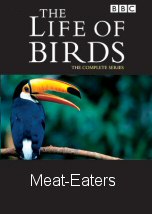
This episode examines those birds whose sustenance comes from flesh and their methods of hunting. In New Zealand, Sir Attenborough observes Keas, parrots that do not eat meat exclusively, raiding a shearwater's burrow for a chick. However, it is the dedicated birds of prey, such as owls, buzzards, eagles, falcons and vultures, to which much of the programme is devoted. In order to spot and pursue their victims, senses of sight and hearing are very acute. Vultures are the exception, in that they eat what others have left, and once a carcass is found, so many birds descend on it that the carrion seems submerged beneath them. The Turkey Vulture is an anomaly within its group, as it also has a keen sense of smell. Eagles defend their territory vigorously, and a pair of sea eagles are shown engaging in an aerial battle. The Galápagos Hawk hunts Marine Iguanas, but can only do so when its quarry is vulnerable, during the breeding season. The African Harrier Hawk has adapted to extracting burrowing animals by virtue of an especially long, double-jointed pair of legs. By contrast, a shrike is not equipped with the requisite sharp beak and talons needed for butchery, and so dismembers its kill by impaling it on the thorns of acacias. The Lammergeier eats bones, and will drop them on to rocks from a great height in order to break them down to a digestible size. Also featured are the Eurasian Sparrowhawk, Goshawk and Peregrine Falcon.
Series: The Life of Birds

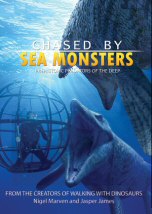
Chased by Sea Monsters 3of3

   2003    Nature
The Basilosaurus, the first of the large whale species, is not a harmless plankton eater but a fearsome high speed hunter. And most frightening of all is the Megalodon, a gargantuan ancestor of the great white that makes its modern day relative look like a tuna.
Series: Chased by Sea Monsters

Seeing Stars

   2011    Science
Around the world, a new generation of astronomers are hunting for the most mysterious objects in the universe. Young stars, black holes, even other forms of life. They have created a dazzling new set of super-telescopes that promise to rewrite the story of the heavens. This film follows the men and women who are pushing the limits of science and engineering in some of the most extreme environments on earth. But most strikingly of all, no-one really knows what they will find out there.

Humpback Whale

   2006    Nature
Few sounds are more beautiful or moving than the underwater songs of the humpback whale. Male whales compete with their songs, which often last for 10 minutes at a time, and can be repeated for hours on end. Whales separated by thousands of miles of sea will sing almost identical songs. Researchers have found that the songs change throughout the breeding months, following a mysterious pattern repeated across the waves. Whales also use sound to hunt. To catch herring, humpback whales release a stream of bubbles to form a shimmering, circular fishing net. Emitting a repetitive loud scream, they scare the fish into a tight ball, then lunge out of the water to swallow the shoal whole. Now it seems that the long-held image of the gentle giant must change to one of a ferocious and opportunistic hunter.