

Last Watched

"Indus"  Sort by

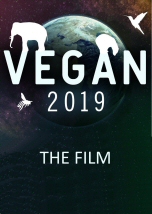
Vegan 2019

   2019    Culture    HD
Widespread dietary changes are needed if we’re to combat the range of health problems associated with obesity and the environmental damage caused by industrial farming. Switching to a vegan diet is a potential solution, but selling the idea to the meat-eaters around the world is a tricky proposition.
Series: Vegan
Big Bird

   2018    Technology
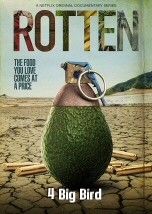
Today, worldwide, we each eat 27 pounds of chicken a year. Chicken's astonishing growth has been propelled and satisfied by a business that creates lives, and harvests them, at breathtaking speed and volume. But now the massive scale of production has exposed those in the chicken business to dangers large and small.
The ruthlessly efficient world of chicken production pits vulnerable growers against each other and leaves them open to vicious acts of sabotage.
Series: Rotten

Milk Money

   2018    Nature
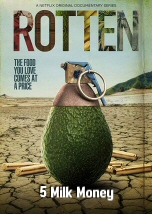
Changing diets and dramatic price swings have put dairy farmers on the ropes and fueled a surge in lucrative but controversial raw milk sales. Proponents of raw milk have stated that there are benefits to its consumption, including better flavour, better nutrition, and the building of a healthy immune system. However, the medical community has warned of the dangers, which include a risk of infection, and has not found any clear benefit
Series: Rotten

Cod is Dead

   2018    Nature
In the last 50 years, we have doubled the amount of fish we consume. Globally, billions of people rely on seafood as their primary source of protein. But the oceans can't keep up with so much demand. Around the world, fish stocks have plummeted and fisheries are crashing. People lost out. There was an industry just completely ravaged.
As the global fish supply dwindles, the industry faces a crisis on all sides - including crooked moguls, dubious imports and divisive regulations.
Series: Rotten

Words on a Page

   2020    History
Writing itself is 5,000 years old, and for most of that time words were written by hand using a variety of tools. The Romans were able to run an empire thanks to documents written on papyrus. Scroll books could be made quite cheaply and, as a result, ancient Rome had a thriving written culture. With the fall of the Roman Empire, papyrus became more difficult to obtain. Europeans were forced to turn to a much more expensive surface on which to write: Parchment. Medieval handwritten books could cost as much as a house, they also represent a limitation on literacy and scholarship.
No such limitations were felt in China, where paper had been invented in the second century. Paper was the foundation of Chinese culture and power, and for centuries how to make it was kept secret. When the secret was out, paper mills soon sprang up across central Asia. The result was an intellectual flourishing known as the Islamic Golden Age. Muslim scholars made discoveries in biology, geology, astronomy and mathematics. By contrast, Europe was an intellectual backwater.
That changed with Gutenberg’s development of movable type printing. The letters of the Latin alphabet have very simple block-like shapes, which made it relatively simple to turn them into type pieces. When printers tried to use movable type to print Arabic texts, they found themselves hampered by the cursive nature of Arabic writing. The success of movable type printing in Europe led to a thousand-fold increase in the availability of information, which produced an explosion of ideas that led directly to the European Scientific Revolution and the Industrial Revolution that followed.
Series: The Secret History of Writing

Energy Revolutions

   2020    Technology
Over the last years, the world has experienced an energy revolution, driven by an urgent need to green the grid and save life on Earth as we know it. 50 years ago, a devastating oil crisis kicked off an energy revolution. The world set course to cut the costly habit of burning fossil fuels. With the urgent new threat of a changing climate, the drive to unleash the power of the sun, earth and wind has accelerated into a race for humanity's survival. Change is taken place but, is it happening fast enough to secure our future? Technologies are right here, right now, and they will enable the transition to 100% renewables, because winning the energy race means a win for the entire world.
Series: The Great Acceleration