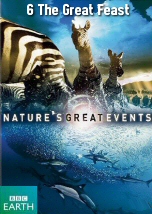
Every year grizzly bear families in North America depend for their survival on a spectacular natural event: the return of hundreds of millions of salmon from the Pacific Ocean to the mountain streams where they were born. The salmon travel thousands of miles to spawn and then die. The great run not only provides food for bears, but for killer whales, wolves, bald eagles, and even the forest itself. The question is: will the salmon return in time to keep hungry bears alive? A mother grizzly and her cubs emerge from their den high in snowy Alaskan mountains. Filming from the air the team capture a TV first, following the bears as they negotiate a near vertical slope on their journey to the coast where they await the return of the salmon. Meanwhile, the salmon are making their way to the to river mouths where they must swim upstream and against the current. The programme reveals how they tackle the torrents and leap over waterfalls, a feat equivalent to a human jumping over a house. Dozens of hungry bears eagerly await the salmon that make it up river. In another TV first, underwater cameras record the ingenuity and fancy footwork they use to collect dead salmon from the bottom of deep pools.
Every summer in the seas off Alaska humpback whales, sea lions and killer whales depend on an explosion of plant life, the plankton bloom. It transforms these seas into the richest on Earth. But will these animals survive to enjoy the great feast? The summer sun sparks the growth of phytoplankton, microscopic floating plants which can bloom in such vast numbers that they eclipse even the Amazon rainforest in sheer abundance of plant life. Remarkably, it is these minute plants that are the basis of all life here. But both whales and sea lions have obstacles to overcome before they can enjoy the feast. Humpback whales migrate 3,000 miles from Hawaii, and during their 3 month voyage lose a third of their body weight. In a heart-rending scene a mother sea lion loses her pup in a violent summer storm, while another dramatic sequence shows a group of killer whales working together to kill a huge male sea lion. In late summer the plankton bloom is at its height. Vast shoals of herring gather to feed on it, diving birds round the fish up into a bait ball and then a humpback whale roars in to scoop up the entire ball of herring in one huge mouthful. When a dozen whales work together they employ the ultimate method of co-operative fishing - bubble net feeding. One whale blows a ring of bubbles to engulf the fish and then they charge in as one. Filmed from the surface, underwater and, for the first time, from the air, we reveal how these giant hunters can catch a tonne of fish every day.
In Southeast Alaska, there's an ice-bound Eden that harbors possibly the richest temperate rainforests of all. Where the coastal mountains meet the Pacific, lays the Alexander Archipelago, a remote island chain running for almost 300 miles along the Alaskan Panhandle. This frozen frontier is one of the last great wildernesses of North America. And a stronghold for the country's highest diversity of megafauna, feasting on the abundance of fleeting summers to make it through relentless winters.
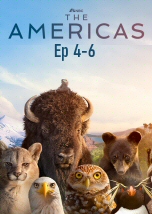
In the next three episodes the journey moves into three radically different worlds where survival depends on mastering water, ice and extreme seasonal change. In the Amazon, giant river otters hunt as a family, black caimans ambush newly hatched turtles, army ants sweep through the forest in highly organized raids and a harpy eagle guards a vulnerable chick high above the jungle floor. The rainforest emerges as a vast living system, shaped by rivers, floods, towering trees and countless species competing for food, space and the chance to raise their young. The story then heads north to Alaska and Canada, where polar bears wait for sea ice, wolves struggle through blizzards, hares evade lynx and immense caribou herds cross dangerous meltwater rivers during their ancient migrations. Finally, along the Gulf Coast, flooded swamps and subtropical wetlands become the stage for black bears, alligators, manatees, burrowing owls and one of America’s rarest wild cats, the ocelot. From the frozen Arctic to the humid marshes of Louisiana, Florida and Texas, these episodes reveal how animals adapt to landscapes that can change completely from one season to the next.

















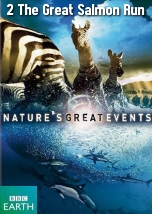



A mother grizzly and her cubs emerge from their den high in snowy Alaskan mountains. Filming from the air the team capture a TV first, following the bears as they negotiate a near vertical slope on their journey to the coast where they await the return of the salmon. Meanwhile, the salmon are making their way to the to river mouths where they must swim upstream and against the current. The programme reveals how they tackle the torrents and leap over waterfalls, a feat equivalent to a human jumping over a house. Dozens of hungry bears eagerly await the salmon that make it up river. In another TV first, underwater cameras record the ingenuity and fancy footwork they use to collect dead salmon from the bottom of deep pools.