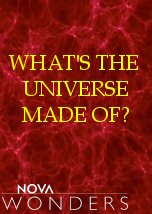
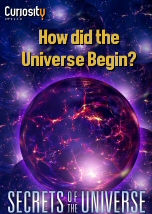
This series takes viewers on a journey to the frontiers of science, where researchers are tackling some of the biggest questions about life and the cosmos. The universe is hiding something. In fact, it is hiding a lot. Everything we experience on Earth, the stars and galaxies we see in the cosmos—all the 'normal' matter and energy that we understand—make up only 5% of the known universe. The other 95% is made up of two mysterious components: 'dark matter' and 'dark energy.' We can’t see them, but we know they’re there. And what’s more —these two shadowy ingredients are locked in an epic battle to control the very fate of the universe. Now, scientists are trying to shed light on the so-called 'dark sector' as the latest generation of detectors rev up, and powerful telescopes peer deeper into space than ever before to observe how it behaves. Will the discoveries help reveal how galaxies formed? In the series finale, Nova Wonders journeys to the stars and back to investigate what we know —and don’t know. Find out how scientists are discovering new secrets about the history of the universe, and why they’re predicting a shocking future.
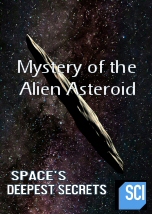
When a mysterious cigar-shaped object is spotted tumbling through our solar system, experts race to uncover it's true nature. The object, nicknamed Oumuamua, meaning 'a messenger that reaches out from the distant past' in Hawaiian, was discovered by the Pan-STARRS 1 telescope in Hawaii. Since its discovery, scientists have been at odds to explain its unusual features and precise origins, with researchers first calling it a comet and then an asteroid before finally deeming it the first of its kind: a new class of 'interstellar objects.' A recent paper by researchers at the Harvard Smithsonian Center for Astrophysics raises the possibility that the elongated dark-red object, which is 10 times as long as it is wide and travelling at speeds of 196,000 mph, might have an 'artificial origin.' The theory is based on the object's 'excess acceleration,' or its unexpected boost in speed as it travelled through and ultimately out of our solar system.
Thirty years ago, scientists first realized that some unknown dark substance was affecting the way galaxies moved. Today, they think there must be five times as much dark matter as regular matter out there. But they have no idea what it is - onl that it's not made of atoms, or any other matter we are familiar with. And Dark Matter is not the only strange substance in the Universe - a newly discovered force, called Dark Energy, seems to be pushing the very fabric of the cosmos apart.
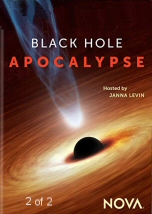
They are the most powerful objects in the universe. Nothing, not even light, can escape the gravitational pull of a black hole. Astronomers now think there are billions of them out in the cosmos, swallowing up planets, even entire stars in violent feeding frenzies. New theoretical research into the twisted reality of black holes suggests that three-dimensional space could be an illusion. That reality actually takes place on a two-dimensional hologram at the edge of the universe.
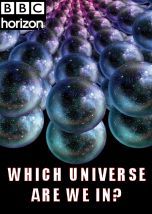
Imagine a world where infinite copies of you are playing out every storyline of your life. It sounds like a plot stolen straight from Hollywood, but far from it. This is the multiverse. Until very recently the whole idea of the multiverse was dismissed as a fantasy, but now this strangest of ideas is at the cutting edge of science. And for a growing number of scientists, the multiverse is the only way we will ever truly make sense of the world we are in. Do multiple universes exist? And if so, which one are we actually in?" Imagine a world where dinosaurs still walk the earth. A world where the Germans won World War II and you are president of the United States. Imagine a world where the laws of physics no longer apply.
Of all the objects in the cosmos, planets, stars, galaxies, none are as strange, mysterious, or powerful as black holes. Black holes are the most mind-blowing things in the universe. They can swallow a star completely intact. Black holes have these powerful jets that just spew matter out. First discovered on paper, on the back of an envelope, some squiggles of the pen. The bizarre solution to a seemingly unsolvable equation, a mathematical enigma. Einstein himself could not accept black holes as real. People didn't even believe for many years that they existed. Nature doesn't work that way. Yet slowly, as scientists investigate black holes by observing the effect they have on their surroundings, evidence begins to mount.























Now, scientists are trying to shed light on the so-called 'dark sector' as the latest generation of detectors rev up, and powerful telescopes peer deeper into space than ever before to observe how it behaves. Will the discoveries help reveal how galaxies formed? In the series finale, Nova Wonders journeys to the stars and back to investigate what we know —and don’t know. Find out how scientists are discovering new secrets about the history of the universe, and why they’re predicting a shocking future.