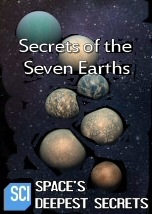
We are living in a new golden age of exploration. Planet hunters are searching far beyond our solar system and they are actually finding new worlds orbiting other suns. Thousands of these alien worlds have already been found, but this is the story of perhaps the greatest discovery yet, a star 40 light-years away with seven Earth-sized planets: Trappist-1. This new discovery of seven alien Earth-like planets in a faraway solar system is a major milestone in our hunt for extraterrestrial life, and experts investigate the secrets of Trappist -1's mysterious worlds to reveal if we're truly alone in the universe.
Odds are excellent that extraterrestrial life exists. So why haven’t we found aliens out in the galaxy? Are we looking in the wrong places? New research shows we should look closer to home, even inside our bodies. It turns out that a lot of our DNA is from a mysterious, nonhuman source. Theoretically, alien microbial life can make the journey to Earth from distant worlds, and scientists are finding some unearthly microbes in our upper atmosphere. Could it be from outer space? Could we be part alien? It’s even possible alien life is already here as digital life forms, hiding inside our technology.
Are we alone? SETI--the Search for Extraterrestrial Intelligence--is a privately funded project using radio telescopes and optical telescopes to scan the stars for signals.
This episode covers the nature of how life may have developed on Earth and the possibility of life on other planets. Tyson begins by explaining how the human development of writing systems enabled the transfer of information through generations, describing how Princess Enheduanna ca. 2280 BCE would be one of the first to sign her name to her works, and how Gilgamesh collected stories, including that of Utnapishtim documenting a great flood comparable to the story of Noah's Ark. Tyson explains how DNA similarly records information to propagate life, and postulates theories of how DNA originated on Earth, including evolution from a shallow tide pool, or from the ejecta of meteor collisions from other planets. In the latter case, Tyson explains how comparing the composition of the Nakhla meteorite in 1911 to results collected by the Viking program demonstrated that material from Mars could transit to Earth, and the ability of some microbes to survive the harsh conditions of space. With the motions of solar systems through the galaxy over billions of years, life could conceivably propagate from planet to planet in the same manner. Tyson then moves on to consider if life on other planets could exist. He explains how Project Diana performed in the 1960s showed that radio waves are able to travel in space, and that all of humanity's broadcast signals continue to radiate into space from our planet. Tyson notes that projects have since looked for similar signals potentially emanating from other solar systems. Tyson then explains that the development and lifespan of extraterrestrial civilizations must be considered for such detection to be realized. He notes that civilizations can be wiped out by cosmic events like supernovae, natural disasters such as the Toba disaster, or even self-destruct through war or other means, making probability estimates difficult. Tyson describes how elliptical galaxies, in which some of the oldest red dwarf stars exist, would offer the best chance of finding established civilizations. Tyson concludes that human intelligence properly applied should allow our species to avoid such disasters and enable us to migrate beyond the Earth before the Sun's eventual transformation into a red giant.
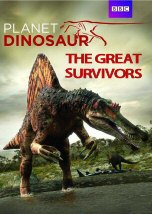
The final episode explores dinosaurs' extraordinary ability to survive. Featured dinosaurs include the bizarre magyarosaurus, which lived in the shadow of the biggest flying animal - hatzegopteryx - and showed an amazing adaptation to island life; and the weird nothronychus, a carnivore that gave up meat eating. This astonishing capacity to evolve into ever more diverse and bizarre forms meant that dinosaurs not only spread throughout the world, but also dominated life upon it for more than 160 million years. It was only an unprecedented extraterrestrial event that finally saw the end of planet dinosaur.
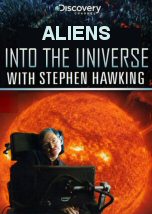
Stephen Hawking, the world's most famous living scientist explores the greatest mysteries of the cosmos. In three landmark instalments he reveals the wonders of the universe as never seen before. Definitive, provocative, surprising, and beautiful, Into the Universe with Stephen Hawking is a fascinating look through the mind's eye of one of the finest brains on the planet. In 'Aliens' Hawking considers one of the most important mysteries facing humankind - the possibility of alien, intelligent life. He leads us on a journey rendered in eye-popping detail, from the moons of Jupiter to a galaxy maybe not so far, far away. We will meet possible aliens and wonder at their form, we will delve into the very principles of what it is to call something alive, and we will calculate the likelihood of 'contact' being made.
























This new discovery of seven alien Earth-like planets in a faraway solar system is a major milestone in our hunt for extraterrestrial life, and experts investigate the secrets of Trappist -1's mysterious worlds to reveal if we're truly alone in the universe.