












Last Watched

"Temperature"  Sort by

The Turning Point

   2007    History
The German army launched Operation Barbarossa, the invasion of the East, with supreme confidence in its own superiority. High Command was sure that victory would come as quickly and as easily as in France. At the onset, the troops advanced rapidly and the Panzer forces under General Guderian were unbeatable. There were, however, far more casualties and more wear-and-tear on equipment than anticipated. The invading force got bogged down short of Moscow and the withdrawal from there was a severe psychological blow to the men. When an extremely severe winter set in, morale sank further. The soldiers were not equipped for such low temperatures and their guns and machinery could not cope. Hitler ordered his troops to stand firm.
Series: The Wehrmacht
Last of the Giants

   2013    Science
Even after thousands of years of ice crushing the northern hemisphere and temperatures of 20 degrees lower than those of today, many of the great giants of the ice age still walked the earth. It was only when the world had warmed up again that mammoths, woolly rhinos, sabre-toothed cats, giant ground sloths and glyptodonts finally became extinct. Professor Alice Roberts sets off on her last voyage back to the Ice Age to discover why.
Series: Ice Age Giants

Frozen Planet: Winter

   2011    Nature
There is no greater test for life than winter, as temperatures plummet to 70 below and winds reach 200kph. Darkness and ice extend across the polar regions and only a few remarkable survivors gamble on remaining. We join a female polar bear trekking into the Arctic mountains to give birth as the first blizzards arrive. Out on the frozen ocean, the entire world's population of spectacled eider ducks brave the winter in a giant ice hole kept open by ferocious currents. Arctic forests transform into a wonderland of frost and snow - the scene of a desperate and bloody battle between wolf and bison, but also where a remarkable alliance between raven and wolverine is made. Beneath the snow lies a magical world of winter survivors. Here tiny voles dodge the clutches of the great grey owl, but cannot escape the ultimate under-show predator - the least weasel. Midwinter and a male polar bear wanders alone across the dark, empty icescape. Below the snow, polar bear cubs begin life in an icy den while fantastical auroras light the night skies above. In Antarctica, we join male emperor penguins in their darkest hour, battling to protect precious eggs from fierce polar storms. Weddell seals escape to a hidden world of jewel-coloured corals and alien-looking creatures but frozen devastation follows as sinister ice stalactites reach down with deadly effect.
Series: Frozen Planet

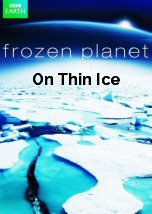
Frozen Planet: On Thin Ice

   2011    Science
Sir David Attenborough journeys to both Polar Regions to investigate what rising temperatures will mean for the people and wildlife that live there and for the rest of the planet. David starts out at the North Pole, standing on sea ice several metres thick, but which scientists predict could be Open Ocean within the next few decades. The Arctic has been warming at twice the global average, so David heads out with a Norwegian team to see what this means for polar bears. He comes face-to-face with a tranquilised female, and discovers that mothers and cubs are going hungry as the sea ice on which they hunt disappears. In Canada, Inuit hunters have seen with their own eyes what scientists have seen from space; the Arctic Ocean has lost 30% of its summer ice cover over the last 30 years. For some, the melting sea ice will allow access to trillions of dollars worth of oil, gas and minerals. For the rest of us, it means the planet will get warmer, as sea ice is important to reflect back the sun's energy. Next David travels to see what's happening to the ice on land: in Greenland, we follow intrepid ice scientists as they study giant waterfalls of meltwater, which are accelerating iceberg calving events, and ultimately leading to a rise in global sea level. Temperatures have also risen in the Antarctic - David returns to glaciers photographed by the Shackleton expedition and reveals a dramatic retreat over the past century. It's not just the ice that is changing - ice-loving adelie penguins are disappearing, and more temperate gentoo penguins are moving in. Finally, we see the first ever images of the largest recent natural event on our planet - the break up of the Wilkins Ice Shelf, an ice sheet the size of Jamaica, which shattered into hundreds of icebergs in 2009.
Series: Frozen Planet

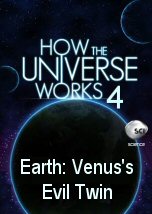
Earth: Venus Evil Twin

   2015    Science
There is a hellish planet in our solar system; covered in thick dense clouds and roasted by colossal temperatures. It will be inevitable that the Earth will someday not only be like Venus, but actually put it to shame. A billion years from now, Earth's oceans will boil off, triggering a runaway greenhouse effect, and the temperature will be so high, its all surface will melt. In the distance future, Earth could be the evil twin of Venus. To understand how our world will be destroyed we need to look at what happened to Venus.
Series: How the Universe Works Season 4

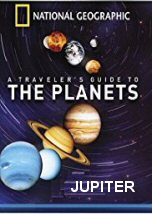
Jupiter

   2010    Science
Head beyond the Asteroid Belt for an out of this world experience. Welcome to Jupiter, home of high adrenaline adventure. Plunge into its mysterious depths. When you drop through the clouds it would get darker and hotter. At the center the temperatures are hotter than the surface of the sun and the pressures are unimaginably high.
Series: A Traveler Guide to the Planets
Abraham Lincoln

Abraham Lincoln

2022  History
Rotten

Rotten

2018  Nature
Walking with Cavemen

Walking with Cavemen

2003  History
Untold

Untold

2021  Culture
Tiger

Tiger

2020  History
Seven Ages of Rock

Seven Ages of Rock

2007  Art
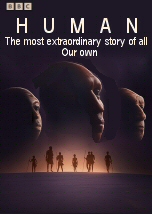
Human

Human

2025  History